
Eledon Pharmaceuticals: Clinical Ambition Meets Capital Constraints in Transplant Innovation
Eledon Pharmaceuticals advances tegoprubart in late-stage transplant trials, but faces the funding and execution hurdles typical of clinical-stage biotech. Success depends as much on capital access and trial outcomes as on regulatory and market dynamics.
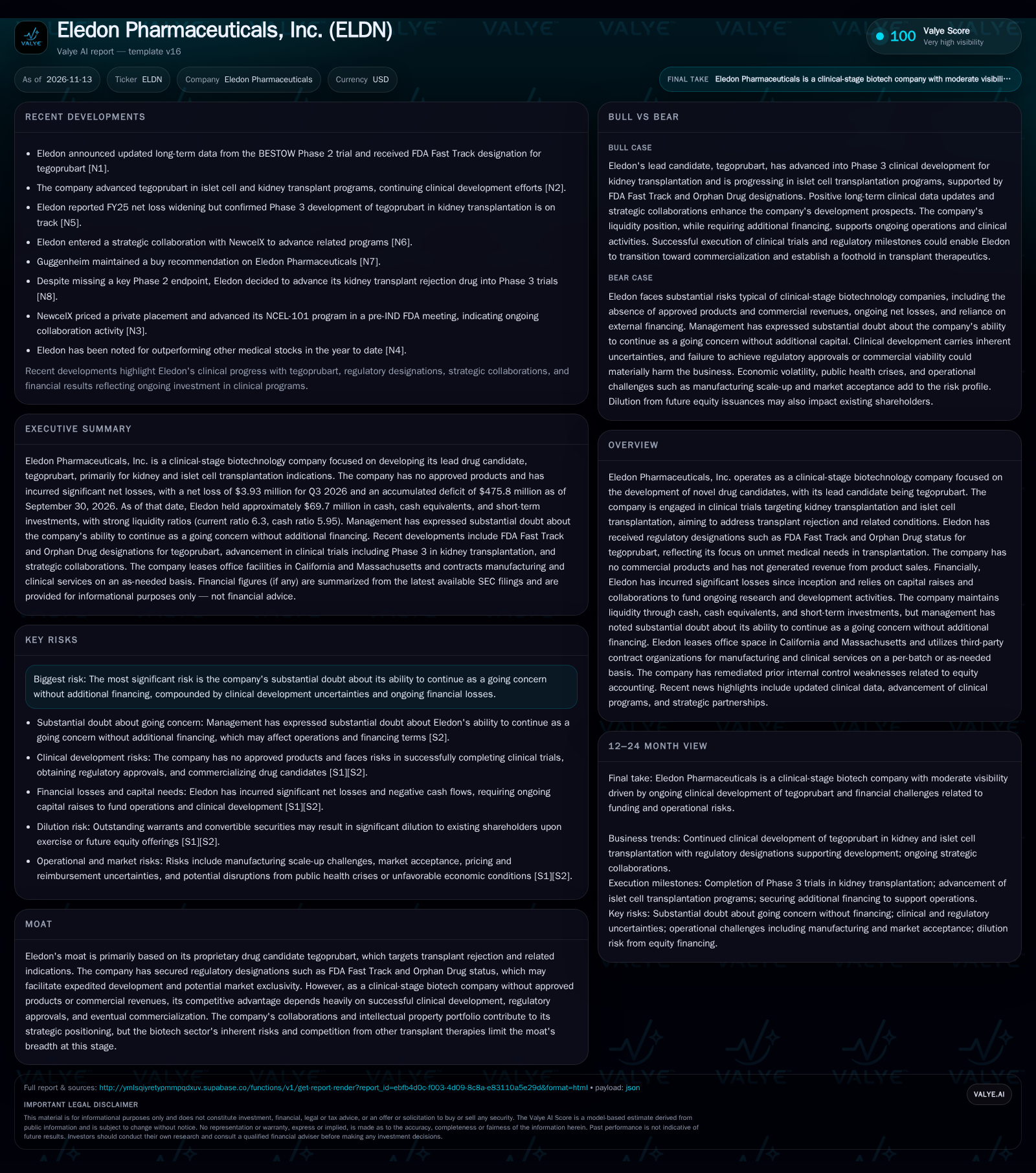
Eledon Pharmaceuticals is advancing its lead immunomodulatory drug, tegoprubart, into Phase 3 kidney transplant trials, buoyed by FDA Fast Track and Orphan Drug designations. The path forward hinges on successful clinical execution, timely capital raises, and eventual regulatory approval, with dilution, development setbacks, and competitive intensity as key risks. [S2] [N2] [N5] [N8]
Eledon Pharmaceuticals is a clinical-stage biotech betting on its lead candidate, tegoprubart, to address the critical unmet need of transplant rejection. The company has recently advanced this program into Phase 3 trials for kidney transplantation, supported by FDA Fast Track and Orphan Drug designations—regulatory signals that may speed up development and open doors to market exclusivity if successful. However, with no commercial products, a widening net loss, and management highlighting substantial doubt about its ability to continue operations without fresh capital, Eledon embodies the high-stakes, high-uncertainty profile of early-stage drug developers. The next 12-18 months will likely determine whether Eledon's science and strategy can translate into a viable business.
Latest Developments Shape Eledon’s Immediate Prospects
Eledon Pharmaceuticals is moving its lead drug candidate, tegoprubart, into Phase 3 trials for kidney transplantation following a decision to proceed despite missing a key Phase 2 endpoint. The program benefits from both FDA Fast Track and Orphan Drug designations, which may shorten regulatory timelines and offer market exclusivity if approved [N1] [N2] [N5] [N8]. However, the company has no products on the market and continues to report significant losses, with a Q3 2026 net loss of $3.93 million and an accumulated deficit of $475.8 million as of September 30, 2026 [S2].
Eledon reported approximately $69.7 million in cash, cash equivalents, and short-term investments at the end of Q3 2026, but management has explicitly stated substantial doubt about its ability to continue as a going concern without additional financing [S2]. The company is leveraging strategic collaborations, such as the recent agreement with NewcelX, to potentially expand or accelerate its development pipeline [N6].
Transplant Drug Development: Cost Structure and Economic Model
Eledon's economic engine is predicated on bringing tegoprubart through late-stage trials, regulatory approval, and ultimately commercial launch in transplant indications. The company currently generates no product revenue and relies entirely on external capital to fund operations, with cash outflows driven by R&D, clinical trial expenses, and relatively low fixed infrastructure due to a reliance on third-party contract manufacturing and clinical services [S2]. This variable cost structure provides flexibility but can also lead to higher per-unit costs if scale or bargaining power is not achieved.
If tegoprubart succeeds clinically and gains regulatory approval, Eledon could transition to a high-margin specialty pharmaceutical model. Pricing for novel transplant therapies is typically premium, reflecting both clinical value and orphan status, but actual revenue realization will depend on payer acceptance, market penetration, and the competitive landscape. The company’s current capital needs are acute: without new funding, it risks halting operations before reaching key value inflection points. The fundamental economic question is whether Eledon can bridge the gap between costly development and revenue generation before dilution or insolvency erode potential upside.
Positioning in a Crowded Transplant Therapeutics Field
Eledon's main asset, tegoprubart, targets immunomodulation in transplantation—a space with entrenched competitors and ongoing innovation. The FDA Fast Track and Orphan Drug designations offer some regulatory and potential commercial advantages, including expedited review and exclusivity, but do not guarantee market success. Eledon faces competition from both established immunosuppressants and emerging therapies, including biologics and cell-based approaches.
Differentiation may hinge on demonstrating superior efficacy, safety, or improved patient outcomes versus standard-of-care regimens. Strategic partnerships, such as the collaboration with NewcelX, could provide access to complementary technologies or non-dilutive funding, but the competitive moat will remain narrow until clinical and regulatory milestones are achieved. The risk of technology substitution—such as gene editing or next-generation immunotherapies—remains a long-term consideration.
Clinical Validation and Capital Access Accelerate Value Creation
The bullish scenario hinges on tegoprubart delivering compelling Phase 3 data in kidney transplantation, leading to regulatory approval and rapid adoption in the transplant community. Fast Track and Orphan Drug status could expedite the path to market and extend exclusivity, allowing Eledon to command premium pricing and potentially out-license or partner the asset for commercialization.
Confirmation of this scenario would come from positive clinical trial results, regulatory acceptance of filings, and successful capital raises (either through partnerships, licensing, or equity at favorable terms). Early signals of payer interest, guideline inclusion, or strategic acquirer interest would further bolster the thesis. Falsification would occur if Phase 3 results disappoint, if the company fails to secure sufficient funding, or if competitors leapfrog Eledon’s clinical progress.
Incremental Progress Amid Persistent Funding and Execution Hurdles
The most likely scenario is that Eledon continues to advance tegoprubart through ongoing trials, but faces periodic delays, dilution from equity raises, and uncertainty around clinical endpoints. The company’s variable cost base allows for operational flexibility, but does not shield it from the need for additional capital—especially as pivotal trials and pre-commercial investments ramp up.
In this scenario, Eledon may secure interim data readouts that justify further investment but fall short of a clear-cut path to approval or market leadership. The scenario would be falsified by either a decisive clinical win and funding breakthrough (tilting toward the upside), or a significant clinical or operational setback (tilting toward the downside).
Funding Shortfall or Clinical Failure Threatens Business Continuity
The adverse scenario plays out if Eledon is unable to secure the capital needed to sustain operations through key clinical milestones, or if tegoprubart fails to demonstrate adequate efficacy or safety in Phase 3. Management has already flagged substantial doubt about going concern, making this a material risk [S2]. Inability to attract partners or raise funds at non-punitive terms could force asset sales, program discontinuation, or even bankruptcy.
This scenario would be confirmed by failed or delayed clinical trials, inability to close new funding rounds, or worsening terms for equity or debt financing. Additional dilution, loss of key personnel, or negative regulatory feedback would further signal that Eledon’s value proposition is deteriorating.
Milestones That Will Decide Eledon’s Clinical and Financial Trajectory
Progression of tegoprubart’s Phase 3 kidney transplant trial: Enrollment rates, interim analyses, and top-line data releases are crucial for validating the program and supporting future funding. [N2] [N5] [N8]
Updates on islet cell transplantation studies: Expansion or acceleration in this indication could diversify risk and expand addressable markets. [N2]
New financing events: The structure, size, and terms of any capital raise, partnership, or licensing deal will determine dilution risk and operational continuity. [S2]
Operational cash burn and runway: Quarterly updates on cash usage and management’s runway guidance (if disclosed) would clarify the urgency and scale of funding needs.
Collaborative or licensing activity: Additional strategic alliances, especially those that bring non-dilutive capital or commercial infrastructure, could improve the risk/reward profile. [N6]
Regulatory feedback and milestone achievements: FDA or ex-U.S. regulatory interactions, especially around expedited pathways or approval requirements, will shape commercial timelines.
Competitive trial readouts: Results from rival transplant therapeutics could alter the perceived value of tegoprubart’s mechanism or market opportunity.
Disclaimer: This is research-only, informational analysis and not investment advice. It may include AI-generated interpretation and general industry context. Always verify important details using primary sources.

Comments