
Armata Pharmaceuticals: Bacteriophage Ambitions Confront Clinical Progress
Armata’s proprietary phage therapies are advancing in late-stage trials and benefiting from regulatory engagement, while a strained balance sheet and uncertain commercial pathways highlight the need for execution and funding clarity.
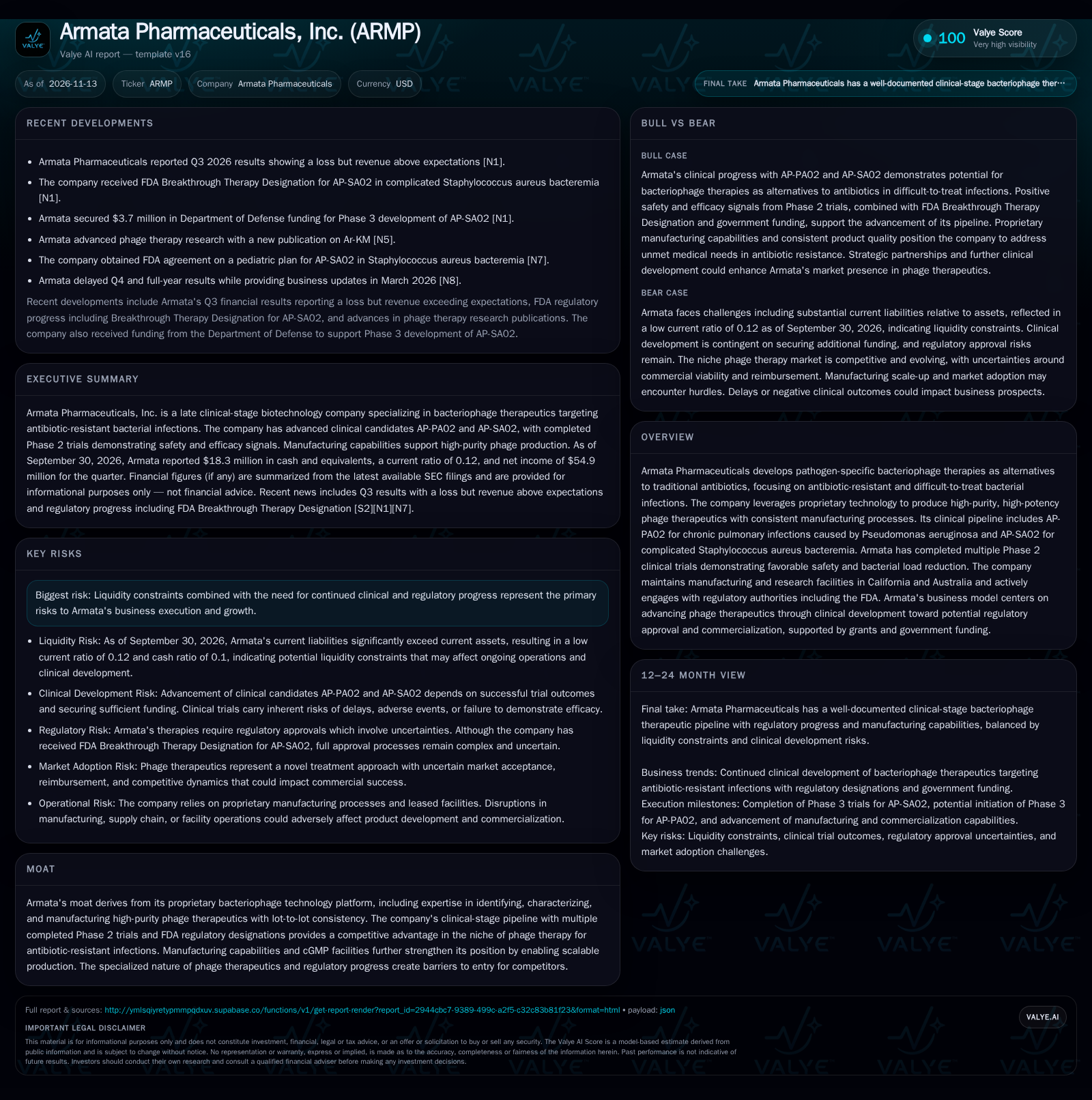
Armata Pharmaceuticals has made clinical and regulatory advances with its phage therapy candidates for antibiotic-resistant infections, supported by specialized manufacturing capabilities. Commercialization will depend on regulatory approvals, market adoption, and the ability to scale manufacturing while competing in a nascent, evolving field. [S1] [S2] [N1] [N7]
Armata Pharmaceuticals is positioning itself at the forefront of the fight against antibiotic-resistant bacteria by advancing high-purity, pathogen-specific bacteriophage therapies through late-stage clinical development. Its proprietary manufacturing capabilities and recent regulatory milestones—the FDA’s agreement on a pediatric plan for its AP-SA02 candidate and positive safety data from multiple Phase 2 studies—signal technical and scientific momentum. The coming quarters will test whether Armata can convert its clinical promise and manufacturing strengths into a viable, scalable business amid a challenging financial and competitive landscape. [S1] [S2] [N7]
Late-Stage Clinical Progress Meets Funding Strains
Armata Pharmaceuticals has achieved three completed Phase 2 trials for its lead bacteriophage candidates: AP-PA02, targeting Pseudomonas aeruginosa in chronic pulmonary infections, and AP-SA02, aimed at Staphylococcus aureus bacteremia. Both programs have demonstrated favorable safety and tolerability, with AP-PA02 also showing reductions in bacterial load. These outcomes affirm technical feasibility and regulatory engagement—evidenced by a recent FDA agreement on a pediatric plan for AP-SA02—expanding potential patient reach. [S1] [N7]
Despite these advances, Armata’s financial snapshot as of September 30, 2026, shows $18.3 million in cash against $186.8 million in current liabilities, yielding a current ratio of just 0.12. [S2]
From a funding perspective, the stark imbalance between cash and current liabilities highlights a critical operational risk that could constrain Armata’s ability to execute its clinical and manufacturing strategies. This funding gap may necessitate strategic prioritization of programs, potential cost rationalization, or accelerated partnership discussions. The timing and terms of such financing will be pivotal, as overly dilutive or restrictive arrangements could impair long-term value creation and operational flexibility.
How Phage Therapeutics Could Reshape Biotech Economics
Armata’s business model is predicated on advancing bacteriophage therapeutics through clinical development toward regulatory approval and commercial launch. Revenue generation would likely hinge on a mix of proprietary drug sales, potential royalties or licensing deals, and possibly contract manufacturing given its cGMP capabilities. The economics of phage therapies differ from small-molecule antibiotics: production is biologically complex, potentially commanding premium pricing for severe, resistant infections, but also requiring high fixed costs for quality-controlled manufacturing, regulatory compliance, and ongoing R&D.
Variable costs are dominated by clinical trial expenses and post-market pharmacovigilance, while scaling to commercial volumes could unlock manufacturing efficiencies if demand materializes.
The unique economic model for phage therapeutics also raises important considerations regarding market access and reimbursement. Given their targeted nature and potential to address multi-drug resistant infections, phage therapies might command premium pricing, particularly in hospital or specialty care settings where antibiotic options are limited. However, payers may require robust health economic evidence demonstrating cost-effectiveness relative to existing treatments, including potential reductions in hospitalization duration or avoidance of costly complications. This dynamic introduces uncertainty around reimbursement timelines and pricing levels, which could influence revenue projections and investment attractiveness. Additionally, the potential for personalized or precision phage cocktails could complicate traditional pharmaceutical pricing models, requiring innovative contracting or value-based reimbursement approaches.
Another layer of economic complexity stems from manufacturing scalability and cost structure. While Armata’s cGMP facilities and lot-to-lot consistency are competitive advantages, scaling biologics production to meet commercial demand involves significant capital expenditure and operational expertise. The company’s ability to optimize yield, reduce batch failures, and streamline quality control processes will directly impact gross margins and profitability potential. Moreover, the opportunity to leverage manufacturing capacity for third-party production could diversify revenue streams and improve asset utilization, but this strategy depends on market demand for contract manufacturing and the company’s capacity to manage external client relationships alongside internal product supply.
Defensible Technology Meets a Nascent but Crowded Landscape
Armata’s proprietary phage discovery, characterization, and manufacturing platform provides differentiation in terms of product purity, consistency, and regulatory readiness. Its cGMP-certified facilities in the U.S. and Australia could enable both internal product supply and third-party manufacturing, creating a potential moat as regulatory expectations for biologics rise.
Competitive threats are multifaceted. Other phage therapy developers, major antibiotics companies, and academic spinouts are all vying to address the antibiotic resistance crisis. While phage therapies offer pathogen specificity and reduced collateral damage versus broad-spectrum antibiotics, they face competition from next-generation antibiotics, monoclonal antibodies, and emerging anti-virulence strategies. Barriers to entry include regulatory hurdles, manufacturing complexity, and the need for robust clinical data. However, as phage science matures and regulatory frameworks clarify, Armata’s early clinical progress and proprietary platform could offer a head start—if it can maintain momentum and financial stability.
Accelerated Clinical Wins and Strategic Partnerships Unlock Value
A favorable trajectory could see Armata’s AP-PA02 and AP-SA02 programs achieve pivotal trial success, leading to regulatory approvals for high-need indications such as cystic fibrosis-related Pseudomonas infections and complicated S. aureus bacteremia. Such clinical wins could prompt partnerships with major biopharma or government agencies, providing non-dilutive funding, commercialization support, or even acquisition interest.
Confirmation of this scenario would come from: positive pivotal trial data, new licensing or co-development deals, successful expansion into pediatric or additional indications, and evidence of reimbursement traction. Increasing utilization of Armata’s cGMP facilities for third-party manufacturing could also validate the scalability and value of its proprietary processes. Falsification would be signaled by failed trials, inability to secure partnerships, or continued delays in regulatory milestones.
Clinical Progress Continues, but Funding Drives Pacing and Scope
The most plausible path is for Armata to continue advancing its lead programs through additional clinical milestones, while seeking bridge financing, grants, or partnership capital to sustain operations. Incremental progress—such as additional positive safety or efficacy readouts, modest regulatory advances, or targeted licensing deals—may support gradual de-risking of the pipeline but will likely be matched by ongoing dilution or constrained development scope due to liquidity needs.
Falsification would involve a failure to secure new funding, missed clinical timelines, or adverse regulatory outcomes that halt or delay development.
Liquidity Crunch Forces Pipeline Pauses or Strategic Review
If Armata’s liquidity position remains unresolved, the company could be forced to pause or terminate trials, delay regulatory filings, or undertake a strategic review including asset sales, partnerships on unfavorable terms, or even restructuring. The high fixed cost base of biomanufacturing and clinical development means that a cash shortfall could quickly impair value and erode first-mover advantages.
Confirmation would come from missed payroll or supplier payments, public statements about going concern risk, or emergency financings at punitive valuations. Falsification would require clear, sufficient new funding to cover at least the next 12-18 months of operations and development.
Signals That Will Determine Armata’s Ability to Deliver on Its Bacteriophage Vision
Updates on pivotal trial initiation and completion dates for AP-PA02 and AP-SA02, including any early efficacy or safety disclosures.
Announcements of new financing—whether equity, debt, grant, or partnership—that extend the operational runway beyond current liabilities.
Evidence of regulatory progress, such as additional FDA designations, acceptance of filings, or movement toward approval for lead or follow-on indications.
Expansion of cGMP manufacturing contracts or third-party production agreements, which would validate manufacturing scalability and create incremental revenue streams.
Disclosures about commercial launch planning, including pricing, reimbursement strategy, and target markets, if available.
Progress or setbacks in pediatric or additional patient population studies for AP-SA02, which could expand the addressable market.
Statements or filings regarding strategic alternatives, asset sales, or restructuring activities, as these would indicate financial distress or a shift in business strategy.
Disclaimer: This is research-only, informational analysis and not investment advice. It may include AI-generated interpretation and general industry context. Always verify important details using primary sources.

Comments