
Xos, Inc.: Can Vertical Integration in Fleet Electrification Overcome Scale and Capital Hurdles?
Xos’s integrated electric vehicle, software, and charging solutions target the commercial fleet market, but ongoing losses and modest revenue highlight the tension between differentiated offerings and the challenge of scaling in a capital-intensive, highly competitive sector.
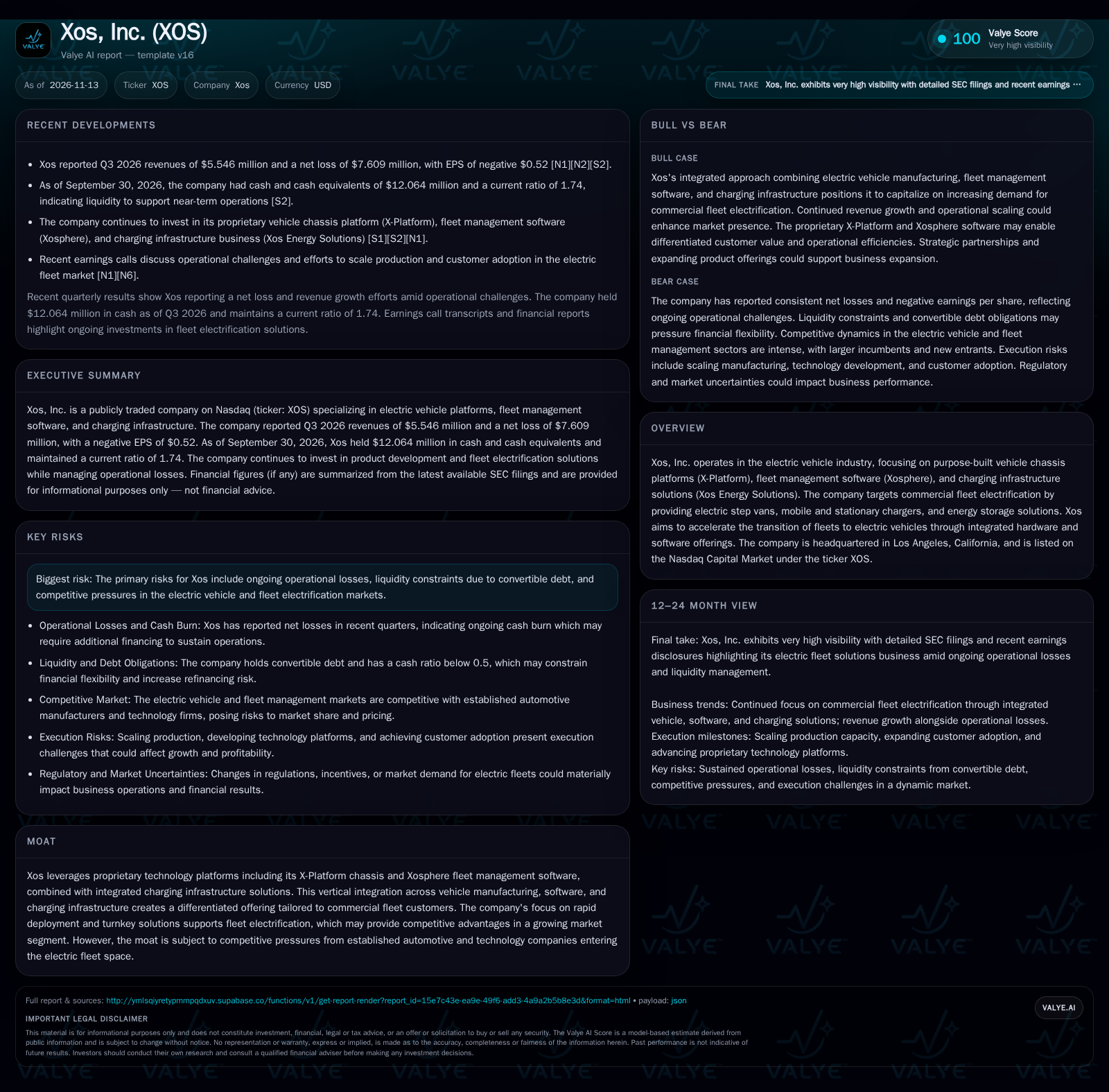
Xos, Inc. reported Q3 2026 revenues of $5.5 million and a net loss of $7.6 million, reflecting ongoing operational challenges as it pursues commercial fleet electrification with proprietary vehicles, software, and charging solutions. With $12 million in cash and convertible debt obligations, the company faces pressure to scale revenue faster than costs while competing against larger, better-capitalized rivals. Xos’s vertically integrated strategy offers differentiation, but its ability to achieve sustainable margins and customer adoption remains unproven. [S2] [N1] [N2]
Xos, Inc. is betting that its vertically integrated approach—combining proprietary electric vehicle platforms, fleet management software, and mobile charging infrastructure—will give it an edge in the rapidly evolving commercial fleet electrification market. Recent financials show some revenue traction but continued operational losses and a reported liquidity position cushion, sharpening the question of whether Xos can achieve the scale and capital efficiency required to compete with both legacy manufacturers and well-funded EV newcomers. The company’s next phase will test whether its differentiated offering can translate into sustainable customer adoption and improved unit economics before liquidity pressures force tough choices.
Recent Results Underscore Scaling Challenge and Capital Pressure
Xos reported Q3 2026 revenues of $5.546 million and a net loss of $7.609 million, with negative earnings per share of $0.52. For the nine months ending September 30, 2026, revenues totaled $21.511 million, while net loss reached $19.418 million. As of the end of Q3, Xos held $12.064 million in cash and cash equivalents, a current ratio of 1.74, and a cash ratio of 0.49. The company’s balance sheet reflects $8 million in current and $6 million in non-current convertible debt, alongside total liabilities of $31.449 million. The company’s ongoing investments in its proprietary vehicle platforms, software, and energy solutions signal a commitment to scaling, but the ability to bridge to profitability remains uncertain. [S2] [N1] [N2]
How Xos’s Integrated Model Could Drive (or Drain) Value
Xos’s business model is built on the premise that commercial fleet operators will increasingly demand turnkey electrification solutions—encompassing vehicles, charging hardware, and fleet management software. The company’s economics depend on multiple, potentially synergistic revenue streams: vehicle sales or leases, software subscriptions or usage fees, and charging infrastructure deployment. If Xos can secure recurring software and services revenue atop higher-margin hardware sales, this could improve gross margins and provide operating leverage as fleet adoption grows.
However, the capital intensity of vehicle manufacturing, the need for ongoing R&D, and the costs of maintaining and deploying charging infrastructure create significant fixed costs. Scaling production should, in theory, enable cost absorption and improve margins, but Xos’s current revenue base is small relative to its fixed expenses. The company’s reported net losses suggest that current volumes are insufficient to achieve breakeven. Convertible debt adds another layer of financial pressure, with potential dilution or refinancing risk if operating cash flow does not improve. Ultimately, Xos’s path to cash generation likely hinges on both scaling hardware volumes and layering on higher-margin, recurring software and charging services.
Differentiation Versus Scale: The Fleet EV Battlefield
Xos seeks to differentiate through vertical integration—offering purpose-built electric step vans, proprietary chassis platforms, integrated fleet management (Xosphere), and rapid-deployment charging solutions (Xos Energy Solutions). This tailored approach targets commercial customers seeking a one-stop shop for electrification. However, the competitive environment is formidable: established commercial vehicle OEMs, EV-first startups, and technology companies are all vying for share in the fleet electrification space.
Larger incumbents benefit from greater manufacturing scale, deeper customer relationships, and stronger balance sheets. New entrants may compete on technology, speed of innovation, or business model innovation. Fleet operators face switching costs related to vehicle uptime, charging access, and integration with legacy systems, but these frictions may be lower as electrification standards mature. Xos’s ability to win and retain customers will depend on demonstrating superior total cost of ownership, reliability, and integration—while fending off pricing pressure and the risk of being outscaled by better-capitalized rivals.
Unlocking Operating Leverage Through Customer Adoption and Recurring Revenue
The favorable scenario for Xos is one where commercial fleet electrification accelerates, and Xos is able to convert its differentiated offering into sustained customer adoption and repeat business. If the company can sign multi-vehicle fleet deals, expand its installed base, and demonstrate strong software and charging service attach rates, revenue could compound more rapidly than fixed costs. This would allow gross margins to expand as production scales, particularly if software and services revenue grows as a percentage of the total. Successful execution would also improve the company’s negotiating leverage with suppliers, further enhancing unit economics.
Evidence that would confirm this scenario includes a step-change in reported backlog or multi-year fleet orders, disclosure of growing software/service revenue as a share of total revenue, improving gross margin trends, and positive operating cash flow. Customer references or case studies demonstrating total cost of ownership advantages could further support the case for accelerating adoption.
Gradual Progress Amid Margin Pressure and Financing Needs
The most plausible trajectory for Xos is a slow grind toward higher volumes, with some incremental improvement in adoption but continued margin pressure and recurring capital needs. In this scenario, Xos wins some new fleet customers and modestly expands its revenue base, but growth is not rapid enough to offset fixed costs or meaningfully improve net losses in the near term. Margins may improve slightly if product mix shifts toward higher-margin software or charging services, but the company likely remains unprofitable and reliant on external financing to fund operations.
Evidence for this outcome would include continued quarterly revenue growth without significant gross margin expansion, persistent operating losses, and additional equity or debt raises. Customer concentration or limited contract visibility would reinforce the view that Xos is not yet achieving the scale needed for sustainable profitability.
Liquidity Shortfall and the Risk of Forced Restructuring
A negative scenario unfolds if Xos cannot accelerate revenue growth or improve margins before its liquidity position deteriorates. If customer adoption stalls, competitive pricing pressures intensify, or supply chain disruptions increase costs, Xos could face a cash crunch—especially with $8 million in current convertible debt and a cash ratio of just 0.49. In this case, the company may be forced to pursue dilutive equity raises, restructure debt, or scale back operations to conserve cash. In the worst case, an inability to raise new capital or refinance existing obligations could force asset sales or a strategic transaction on unfavorable terms.
Evidence confirming this scenario would be a rapid drawdown of cash reserves, increasing accounts payable, missed debt payments, or announcements of cost-cutting measures and workforce reductions. A sharp rise in financing costs or inability to raise new capital at reasonable terms would further validate liquidity stress.
Milestones That Will Determine If Xos Can Bridge to Scale and Profitability
Quarterly gross margin trends—sustained improvement would indicate scaling benefits and a possible path to breakeven; further compression would signal persistent cost challenges.
Breakout of software and charging services revenue (if disclosed)—rising contribution would support the thesis of higher-margin, recurring revenue streams.
Fleet order announcements or reported backlog—large, multi-year deals would provide evidence of customer adoption and future revenue visibility.
Cash burn rate and operating cash flow—slowing cash burn or positive cash flow would reduce financing risk; accelerating burn would heighten liquidity concerns.
Convertible debt refinancing or conversion events—terms and timing of refinancings will affect dilution risk and potential financial flexibility.
Customer concentration and retention metrics—evidence of a diversified, growing customer base would suggest market traction; high concentration or churn would increase risk.
Disclosures on production capacity utilization—rising utilization would signal scaling progress; underutilization would point to demand or execution issues.
Disclaimer: This is research-only, informational analysis and not investment advice. It may include AI-generated interpretation and general industry context. Always verify important details using primary sources.

Comments