
USA Rare Earth: Supply Chain Ambitions, Execution Risks, and the Realities of U.S. Magnet Manufacturing
The company's ability to convert development-stage projects into reliable production—while building commercial relationships in a reshoring-driven landscape—will define its competitive relevance.
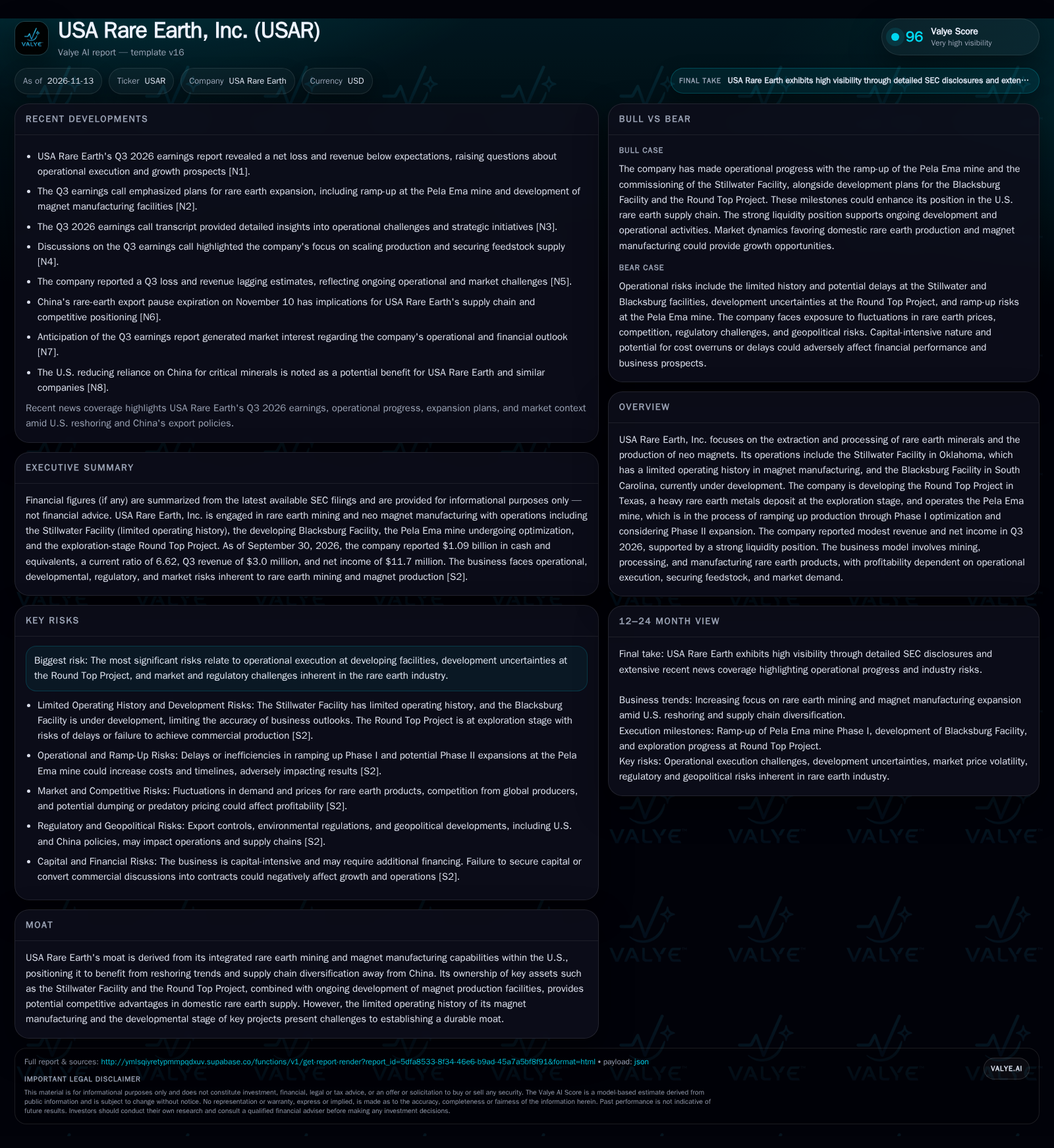
USA Rare Earth, Inc. reported liquidity position with $1.09 billion in cash and a current ratio of 6.62 as of Q3 2026, but delivered only $3.0 million in revenue and a mixed EPS profile. Its core assets—Stillwater, Blacksburg, Pela Ema, and the exploration-stage Round Top—are at varying stages of ramp-up, with limited operating history in magnet manufacturing. The company's future hinges on execution, feedstock security, and the evolving U.S. rare earth supply chain amid continued exposure to market, regulatory, and geopolitical risks. [S2]
USA Rare Earth, Inc. is positioning itself as a vertically integrated player in the rare earth minerals and magnet manufacturing market, seeking to capitalize on U.S. supply chain reshoring trends and geopolitical concerns over Chinese dominance. Despite a reported liquidity position and several key projects in development or ramp-up, the company’s actual commercial operations remain limited, as evidenced by modest Q3 2026 revenue and a mixed EPS result. The fundamental challenge is whether USA Rare Earth can overcome operational, developmental, and market risks to transform its asset base into a scalable, competitive business—especially as the rare earth market faces fresh uncertainties with the recent expiration of China’s export pause.
Recent Results Highlight Execution Challenges and Liquidity Buffer
As of September 30, 2026, USA Rare Earth reported Q3 revenue of $3.0 million and net income of $11.7 million, but with diluted EPS of -$0.02, highlighting the company's uneven financial profile during its ramp-up phase. The company’s cash and equivalents stood at $1.09 billion, and current assets totaled $1.22 billion against $184 million in current liabilities, yielding a current ratio of 6.62 and a cash ratio of 5.93. The company reported cash and liquidity metrics for the period; these figures do not by themselves establish operating runway, investment capacity, financial flexibility, or financing capacity. The Pela Ema mine is still ramping up, and the Round Top Project remains at the exploration stage, making near-term production growth uncertain. [S2]
How Profitability Could Emerge: Integration, Scale, and Feedstock Dynamics
USA Rare Earth's business model aspires to integrate rare earth extraction with domestic magnet manufacturing—potentially capturing more margin by moving up the value chain. The economics of this model are largely untested at commercial scale within the company: Stillwater’s limited operating history means unit cost, yield, and throughput are not yet established, while Blacksburg is not yet online. The Pela Ema mine is undergoing optimization, but production volumes and cost structure remain in flux. If the company can achieve consistent production, vertical integration could reduce raw material risk and improve pricing leverage, but only if it secures feedstock at competitive prices and achieves high utilization at its magnet plants. The capital intensity of mine development and plant construction requires careful balancing of upfront investment against uncertain demand and volatile rare earth prices. Operating leverage could be substantial once facilities are scaled, but early-stage lumpy revenue and margin pressure are likely until stable, repeatable production is achieved.
U.S. Reshoring Tailwinds Meet Entrenched Global Competition
USA Rare Earth’s potential moat lies in its U.S.-based integrated supply chain, which aligns with policy trends favoring domestic rare earth and magnet production. This could offer some insulation from geopolitical disruptions and supply chain shocks—especially relevant as China’s rare earth export pause recently expired. However, the company faces intense competition from global incumbents with established production, scale, and customer relationships. Substitutes for rare earth magnets are limited in high-performance applications, but price-sensitive segments could shift to alternatives if costs rise. Without a proven track record in large-scale magnet production, USA Rare Earth must overcome both operational barriers and customer switching frictions. The ability to secure long-term contracts or relationships with downstream manufacturers would be critical for market entry and margin stability, but such visibility has not yet been demonstrated.
If Execution Delivers: Asset Ramp-Up and U.S. Supply Chain Demand Converge
The bull case for USA Rare Earth hinges on the successful ramp-up of Pela Ema, commercial commissioning of Stillwater and Blacksburg, and eventual development of the Round Top Project. If the company is able to demonstrate reliable, cost-effective production and secure feedstock internally or on favorable market terms, it could benefit from strong demand for domestically produced magnets as U.S. manufacturers seek to diversify away from Chinese suppliers. Confirmation would come in the form of sequential revenue growth, positive facility-level margins, and multi-year supply agreements or purchase commitments with key U.S. customers. Evidence of operational milestones—such as reaching target throughput at Stillwater or achieving commercial output at Pela Ema—would support the upside narrative. Conversely, persistent delays or inability to meet cost targets would falsify this scenario.
Early-Stage Operations Lead to Gradual Progress and Ongoing Volatility
The most plausible path is a period of continued operational volatility as USA Rare Earth navigates the ramp-up of its facilities. Revenue is likely to remain modest and lumpy, with margins pressured by startup inefficiencies, ongoing capex, and market price swings. Progress at Pela Ema and Stillwater may be incremental, with occasional setbacks due to technical or supply chain challenges. The company’s reported liquidity position should allow it to weather initial setbacks, but the absence of established customer contracts or validated production economics means commercial traction could be slow. Confirmation of this scenario would include continued modest revenue growth, periodic losses or breakeven quarters, and incremental updates on project milestones. Evidence of sustained underutilization, cost overruns, or inability to secure customer demand would suggest downside risk.
Project Delays, Cost Overruns, and Persistent Market Headwinds
In a negative scenario, USA Rare Earth could face extended delays at the Blacksburg and Round Top projects, persistent ramp-up issues at Pela Ema, and operating shortfalls at Stillwater. If production costs remain high and feedstock procurement is challenged by global price volatility or supply disruptions, margins could erode. The absence of long-term customer agreements would exacerbate exposure to spot market swings and make it difficult to plan capacity or justify further investment. Regulatory or environmental setbacks—especially in the context of heightened scrutiny on mining and industrial projects—could further increase costs or delay commercialization.
Milestones That Will Determine USA Rare Earth's Place in the Domestic Supply Chain
Quarterly production volumes and plant utilization rates at Stillwater and, if disclosed, at Pela Ema—direct measures of operational progress and cost structure.
Updates on the commissioning timeline and initial output from the Blacksburg Facility, which will indicate whether the company can expand magnet manufacturing capacity as planned.
Signed long-term supply or offtake agreements with major U.S. manufacturers, if announced, as evidence of commercial traction and demand visibility.
Progress reports and capital allocation updates on the Round Top Project, including any movement from exploration to development or pilot-scale output.
Sequential revenue growth and facility-level margin disclosure, if provided, to test whether scale and integration are translating into improved financial performance.
Any regulatory, permitting, or environmental developments that affect mine ramp-up or plant operations, especially as U.S. scrutiny grows.
Management commentary on feedstock sourcing strategies and raw material cost trends, which could impact gross margins and supply chain resilience.
Evidence of cost overruns, project delays, or additional capital raises, which would signal execution risk and potential liquidity pressure despite the current cash position.
Disclaimer: This is research-only, informational analysis and not investment advice. It may include AI-generated interpretation and general industry context. Always verify important details using primary sources.

Comments