
Karman Line Acquisition Corp.: Blank Check Mechanics, Interest Income, and the Realities of SPAC Value Creation
Karman Line Acquisition Corp. (XTER) entered the public markets as a blank check company, reporting reported liquidity position and positive net income for Q3 2026—driven by interest income on IPO proceeds held in trust. With no operating business or target identified, the company’s future hinges entirely on its ability to source and execute a compelling merger. Investors face high transparency risk, and the ultimate business value will depend on deal quality, market conditions, and post-combination execution.
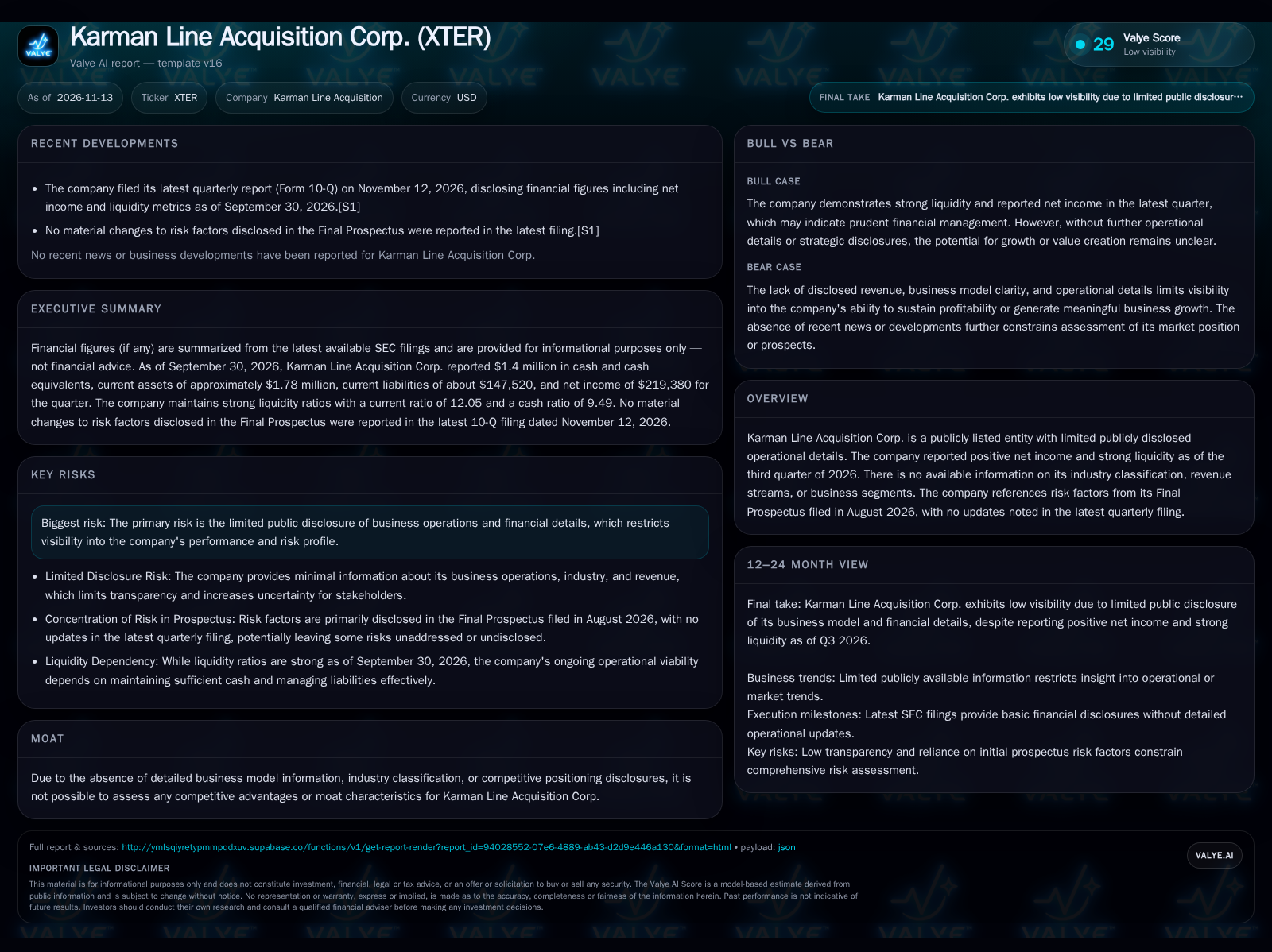
Karman Line Acquisition Corp. is a newly formed SPAC with $1.4M in cash and $1.78M in current assets versus $147K in current liabilities as of September 30, 2026, and reported Q3 net income of $219K due to interest income. No operating business or target has been announced. The company’s prospects are entirely dependent on its eventual business combination, with transparency and deal-execution risk as central themes.[S1]
Karman Line Acquisition Corp. (XTER) exemplifies the blank check company structure, with its current financials and public disclosures reflecting the pre-operational stage typical of a newly formed SPAC. The company’s reported liquidity position and positive quarterly net income are products of interest earned on IPO proceeds held in trust, not from any underlying business activity. With no acquisition target identified as of September 2026, the primary risk for stakeholders is the absence of operational transparency and the inherent uncertainty in the outcome of a future business combination. The next chapter for Karman Line—and its investors—will be written only if and when a suitable merger is sourced and executed.[S1]
Financial Snapshot: Trust-Driven Income, High Liquidity, and No Business Yet
As of September 30, 2026, Karman Line Acquisition Corp. reported $1.4 million in cash and cash equivalents and $1.78 million in current assets, with current liabilities of only $147,520. These figures translate into a current ratio of 12.05 and a cash ratio of 9.49—metrics indicative of reported liquidity position for a blank check company.[S1] Importantly, the company posted net income of $219,380 for the quarter, but this was almost entirely due to $590,805 in interest income on trust assets. There is no evidence of revenue or operating activity; the company remains in a pre-deal phase with no target identified or announced as of the latest filing.[S1] The risk disclosures have not materially changed since the Final Prospectus, and no substantive business developments or news have been reported.[S1]
SPAC Economics: Interest Income Today, Contingent Operating Model Tomorrow
Karman Line Acquisition Corp. currently generates income through interest earned on the cash and marketable securities held in its trust account, a standard mechanism for SPACs prior to consummating a business combination. These proceeds are typically invested in low-risk instruments, with interest income supporting administrative and compliance expenses until a merger is completed. The operating leverage and business economics will fundamentally change only after a deal is executed. At that point, the combined entity’s revenue streams, cost structure, and capital needs will be determined by the acquired target’s business model.
SPACs frequently face a binary outcome: either they successfully close a merger and transition to a traditional operating company, or they fail to find a suitable target and must return capital to shareholders. In the interim, expenses are relatively fixed—legal, audit, listing, and administrative costs—while income is variable and largely dependent on prevailing interest rates. Should a business combination occur, future economics will depend on the sector, growth prospects, and profitability profile of the acquired business, as well as the terms and dilution associated with the deal.
The interest income generated by SPACs like Karman Line Acquisition Corp. is inherently sensitive to macroeconomic conditions, particularly prevailing interest rates and monetary policy shifts. In a rising rate environment, the trust assets yield higher returns, which can modestly extend the SPAC’s operational runway before a business combination is consummated. Conversely, prolonged low-rate conditions compress interest income, increasing reliance on sponsor capital contributions or necessitating cost reductions. Moreover, the timing of a merger has strategic implications: earlier deals may capture more favorable market valuations but limit due diligence scope, whereas delayed transactions risk eroding trust account balances through ongoing expenses and potential market volatility. Understanding these dynamics is critical to assessing the sustainability of the SPAC’s pre-deal economics and the implicit pressure on management to execute within the allotted timeframe.
SPACs in the Market: Sponsor Reputation and Target Quality as Differentiators
Karman Line’s competitive position must be considered within the broader SPAC ecosystem, where hundreds of blank check companies compete for attractive merger targets. In this landscape, the primary differentiators are typically the reputation, deal-making experience, and industry expertise of the sponsor team—factors not detailed in the current filing. SPACs also compete with private equity, strategic acquirers, and direct listings for high-quality private companies.
Without a disclosed target or operational focus, Karman Line’s ability to source a compelling deal is unproven. The competitive environment is shaped by the supply of SPAC capital and the demand from private companies seeking public listings. Overcrowding, deal fatigue, and waning investor enthusiasm for speculative combinations can all erode a SPAC’s negotiating leverage, especially if the market is saturated or if redemptions spike near the time of a proposed merger.
Sponsor reputation and network access not only influence deal sourcing but also impact the terms and valuation of potential mergers. Experienced sponsors with strong industry relationships can negotiate more favorable acquisition terms, secure credible PIPE investors, and attract high-quality targets that align with market demand. Conversely, less established sponsors may face elevated costs of capital, higher redemption risks, and constrained deal flow, which can dilute shareholder value post-merger. Additionally, market sentiment toward SPACs broadly affects competitive positioning; periods of investor skepticism or regulatory scrutiny can reduce the attractiveness of SPACs as a listing vehicle, limiting the pool of willing targets and increasing the likelihood of suboptimal transactions. Thus, competitive advantage in the SPAC market is a function of both sponsor capabilities and external market conditions.
How a High-Quality Merger Could Unlock Value
The most favorable scenario for Karman Line would involve identifying and merging with a private company that possesses strong growth prospects, robust operating margins, and a clear path to public market value creation. Such a deal could generate immediate investor enthusiasm, minimize redemptions, and provide the combined entity with sufficient capital and public currency for future expansion.
This scenario would be confirmed by the announcement of a definitive merger agreement with a credible, well-regarded target, followed by positive market reaction, low redemption rates, and clear post-combination financial guidance. Evidence of sponsor alignment—such as significant at-risk capital or lock-up agreements—would further support the upside case.
Most Likely: Extended Search, Deal Uncertainty, and Dilution Risks
Given the absence of a target and the typical SPAC lifecycle, the most probable outcome is an extended search period characterized by incremental expenses, modest interest income, and rising pressure as the deadline for a business combination approaches. If a merger target is found, the quality of the deal, the negotiation of favorable terms, and investor willingness to remain through the de-SPAC process will determine ultimate value.
This scenario would be confirmed by ongoing administrative filings, continued reference to the initial prospectus risk factors, and eventual deal announcements subject to shareholder approval. Falsifying evidence would include failure to announce a target within the allotted timeframe, significant sponsor share forfeitures, or an inability to secure PIPE (private investment in public equity) funding to support a proposed transaction.
Deal Failure, Redemption Waves, and Capital Return
The adverse scenario materializes if Karman Line is unable to identify or close a merger within the required timeline, or if a proposed deal is met with overwhelming shareholder redemptions. In this case, the company would be forced to liquidate and return the IPO proceeds held in trust to public shareholders, minus allowable expenses. Additional downside risks include excessive dilution from sponsor or PIPE arrangements, unfavorable deal terms for public shareholders, or regulatory and legal challenges that delay or derail a transaction.
Evidence confirming this scenario would include mounting redemption requests, missed merger deadlines, sponsor resignations, or announcements of liquidation and capital return. Negative market sentiment and lack of PIPE support would further validate the downside thesis.
In a scenario where deal failure occurs, the residual impact on shareholder value extends beyond capital return mechanics. Even if IPO proceeds are returned, investors may face opportunity costs and transaction fees that reduce net recoveries. Furthermore, reputational damage to the sponsor and associated parties can impede future capital raising or deal-making efforts. Regulatory developments, such as increased SEC scrutiny or changes to SPAC accounting and disclosure requirements, may also raise compliance costs and elongate deal timelines, exacerbating redemption pressures. Finally, adverse market environments can depress valuations of potential targets, forcing SPACs into less attractive deals or liquidation, underscoring the interconnected risks of timing, market sentiment, and regulatory landscape in determining ultimate outcomes.
Milestones That Will Define Karman Line’s Trajectory
Announcement of a definitive merger agreement, including target identity, industry, and transaction terms.
Shareholder redemption rates during the business combination vote—if disclosed—which signal market confidence or skepticism.
PIPE financing commitments or other external capital raised to support the merger.
Sponsor team equity contributions, lock-ups, or forfeitures that demonstrate alignment with public shareholders.
Updated risk disclosures beyond those in the original prospectus—would help clarify any new business or regulatory threats.
Material changes in trust account value, reflecting either investment returns or withdrawal for permitted expenses.
Timely SEC filings and proxy statements detailing deal progress, financial projections, and post-combination management structure.
Any regulatory or legal proceedings disclosed in future filings that could impact deal execution or timing.
Disclaimer: This is research-only, informational analysis and not investment advice. It may include AI-generated interpretation and general industry context. Always verify important details using primary sources.

Comments