
KinderCare’s Financial Strain Highlights the Stakes of Scale in Early Childhood Education
The company’s established operational footprint provides demand stability, but sector competition, regulatory pressure, and execution risk could determine whether KinderCare’s scale becomes an advantage or a liability.
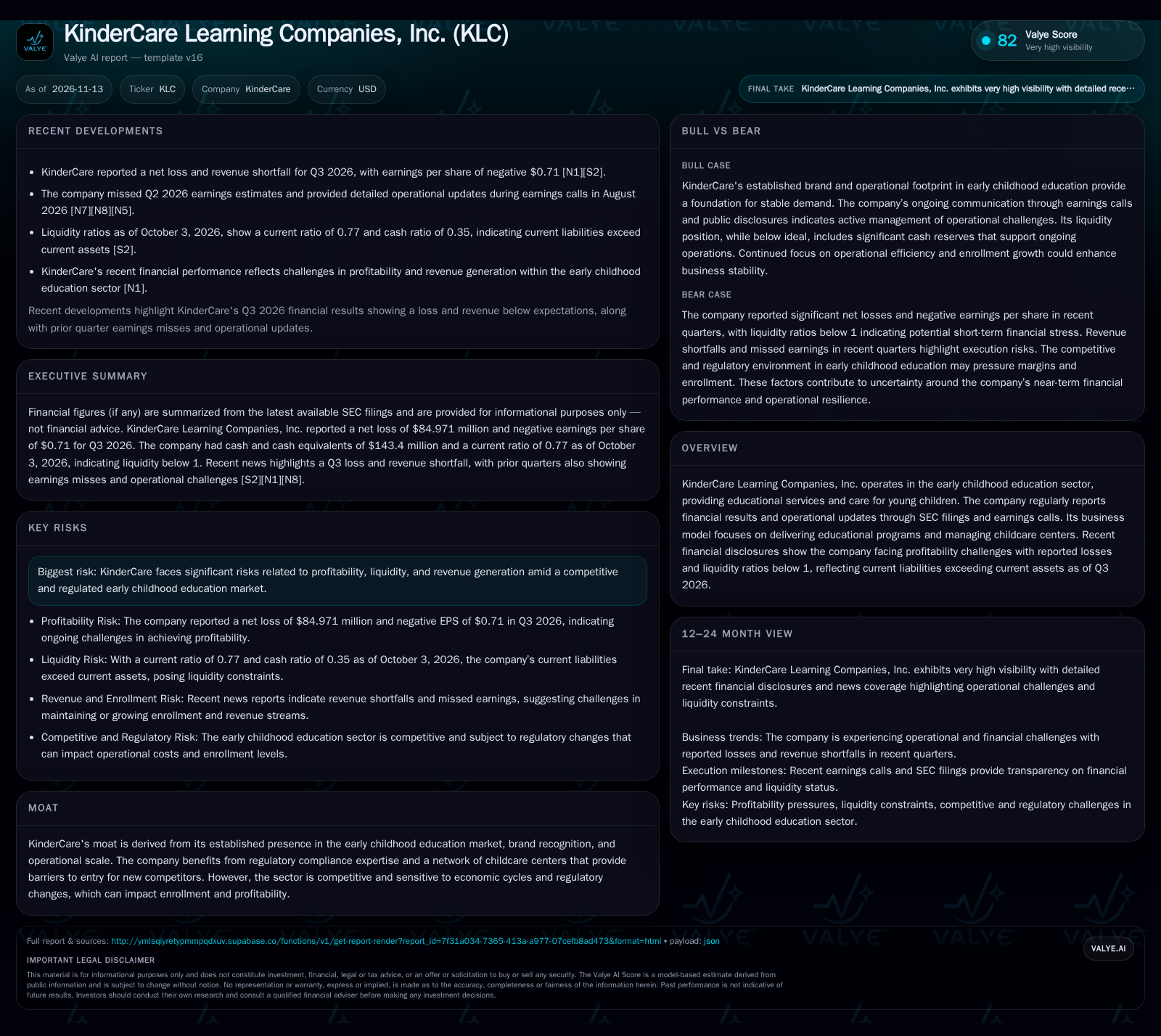
KinderCare reported a net loss of $84.97 million in Q3 2026, with liquidity ratios below 1 and revenue underperforming expectations. Its business model relies on scale in early childhood education, but current operational and financial headwinds highlight both the defensive value of its footprint and the risks of inflexible cost structures in a volatile enrollment environment. The next phase hinges on KinderCare’s ability to stabilize revenue, manage costs, and adapt to sector competition and regulatory shifts. [S2] [N1] [N8]
These results expose the double-edged nature of scale in early childhood education—while KinderCare’s national footprint and brand recognition may support baseline demand, its large fixed-cost base leaves little room to maneuver when enrollment or pricing falters. The company’s next moves will test whether operational adjustments can restore profitability and liquidity, or whether sector headwinds will force more drastic measures.
KinderCare’s Q3 2026 Loss and Liquidity Shortfall: Immediate Implications
KinderCare reported a net loss of $84.971 million for the quarter ended October 3, 2026, with both basic and diluted earnings per share at negative $0.71 [S2] [N1]. As of the same date, KinderCare’s cash and cash equivalents stood at $143.4 million, while total current assets were $319.9 million against current liabilities of $415.2 million, resulting in a current ratio of 0.77 and a cash ratio of 0.35 [S2]. These liquidity metrics indicate that KinderCare’s current liabilities now substantially exceed its immediately available assets, raising near-term financial pressure. The company also reported revenue below expectations in both Q2 and Q3 2026, compounding the challenge of covering its fixed cost structure [N1] [N8]. These developments make KinderCare’s ability to maintain enrollment, manage costs, and potentially access additional capital critical to its operational continuity.
How KinderCare’s Scale Drives Both Opportunity and Rigidity in Its Cost Structure
KinderCare’s core economics are driven by its network of early childhood education centers, where revenue is primarily a function of enrollment volume and pricing per child. The cost base is heavily weighted toward fixed expenses—facility leases or ownership, staffing, regulatory compliance, and curriculum development. This structure creates high operating leverage: incremental enrollments can drive meaningful margin improvement, but any softness in demand or inability to adjust pricing flows straight to the bottom line.
The company reported cash and liquidity metrics for the period; these figures do not by themselves establish operating runway, investment capacity, financial flexibility, or financing capacity. In the absence of enrollment recovery or price increases, KinderCare may need to consider restructuring, asset sales, or new capital infusions to bridge the gap. Meanwhile, regulatory requirements and quality standards limit the company’s ability to cut costs without risking compliance or reputation.
The long-term economic model could improve if KinderCare leverages its scale to achieve higher occupancy rates, deploy new curriculum offerings, or introduce ancillary services, but these require upfront investment and time to ramp—further testing liquidity and execution capacity.
Competitive Dynamics: Scale, Brand, and the Threat of Substitution
KinderCare’s principal competitive assets are its national brand, established regulatory relationships, and operational experience managing large-scale childcare networks. These advantages can support enrollment and provide some pricing power in markets with high demand and limited supply. However, the early childhood education sector is fragmented, with competition from local independent providers, regional chains, nonprofit centers, and even employer-sponsored or public programs.
Substitution risk is material: families may shift to informal care arrangements, subsidized alternatives, or competitors offering lower prices or more flexible hours. Regulatory changes—such as shifts in subsidy policy, staff-to-child ratio mandates, or local licensing rules—can also alter the competitive landscape and cost structure. In downturns, price sensitivity can increase, compressing margins and challenging KinderCare’s ability to pass through cost inflation.
In theory, KinderCare’s scale could allow for centralized procurement, standardized training, and digital engagement platforms, but these benefits must be weighed against the inertia of a large asset base and the risk that local competitors adapt more nimbly to shifting parental preferences.
If Enrollment Recovers and Fixed Costs Are Leveraged: A Route to Margin Expansion
The most favorable scenario for KinderCare involves a sustained recovery in enrollment, driven by improving labor market participation, demographic trends, or successful marketing and partnership initiatives. If center occupancy rates rise and pricing holds or improves, the company’s high fixed-cost leverage could amplify gains, turning incremental revenue into disproportionate margin improvement.
Such a turnaround would likely be confirmed by a return to positive net income, rising occupancy/utilization rates, and stabilization or growth in cash balances despite high current liabilities. Additional supporting evidence might include disclosure of new corporate or government partnerships, successful expansion of value-added services (such as after-school programs), and improved guidance on forward-looking revenue and cost metrics.
This scenario could be falsified by continued revenue underperformance, further net losses, or operational disclosures indicating persistent enrollment or pricing pressures.
KinderCare’s Most Likely Near-Term Trajectory: Slow Recovery or Ongoing Strain
The most plausible outcome is a gradual operational adjustment period, as KinderCare seeks to stabilize enrollment and manage costs within the constraints of its liquidity position. Modest improvements in revenue—through targeted marketing, selective price adjustments, or incremental service offerings—could slow the pace of losses but may not restore profitability in the near term given the magnitude of fixed costs and current liabilities.
Evidence for this scenario would include sequential improvements in revenue or reduced net losses, continued but narrowing liquidity gaps, and management commentary focused on operational efficiency, retention, and selective investment. Falsifying evidence would be a marked acceleration in net losses, deterioration of liquidity ratios, or material enrollment declines triggering more urgent restructuring or capital-raising activity.
What If Enrollment Weakness and Liquidity Pressure Intensify?
In a more adverse scenario, KinderCare could face compounding enrollment declines or price competition, with fixed costs proving unresponsive. If cash outflows persist and external financing is unavailable or costly, the company may approach a liquidity crisis, forcing asset sales, center closures, or emergency restructuring. Regulatory actions or reputational events could accelerate this process if compliance lapses or service quality issues arise under financial stress.
Confirmation of this scenario would come from worsening liquidity ratios, new disclosures about credit facility draws or asset divestitures, mass layoffs or center closures, or regulatory warnings. Conversely, stabilization of cash balances and a halt to enrollment declines would challenge the downside thesis.
Signals That Will Determine Whether KinderCare’s Scale Is an Asset or a Liability
Quarterly net income or loss and the trend in operating cash flow, both of which would indicate whether KinderCare is closing the gap between revenue and fixed costs.
Enrollment and occupancy/utilization rates at KinderCare centers—if disclosed—would provide a direct read on demand and revenue recovery.
Sequential changes in revenue, especially any inflection from declining to stable or growing, as a sign of operational momentum.
Any new financing arrangements, asset sales, or restructuring announcements that could alter the company’s capital structure or cost base.
Updates on regulatory or compliance events, as these could impose additional costs or disrupt operations in a stressed financial environment.
Management guidance or commentary on cost control initiatives, efficiency measures, or new service/program launches that could change the revenue mix or reduce fixed expense burden.
Disclosures around competitive responses—such as pricing moves, partnerships, or expansion by local and regional providers—which could impact KinderCare’s market share and pricing power.
Disclaimer: This is research-only, informational analysis and not investment advice. It may include AI-generated interpretation and general industry context. Always verify important details using primary sources.

Comments