
Battalion Oil: Reserve Development Ambitions Confront Persistent Losses and Listing Pressure
Battalion Oil Corp is pressing forward with U.S.-focused oil and gas reserve development, deploying capital and technology in pursuit of production growth. Yet, steep net losses and a sub-$1 share price raise the stakes for execution, capital access, and survival as a listed company.
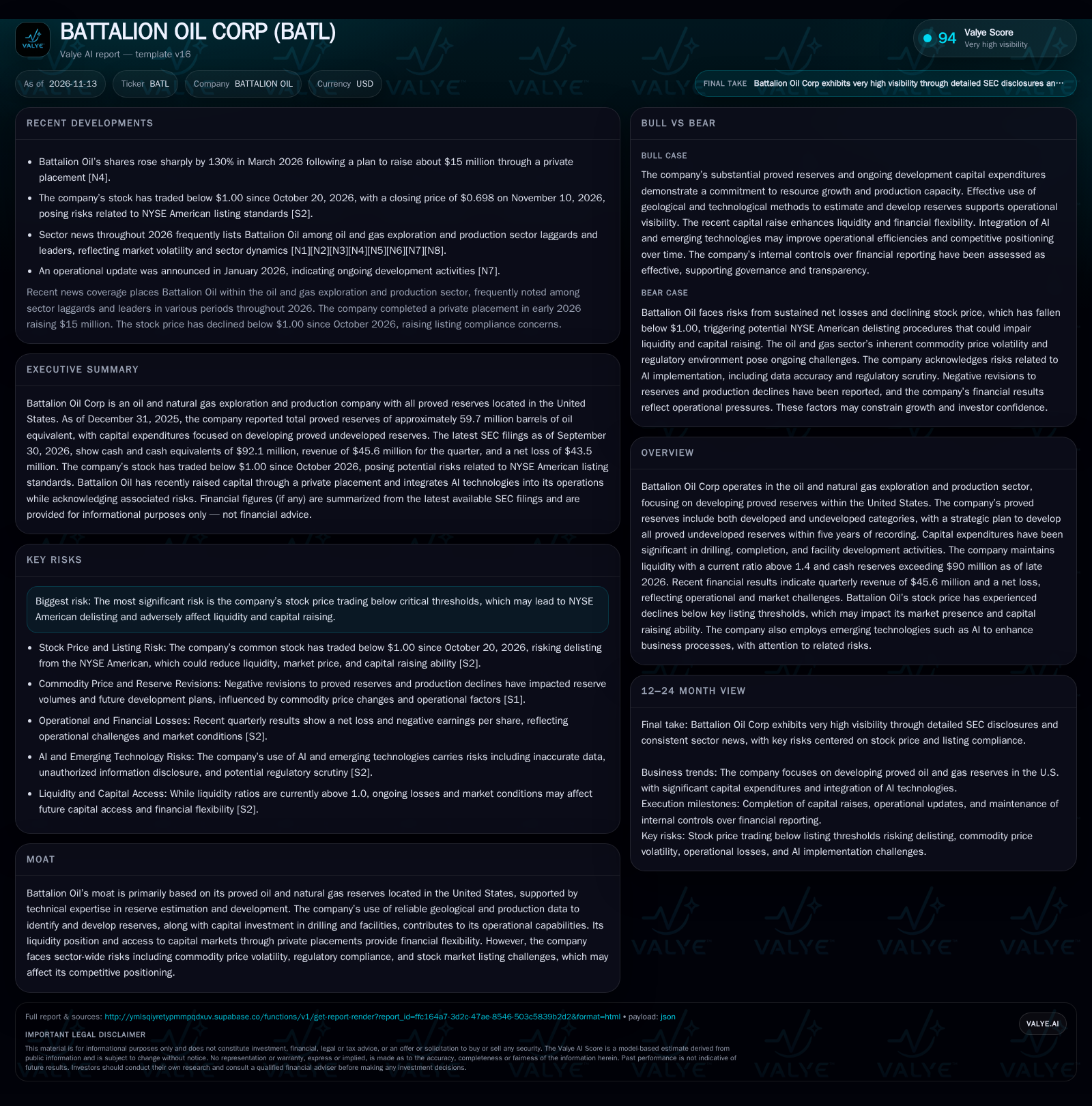
Battalion Oil’s 2026 results show it is investing heavily to develop its 59.7 MMBoe of proved reserves, but negative earnings, shrinking undeveloped reserves, and a stock price below NYSE American’s $1.00 threshold threaten its market access and strategic flexibility. [S1] [S2]
Battalion Oil Corp is a U.S.-focused oil and gas exploration and production company navigating a challenging inflection point. Despite reporting nearly 60 million barrels of proved reserves and ongoing capital investment in reserve development, the company faces mounting pressure from persistent net losses and a sustained sub-$1 share price that threatens its NYSE American listing. With $92.1 million in cash and efforts to modernize operations through AI, Battalion Oil has tools at its disposal—but must overcome sector volatility, reserve downgrades, and potential market exclusion to secure its future. The next year will test whether its resource base and technology adoption can translate into operational and financial resilience. [S1] [S2]
Reserve Declines, Capital Deployment, and Listing Risk Define the Present
At the close of 2025, Battalion Oil reported 59.7 million barrels of oil equivalent in total proved reserves, split between 35.7 MMBoe developed and 24.1 MMBoe undeveloped. However, both categories declined from the prior year due to negative revisions, production, and commodity price impacts. The company invested $61.7 million in 2025 in drilling, completions, and facilities to advance development of these reserves, aiming to convert undeveloped volumes to production within five years. [S1]
The company reported cash and liquidity metrics for the period; these figures do not by themselves establish operating runway, investment capacity, financial flexibility, or financing capacity. [S2] [S2]
The company’s stock price has traded below $1.00 since October 20, 2026—closing at $0.698 on November 10, 2026—which risks triggering NYSE American delisting procedures. This jeopardizes Battalion Oil’s ability to raise capital and maintain investor visibility, compounding the operational and financial pressures already in play. [S2]
How Battalion Oil’s Asset-Driven Model Faces Margin and Funding Constraints
Battalion Oil’s business model is fundamentally asset-driven: it monetizes oil and gas reserves through development, production, and sale, with realized revenue tied directly to commodity prices and production volumes. Capital expenditures are front-loaded—$61.7 million in 2025 went to drilling, completion, and facilities—to convert undeveloped reserves into producing assets. This creates a cycle where capital intensity is high, and returns are highly sensitive to both operational execution and commodity price swings. [S1]
Operating leverage in this model can be significant: higher production volumes and improved commodity prices can rapidly improve margins, but the inverse is also true, amplifying losses during downturns. Battalion’s Q3 2026 results—a net loss nearly equal to revenue—suggest that current production levels and/or realized prices are insufficient to cover fixed costs, depreciation, and ongoing investment needs. [S2]
The company relies on periodic capital raises, such as the $15 million private placement in March 2026, to supplement internally generated cash. Persistent net losses, however, threaten future access to capital markets, especially if delisting risk materializes. This dynamic makes cost discipline, production efficiency, and successful reserve conversion critical for long-term viability.
Asset Base and Technology Adoption Offer Potential, But Sector Pressures Persist
Battalion Oil’s principal competitive asset is its base of proved oil and gas reserves, all located in the United States. This domestic focus can offer logistical, regulatory, and pricing advantages relative to internationally exposed peers. The company’s technical expertise in reserve estimation and development—using seismic data, well logs, and production history—supports resource conversion, but is not unique in a sector where such capabilities are widespread. [S1]
Recent efforts to integrate AI and emerging technologies into business processes could, if effective, lower operating costs, improve drilling accuracy, and enhance recovery rates. However, the benefits of such initiatives typically require scale, robust data infrastructure, and operational buy-in, all of which present execution risk for a mid-sized independent operator. [S2]
Battalion competes with other independent E&Ps and, indirectly, with integrated majors that possess stronger balance sheets, access to lower-cost capital, and often greater resilience to cyclical downturns. In a sector characterized by capital intensity and commodity price volatility, potential financial flexibility and scale often determine which players can weather downturns and reinvest in growth.
If Reserve Conversion and Technology Pay Off, Earnings and Listing Could Recover
A favorable scenario for Battalion Oil would involve successful, timely conversion of proved undeveloped reserves into producing assets, resulting in higher production volumes and improved revenue. If commodity prices stabilize or rise, operating leverage could turn incremental production into positive net income, particularly if AI-driven efficiencies reduce per-barrel costs.
Confirmation of this scenario would come from sequential increases in production volumes, reductions in operating costs per barrel, and a return to positive net earnings. A sustained share price recovery above $1.00 would remove the immediate listing threat and signal renewed investor confidence. Evidence of successful technology adoption—such as improved drilling success rates or cost reductions attributed to AI—would further support the thesis.
On the capital side, the ability to raise additional funds on favorable terms, or to generate positive free cash flow, would indicate that the business model is regaining traction.
Most Plausible Outcome: Ongoing Strain with Incremental Progress and Persistent Uncertainty
The most likely path is that Battalion Oil continues to invest in converting reserves to production, but faces ongoing margin pressure from modest production growth, commodity price volatility, and high fixed costs. The company may remain in a cycle of modest capital raises and cost containment, with periodic reserve revisions reflecting both operational and market realities.
Confirmation would come from gradual depletion of cash reserves, continued net losses (albeit potentially narrowing), and periodic but not transformative operational improvements. The share price may remain volatile and at risk of delisting, with management pursuing remedies such as a reverse split or appeal if the NYSE American initiates delisting procedures.
If the company demonstrates gradual improvement in reserve conversion efficiency and cost discipline, but without a sustained move to profitability, its strategic options may narrow to asset sales, partnerships, or a search for scale via M&A.
Listing Loss and Capital Access Shortfall Could Force Restructuring or Asset Sales
In a bearish scenario, Battalion Oil’s share price remains below the $1.00 threshold, triggering NYSE American delisting and severely impairing liquidity and access to public capital markets. Combined with ongoing net losses and negative reserve revisions, this could precipitate a cash crunch, forcing the company to halt or scale back development plans.
Confirmation of this scenario would include formal delisting notices, inability to raise additional capital, accelerated depletion of cash reserves, and further negative revisions to reserves. Operationally, production could stagnate or decline as capital for new drilling dries up.
This scenario raises the risk of asset fire sales, distressed financing, or restructuring—potentially at the expense of existing equity holders. Regulatory or operational setbacks, such as failed technology integration or safety incidents, could further compound the downside.
Milestones and External Forces That Will Determine Battalion Oil’s Next Chapter
Quarterly production volumes and realized pricing trends—higher output or improved price realizations would signal reserve conversion and revenue progress.
Operating costs per barrel and evidence of efficiency gains, especially those attributable to AI or process improvements, if disclosed.
Quarterly net income trajectory—whether losses are narrowing, stabilizing, or widening.
Cash burn rate and capital expenditures relative to remaining liquidity—watch for signs of financial strain or discipline.
Share price performance and any formal communication from NYSE American regarding listing status, including reverse split announcements or compliance plans.
Reserve revisions in future SEC filings—positive reclassifications or negative write-downs will affect asset value and development runway.
Ability to raise additional capital—terms, dilution, and investor appetite in any new equity or debt offerings.
Operational updates on AI and technology integration, including specific metrics on efficiency, safety, or cost impacts, would help test the thesis.
Disclaimer: This is research-only, informational analysis and not investment advice. It may include AI-generated interpretation and general industry context. Always verify important details using primary sources.

Comments