
Marblegate Capital Corp: Taxi Medallion Lending, Asset Valuation, and the Realities of Niche Financial Services
Marblegate Capital Corp operates in the specialized field of taxi medallion lending and fleet management, reporting a Q3 2026 net loss despite stable medallion valuations and access to credit facilities.
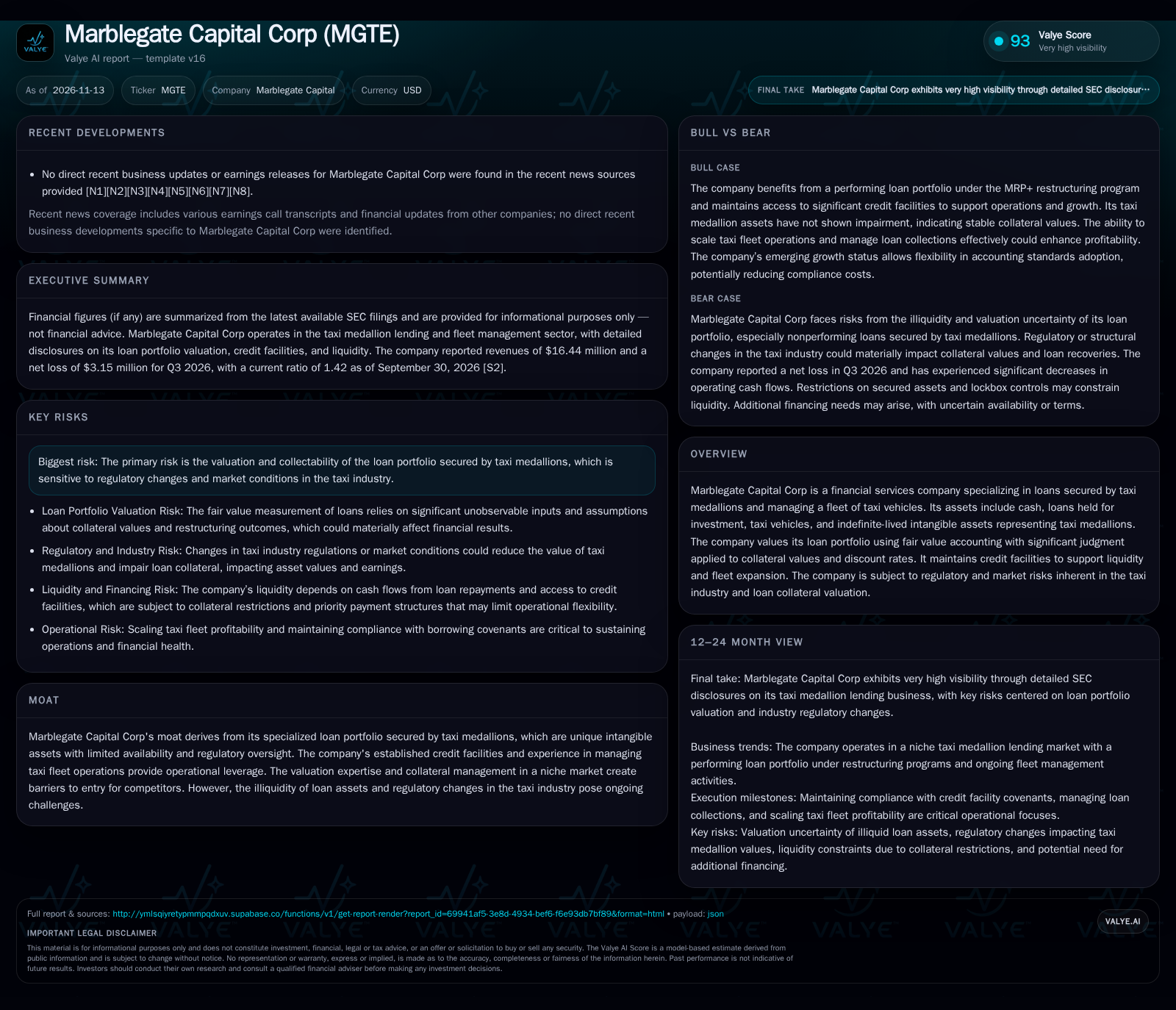
Marblegate Capital Corp operates in the specialized field of taxi medallion lending and fleet management, reporting a Q3 2026 net loss despite stable medallion valuations and access to credit facilities. The company’s economics are shaped by the performance of restructured loans, the illiquidity of its core assets, and the evolving regulatory environment. Key variables include loan recoveries, asset impairment risks, and the operational profitability of its managed taxi fleet [S1] [S2].
Marblegate Capital Corp sits at the intersection of legacy taxi finance and asset-based specialty lending, operating a portfolio dominated by loans secured by New York City taxi medallions—a collateral type both unique and fraught with valuation complexity. Recent results show ongoing revenue generation but persistent net losses, underscoring the challenge of extracting consistent value from an illiquid, highly regulated asset base. As the broader mobility landscape continues to shift, Marblegate’s ability to manage restructuring outcomes, preserve collateral value, and maintain liquidity through credit facilities will determine whether it can stabilize and ultimately grow in a sector facing structural headwinds.
Recent Performance and Balance Sheet Position Shape Strategic Options
In Q3 2026, Marblegate Capital Corp reported $16.44 million in revenue and a net loss of $3.15 million, with negative earnings per share, continuing a trend of operating losses [S2]. As of September 30, 2026, the company held $11.55 million in cash and current assets totaling $24.59 million against $17.36 million in current liabilities, resulting in a current ratio of 1.42 and a cash ratio of 0.67 [S2]. The company’s loans are primarily collateralized by taxi medallions, valued using Level 3 fair value models, and remain free from impairment charges for both 2024 and 2025 [S1]. These figures highlight a business with ongoing revenue streams but persistent profitability and liquidity pressures, where asset valuation and cash flow stability are central to future outcomes.
How Taxi Medallion Lending and Fleet Operations Drive Earnings—and Risks
Marblegate Capital’s core economic engine is its portfolio of loans secured by taxi medallions, with the majority of performing loans falling under restructuring programs such as MRP+ [S1]. Interest and fee income from these loans represent a significant portion of reported revenue, but the economics are tightly bound to the collectability of principal and interest, as well as the stability of medallion collateral values. Medallion loans are illiquid and subject to valuation swings, requiring fair value accounting with significant management judgment. Nonperforming loans are marked to the lower of unpaid principal or collateral value, less estimated costs, meaning any deterioration in medallion values can directly impact reported asset values and earnings.
Fleet management operations introduce additional revenue streams but also fixed and variable costs—vehicle acquisition (partly financed by a $17.2 million term loan), maintenance, insurance, and regulatory compliance. Operating leverage exists if the company can increase fleet utilization and loan collections without proportionally increasing overhead. However, persistent net losses and a declining cash flow from operations in 2025 raise questions about the scalability and profitability of the business under current industry conditions [S1]. The company’s access to a $120 million credit facility offers expansion potential but is constrained by lockbox arrangements and priority payment structures that restrict free cash movement [S1] [S2].
Specialization in Medallion Lending: Moat or Structural Liability?
Marblegate’s focus on taxi medallion-backed lending provides a competitive moat rooted in expertise and regulatory barriers; few entrants have the operational sophistication or risk tolerance for this niche. Medallions are unique, city-regulated intangible assets with limited issuance—historically supporting high collateral values and limiting direct competition. However, the rise of ride-hailing alternatives and evolving urban transport policies have eroded the market power once enjoyed by medallion holders, introducing structural headwinds.
Competitors include other specialty finance companies, distressed asset investors, and to a lesser extent, banks with legacy exposure. The company’s operational edge may rest in its ability to restructure loans and actively manage fleet assets, but this is offset by asset illiquidity, concentrated exposure to New York City, and external risks like regulatory reform or further taxi market contraction. The absence of impairment losses in recent periods suggests some stabilization in collateral values, but the long-term durability of this advantage remains uncertain [S1].
Restructuring Success and Medallion Value Stability Could Unlock Earnings Recovery
A favorable scenario would see the MRP+ and other restructuring programs continue to drive performing loan status, boosting interest collections and reducing credit losses. If New York City medallion values stabilize or recover—potentially due to regulatory support, reduced medallion supply, or improved taxi demand—the company could avoid further asset write-downs and benefit from higher recoveries on nonperforming loans. Enhanced fleet profitability, through higher utilization or operational efficiencies, could also contribute to margin expansion.
Confirmation of this scenario would come from sustained revenue growth, a return to operating cash flow positivity, and a shift to net profitability. Additional evidence would include stable or rising medallion appraisal values, improved collection rates on restructured loans, and lower loan loss provisions. Disclosure of new fleet contracts or expansion of the performing loan book would further validate the upside thesis.
Navigating a Stabilized but Challenged Taxi Finance Landscape
The most plausible outcome is continued operation in a low-growth, high-uncertainty environment. Marblegate may sustain moderate revenue from its performing loan portfolio and fleet operations but remain pressured by nonperforming loans, constrained liquidity, and thin or negative margins. Medallion values could remain stable but low, forestalling impairment but limiting upside. The company’s current credit facilities and asset base may support ongoing operations, but cash flow and profitability will likely hinge on management’s ability to contain costs, navigate fleet utilization cycles, and avoid significant credit losses.
Evidence for this scenario would include stable but unremarkable revenue trends, ongoing—but not worsening—net losses, and flat or slightly declining medallion values. Disclosures of incremental loan restructurings, modest fleet expansion, or cautious borrowing against existing facilities would further support the base case.
Collateral Value Decline or Regulatory Disruption Could Trigger Losses and Liquidity Strain
An adverse outcome would be precipitated by a significant drop in New York City taxi medallion values, triggered by regulatory changes, further ride-hailing market penetration, or weak taxi demand. This would force asset write-downs, increase loan losses, and potentially put the company out of compliance with credit facility covenants. If fleet utilization falters or cost inflation erodes margins, operating losses could deepen, pressuring liquidity and possibly requiring distressed asset sales or dilutive financing.
Downside confirmation would come from reported medallion impairments, a sharp increase in nonperforming loans, negative operating cash flows, or amendments to credit facility terms reflecting covenant breaches. Regulatory developments adverse to the taxi industry or a spike in asset liquidation activity would also be clear warning signs.
Testing the Marblegate Thesis: Collateral, Collections, and Cash Flow Dynamics
Reported fair value and appraisal trends for taxi medallion collateral, particularly in New York City, as these directly affect loan valuations and capital adequacy.
Proportion of the loan portfolio classified as performing versus nonperforming, and the rate of successful restructurings under programs such as MRP+ (if disclosed).
Quarterly operating cash flow and free cash flow trends, as persistent negative cash flow could signal deeper structural challenges.
Updates on credit facility utilization, borrowing capacity, and compliance with DZ Bank and Auxilior covenants, which influence liquidity and operational flexibility.
Fleet utilization rates, acquisition costs, and profitability metrics for taxi operations—these would clarify whether scale or operational improvements are achievable.
Any disclosed changes to the regulatory environment for taxi medallions, including new city ordinances or ride-hailing legislation, which could impact collateral values.
Impairment charges or disclosures of asset write-downs, especially for medallion intangible assets or taxi vehicle fleet.
Announcements regarding additional financing, asset sales, or restructuring of existing credit facilities, as these signal management’s outlook on liquidity and risk.
Disclaimer: This is research-only, informational analysis and not investment advice. It may include AI-generated interpretation and general industry context. Always verify important details using primary sources.

Comments