
Pinnacle Acquisition Corp: Reported Liquidity Position and Net Losses Mark Early Journey of a SPAC
Pinnacle Acquisition Corp’s financials reveal significant liquidity and a steep quarterly net loss, but the absence of any operational disclosure leaves its business model, revenue prospects, and strategic direction entirely opaque. The company’s future now hinges on its ability to consummate a business combination, with the risk of prolonged uncertainty and capital erosion if progress stalls.
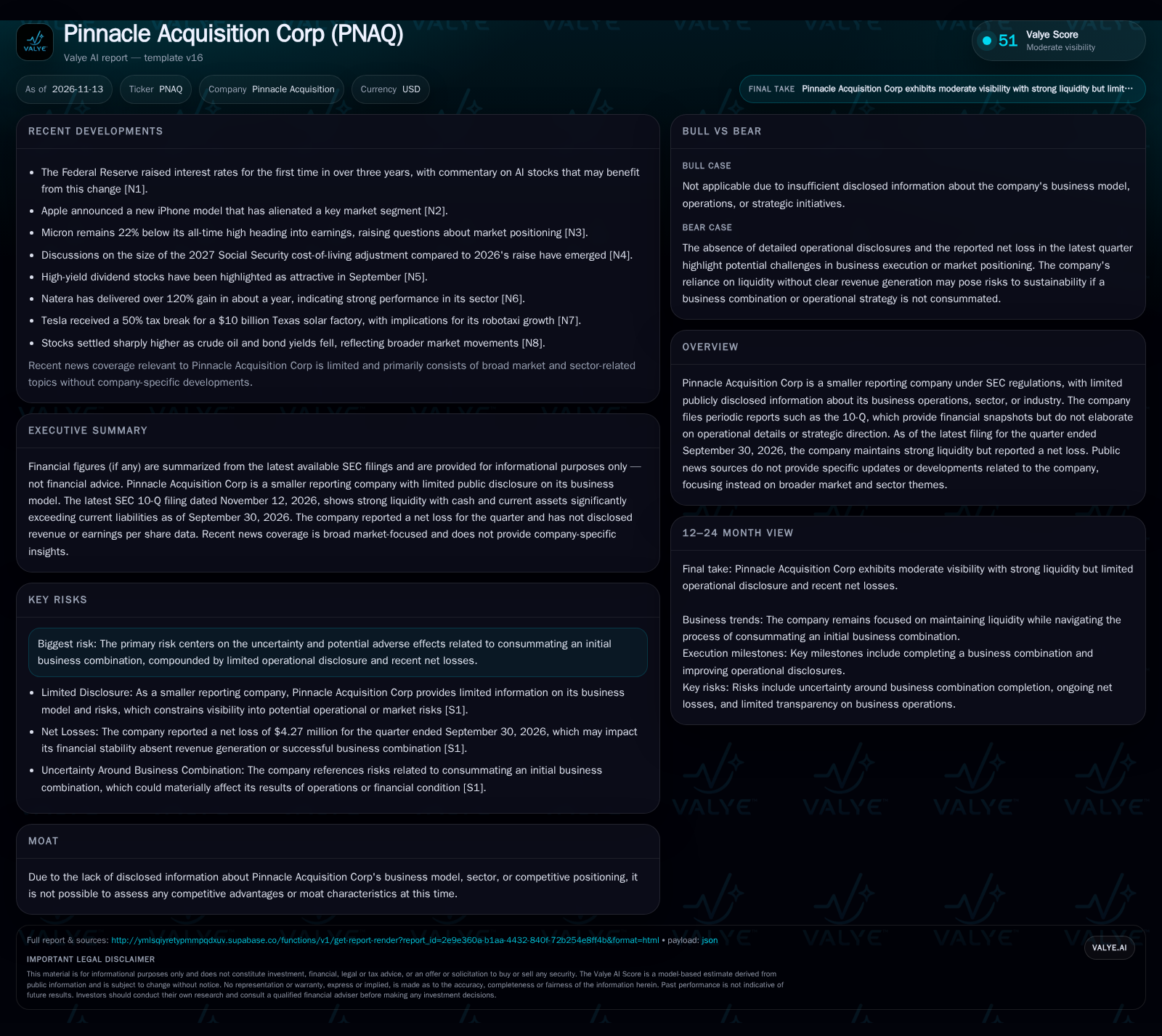
Pinnacle Acquisition Corp’s latest 10-Q highlights a large reported cash balance and minimal current liabilities, but the company reported a net loss of $4.27 million for the quarter ended September 30, 2026, and has not disclosed any revenue or operational details. With no insight into its target industry or merger pipeline, the company’s fate depends on whether it can execute a successful business combination before liquidity is depleted or market conditions shift unfavorably. [S1]
Pinnacle Acquisition Corp stands as a classic blank check company: flush with cash, burdened by net losses, and shrouded in strategic ambiguity. The latest financial snapshot underscores its reported liquidity position—current assets dwarf current liabilities—but the lack of any operational disclosure or revenue data leaves investors flying blind. With no clarity on its sector ambitions, acquisition pipeline, or value creation plan, Pinnacle’s future depends entirely on its ability to consummate a business combination before the clock runs out on its capital reserves. This analysis unpacks the implications of Pinnacle’s financial and disclosure posture, dissects the economics of blank check entities, and explores the scenarios that could define its trajectory.
Current Liquidity Levels and Quarterly Net Losses Outline Immediate Status
The most recent 10-Q for Pinnacle Acquisition Corp, filed November 12, 2026, shows the company with $1,280,766 in cash and cash equivalents and $1,371,503 in current assets, set against current liabilities of just $163,260—a current ratio of 8.4 and cash ratio of 7.84. The company reported cash and liquidity metrics for the period; these figures do not by themselves establish operating runway, investment capacity, financial flexibility, or financing capacity. However, the company posted a net loss of $4,266,376 for the quarter ended September 30, 2026. Notably, there is no disclosure of revenue, operational activity, or sector focus, leaving the business model and strategic intentions entirely ambiguous. The combination of a high reported cash balance and ongoing losses underscores the urgency for some form of value-creating transaction, such as a business combination, to justify continued existence and investor patience. [S1]
While the reported current ratio and cash ratio indicate reported liquidity position on paper, these metrics alone do not capture the nuances of cash burn dynamics within a SPAC. The timing and magnitude of operating expenses, particularly legal, advisory, and due diligence costs, can vary significantly depending on deal activity and regulatory complexity.
Additionally, the lack of operational disclosure creates a challenge in evaluating the company’s strategic positioning and risk profile. Without insight into sector focus or pipeline progress, investors cannot assess the quality, scalability, or competitive advantages of potential acquisition targets. This opacity increases uncertainty around the timing and value accretion potential of any future business combination. From a financial modeling perspective, the absence of revenue or earnings guidance precludes scenario analysis on post-merger performance, making it difficult to estimate the intrinsic value or potential returns for shareholders beyond the liquidation value of remaining cash.
Value Creation and Destruction Patterns in Blank Check Firms
The economics of a blank check or special purpose acquisition company (SPAC) like Pinnacle hinge on its ability to deploy cash into a value-accretive merger or acquisition. Until such a deal is executed, the company typically generates no revenue, and expenses are primarily administrative, legal, and due diligence costs—all of which are fixed and erode the cash base over time. The current net loss, absent any revenue, suggests significant non-operating costs, potentially including deal sourcing, compliance, and sponsor-related expenses. If a merger is consummated, the economics pivot: the combined entity’s future depends on the acquired business’s revenue generation and margin profile. In the absence of a deal, the company’s capital is gradually depleted by G&A and professional fees, ultimately forcing a return of residual funds to shareholders or a wind-down. The key economic lever is therefore the speed and quality of deal execution versus the drag of ongoing expenses.
The fixed nature of SPAC operating expenses means that the economics are highly sensitive to the timeline of deal execution. Extended search periods without consummated transactions amplify value destruction through continuous cash depletion, while accelerated deal closure can preserve capital but may pressure the company to accept suboptimal targets. Furthermore, the quality of the target business fundamentally alters the post-merger economic equation, as a high-margin, growing company can generate sufficient cash flow to offset integration costs and justify the initial investment. Conversely, acquiring a low-growth or distressed entity risks perpetuating losses and diluting shareholder value, underscoring the critical importance of disciplined deal sourcing and due diligence.
Another dimension to consider is the alignment of incentives between SPAC sponsors and public shareholders. Sponsors typically receive a promote or equity stake contingent on deal completion, which can create pressure to finalize a transaction even if the target’s fundamentals are weak. This dynamic may lead to value-destructive mergers if not counterbalanced by rigorous governance and shareholder approval processes. Therefore, the economic outcomes for investors hinge not only on external market conditions and target quality but also on internal governance structures and sponsor behavior, which remain opaque without detailed disclosures.
Pinnacle’s Position Among Numerous SPACs Lacks Clear Differentiators
In the current market, blank check companies face intense competition—not for market share in a traditional sense, but for access to attractive acquisition targets and sponsor credibility. With no disclosed sector focus, operational differentiators, or sponsor reputation, Pinnacle offers no visible edge over the hundreds of other SPACs and acquisition vehicles vying for limited high-quality targets. The market has grown wary of undifferentiated SPACs, especially those with limited transparency or a lack of clear deal pipelines. Without a disclosed niche, tenured management, or competitive sourcing advantage, Pinnacle’s only asset is its liquidity—but this is rapidly eroded by ongoing net losses. Meanwhile, the pool of high-quality merger candidates has shrunk as more mature companies opt for traditional IPOs or strategic sales, intensifying the challenge.
Potential Upside from Securing a High-Quality Merger Target
The most favorable scenario for Pinnacle is the successful identification and merger with a high-growth, scalable target in a sector with robust fundamentals. If the company leverages its cash position to secure a differentiated target—ideally one overlooked by competing SPACs—it could unlock significant value for shareholders. Confirmation of this scenario would require announcements of a definitive merger agreement, regulatory filings outlining a compelling target with strong revenue and earnings prospects, and subsequent shareholder approval. Early signs could include increased deal-related expenses, public statements about a letter of intent, or sector-specific hires. Falsification would occur if the company repeatedly extends timelines, fails to announce a target, or pursues a low-quality merger in a distressed sector, eroding trust and capital.
Base Outlook Centers on Preserving Capital While Pursuing Transaction Opportunities
The most plausible scenario is that Pinnacle continues to incur net losses as it searches for a suitable business combination, with its cash base gradually declining due to operating and administrative expenses. In the absence of revenue or operational progress, the company’s value proposition remains purely optionality: the potential for a future deal. This scenario is confirmed by ongoing losses, lack of revenue disclosure, and no merger announcements. If the company begins to approach the typical SPAC deadline (often two years from IPO), it may seek extensions or modestly increase deal activity. Falsification could occur if the company unexpectedly announces a lucrative target or, conversely, if sponsor support wanes and no extension is granted, forcing liquidation.
Risks of Capital Drain and Merger Delays Impact Future Prospects
The negative scenario involves Pinnacle continuing to burn cash on administrative and professional fees without executing a business combination. As expenses mount and the cash base dwindles, the company may struggle to attract high-quality targets or even meet minimum capital requirements for a merger. If no deal is reached within the permissible timeline, Pinnacle could be forced to liquidate, returning remaining funds to shareholders—likely at a loss due to the erosion of the initial capital base. Confirmation of this scenario would include continued net losses, no material deal progress, failed extension votes, or sponsor withdrawal. Signs of deteriorating sponsor confidence or rising legal/professional costs could further reinforce the downside risk.
Key Developments Influencing Pinnacle Acquisition Corp’s Trajectory
Announcement of a definitive business combination or letter of intent would directly test the company’s ability to execute on its mandate.
Disclosure of a target sector, industry focus, or sponsor strategy—if provided—would clarify the competitive landscape and investment thesis.
SEC filings or investor communications regarding timeline extensions or changes to the business combination deadline.
Shifts in sponsor support, including new capital commitments, sponsor redemptions, or sponsor-related party transactions, if disclosed.
Changes in administrative, legal, or professional fee expenses, which could indicate deal activity or, conversely, unproductive burn.
Evidence of shareholder sentiment, such as extension vote outcomes or redemption rates, as a proxy for market confidence in the company’s prospects.
Disclaimer: This is research-only, informational analysis and not investment advice. It may include AI-generated interpretation and general industry context. Always verify important details using primary sources.

Comments