
DiaMedica Therapeutics: Recombinant KLK1 Ambitions, Clinical Progress, and the Realities of Rare Disease Drug Development
DiaMedica Therapeutics is advancing DM199, a recombinant human KLK1 protein, through mid-stage trials targeting preeclampsia and acute ischemic stroke. Early clinical signals are promising, but regulatory, clinical, and commercial hurdles remain substantial, with financial sustainability hinging on further trial progress and external validation.
DiaMedica Therapeutics’ lead candidate DM199 has shown encouraging Phase 2 safety and pharmacodynamic results in preeclampsia and holds FDA Fast Track Designation for acute ischemic stroke. Commercial success depends on further clinical validation, regulatory approval, and eventual market adoption in large but challenging indications.
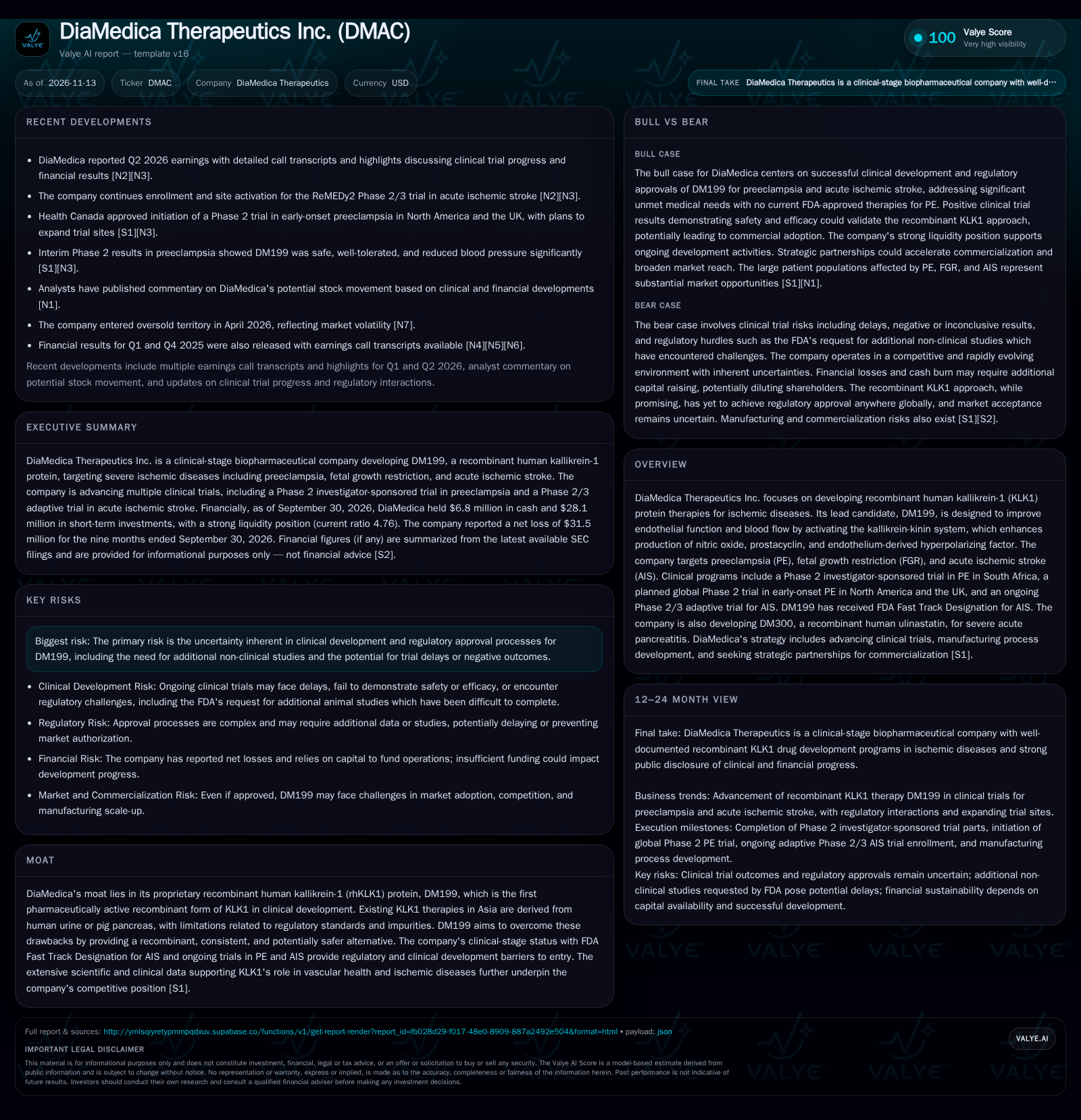
DiaMedica Therapeutics stands at a pivotal juncture in rare disease drug development, leveraging its proprietary recombinant KLK1 platform with DM199 as the lead asset. The company is targeting significant unmet needs in preeclampsia (PE) and acute ischemic stroke (AIS), where current treatment options are limited or purely symptomatic. Early clinical data in PE indicate DM199 is both safe and capable of producing rapid, sustained reductions in blood pressure, while regulatory progress includes FDA Fast Track Designation for AIS and Health Canada approval to initiate a pivotal global trial. However, the company faces the typical financial and regulatory uncertainties of clinical-stage biopharma, compounded by the need for additional animal studies and ongoing cash burn. The next 12-24 months will be critical in determining whether DiaMedica’s scientific promise can translate into meaningful clinical and commercial milestones.
Recent Clinical and Regulatory Milestones Shape DiaMedica’s Outlook
DiaMedica’s clinical pipeline is anchored by DM199, the first recombinant human KLK1 protein studied in humans, with a focus on preeclampsia (PE), fetal growth restriction (FGR), and acute ischemic stroke (AIS). Interim Phase 2 investigator-sponsored trial results in PE patients at Tygerberg Hospital showed that DM199 was safe, well-tolerated, and produced statistically significant, sustained reductions in blood pressure over 24 hours post-infusion—an important early signal in a disease with no FDA-approved therapies [S1] [N3].
Financially, as of September 30, 2026, DiaMedica reported $6.8 million in cash and $28.1 million in short-term investments, with a net loss of $31.5 million for the first nine months of the year. The reported current ratio (4.76) reflects ample current assets relative to liabilities, supporting continued R&D activity in the near term [S2].
Regulatory progress includes Health Canada’s approval to initiate a Phase 2 trial in early-onset PE, with a similar application pending in the UK. However, the FDA has requested additional non-clinical embryo-fetal development studies, and the initial rabbit study was inconclusive due to an antibody response, requiring exploration of alternative animal models [S1]. These developments directly impact DiaMedica’s trial timelines and risk profile.
Economic Model: The High Stakes and High Costs of Biotech Innovation
DiaMedica, like most clinical-stage biotechs, currently generates no product revenue and is heavily reliant on external capital to fund research and development. The company’s cost structure is dominated by R&D expenses, which reached $25.4 million in the nine months ended September 30, 2026, with general and administrative costs of $7.2 million over the same period [S2]. This reflects the intensive resource demands of running multiple parallel clinical programs, including global, adaptive-design trials.
The economics of DM199, if approved, would likely reflect orphan-drug pricing dynamics in indications like preeclampsia and stroke. Pricing power could be substantial if DM199 demonstrates disease-modifying effects in PE, given the absence of FDA-approved therapies and the high cost of complications in this population. However, ultimate commercial potential depends on regulatory approval, payer acceptance, and the ability to demonstrate clear clinical and economic value relative to existing symptom-management approaches.
Manufacturing of a recombinant protein such as DM199 entails significant fixed costs, especially in scaling up for late-stage and commercial supply. Variable costs may decrease with scale, but commercial margins will depend on both pricing and the cost structure of recombinant protein production, which is typically higher than for small molecules but can be offset by premium pricing in rare or severe diseases. Capital needs remain high until regulatory and commercial inflection points are achieved.
Proprietary KLK1 Platform and First-Mover Advantage—But Barriers Remain
DiaMedica’s competitive position is rooted in DM199 being the first pharmaceutically active recombinant KLK1 protein in clinical development. In Asia, KLK1 therapies are derived from human urine or pig pancreas and are used for AIS and cardiovascular diseases, but these products face regulatory and purity limitations outside their home markets [S1]. DM199’s recombinant nature may offer a consistency and safety profile that legacy products cannot match, potentially enabling regulatory approval in North America and Europe where biologic manufacturing standards are stringent.
The company’s FDA Fast Track Designation for AIS and ongoing clinical trials in PE and AIS create clinical and regulatory barriers to entry for potential competitors. However, the biopharma landscape is highly competitive and dynamic, with larger pharmaceutical companies and academic consortia pursuing diverse modalities for ischemic and hypertensive disorders. While DM199’s mechanism of action is differentiated, substitutes could emerge from gene therapy, small molecules targeting vascular pathways, or other protein therapeutics if they demonstrate superior efficacy or ease of use.
DiaMedica’s moat depends on translating its scientific lead into regulatory approval and commercial traction before competitors with greater resources can enter the space. Intellectual property around recombinant KLK1 and manufacturing know-how also provide some protection, but market leadership is not assured until late-stage clinical success is secured.
Breakthrough Efficacy and Regulatory Success Could Unlock Transformative Value
The most favorable scenario for DiaMedica involves continued positive clinical data in both preeclampsia and acute ischemic stroke, leading to successful completion of Phase 2/3 trials and eventual regulatory approval of DM199. This would position DM199 as the first disease-modifying therapy for PE and a novel option for AIS, both areas of high unmet need and large addressable populations.
Confirmation of DM199’s safety and sustained blood pressure-lowering effects in larger, multi-center trials—especially with endpoints demonstrating improved maternal and neonatal outcomes in PE—would drive regulatory momentum and attract strategic partners or acquirers. If the company can demonstrate that DM199 meaningfully reduces healthcare utilization, such as preterm deliveries or maternal ICU admissions, payers may be willing to reimburse at premium orphan-drug pricing.
External validation from regulatory agencies (e.g., successful completion of requested animal studies, positive interim analyses, or Breakthrough Therapy Designation) would further de-risk the development path. Evidence of strong recruitment, trial retention, and reproducible efficacy across geographies would help confirm this scenario.
Incremental Clinical Progress, Prolonged Timelines, and Continued Cash Burn
The most plausible near-term scenario is one of continued but measured clinical progress, with DiaMedica advancing its PE and AIS trials while working through regulatory and operational hurdles. Completion of the additional non-clinical embryo-fetal studies required by the FDA is likely to delay late-stage PE trial initiation in the US, even as the company proceeds with Health Canada–approved sites and seeks UK regulatory clearance [S1].
Interim clinical data may continue to show safety and pharmacodynamic activity, but definitive efficacy signals may not emerge until larger, later-phase studies are complete. During this period, DiaMedica will likely continue to incur significant R&D expenses and net losses, necessitating further capital raises absent a major partnership or non-dilutive funding.
Evidence supporting this scenario would include steady patient enrollment, incremental regulatory progress, and manageable cash burn relative to available resources.
Clinical Setbacks or Regulatory Barriers Could Force Strategic Reassessment
The primary downside risks are clinical trial failures, inconclusive efficacy, or insurmountable regulatory barriers. If additional animal studies or Phase 2/3 trials reveal unexpected safety issues, lack of efficacy, or insurmountable immunogenicity (as suggested by the antibody response in rabbits), DM199’s clinical and commercial prospects could be severely impaired [S1].
Extended delays in meeting FDA requirements or failure to secure regulatory clearance in key markets (e.g., the US or UK) would erode DiaMedica’s competitive advantage and could exhaust its financial resources before reaching value-creating milestones. In this scenario, continued net losses and cash burn without corresponding progress would likely necessitate significant dilution or forced out-licensing of assets at suboptimal terms.
Signals confirming a downside scenario would include negative or inconclusive trial data, regulatory holds, persistent enrollment problems, or disclosures of urgent capital needs that cannot be met on favorable terms.
Milestones and Data Points That Will Determine DiaMedica’s Trajectory
Final readouts from the ongoing Phase 2 investigator-sponsored trial in preeclampsia, especially data on maternal and perinatal outcomes beyond blood pressure if disclosed.
Progress in completing the FDA-requested non-clinical embryo-fetal development studies in alternative animal models, and any resulting regulatory feedback.
Interim analyses and enrollment rates in the global Phase 2/3 ReMEDy2 trial for acute ischemic stroke, as well as the pace of site activations and protocol compliance.
Cash burn trajectory relative to available liquidity, including any announced capital raises, partnerships, or non-dilutive funding events.
Initiation and progress of North American and UK sites in the planned global Phase 2 trial for early-onset preeclampsia.
Any evidence of strategic partnerships, licensing deals, or external validation by larger pharmaceutical companies.
Updates on manufacturing scale-up and supply readiness for late-stage and eventual commercial production, as this could impact both timelines and margins.
A useful metric would be patient retention rates and adverse event profiles in larger, multi-site trials, which would help test the scalability and tolerability of DM199.
Disclaimer: This is research-only, informational analysis and not investment advice. It may include AI-generated interpretation and general industry context. Always verify important details using primary sources.

Comments