
Innventure’s Disruptive Conglomerate Model: Execution, Scale, and the Realities of Tech Commercialization
Innventure’s approach—founding and scaling subsidiaries around transformative technologies sourced from multinationals—offers a diversified path to value creation, but sustained losses, leadership transitions, and the challenge of moving innovations from lab to market underscore the importance of execution, capital discipline, and partnership leverage.
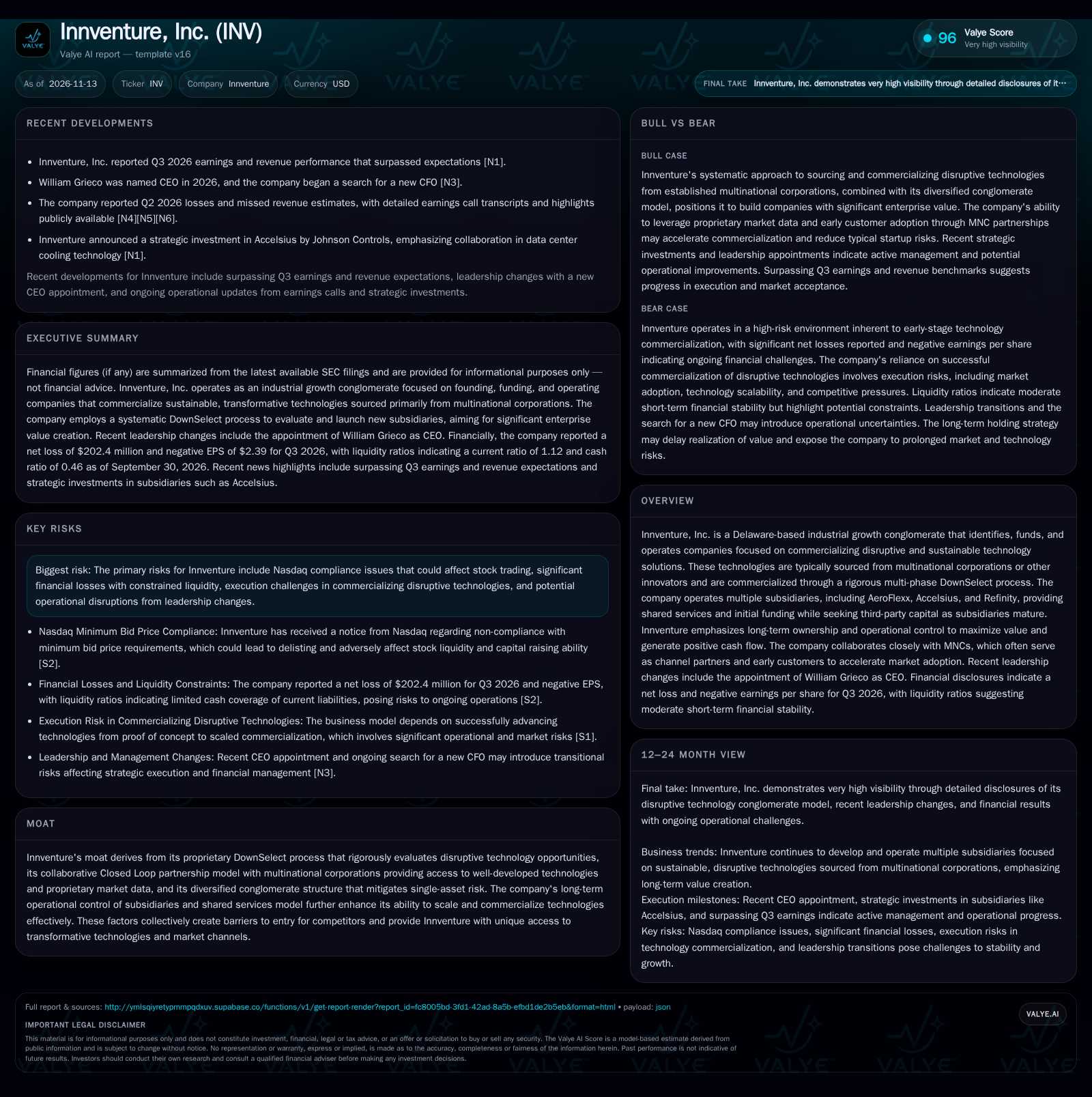
Innventure, Inc. runs a multi-subsidiary conglomerate model, aiming to commercialize disruptive technologies sourced primarily from multinational partners. The company’s future hinges on its ability to de-risk technology launches, secure third-party funding at the subsidiary level, and convert early strategic partnerships into scalable revenue streams. [S1] [S2] [N1] [N3]
Innventure, Inc. is betting on a highly orchestrated approach to industrial innovation: it systematically acquires, funds, and operates subsidiaries built around transformative technologies, largely sourced from multinational corporations. By applying a proprietary DownSelect process and leveraging MNC partnerships for early customer adoption, Innventure seeks to mitigate the high risks inherent in tech commercialization. The company’s next phase will test whether disciplined execution, capital sourcing, and the conversion of partnerships into scalable revenue can overcome the structural hurdles of early-stage industrial innovation. [S1] [S2] [N1] [N3]
Recent Results and Strategic Shifts Define the Inflection Point
Innventure finished Q3 2026 with a net loss of $202.4 million and negative EPS of $2.39, continuing a pattern of sizable operational losses. The company reported cash and liquidity metrics for the period; these figures do not by themselves establish operating runway, investment capacity, financial flexibility, or financing capacity. [S2] Leadership changes are underway, with William Grieco appointed CEO in 2026 and a search for a new CFO in progress, signaling a period of transition and possible strategic realignment. [N3] Notably, Q3 2026 results beat earnings and revenue expectations, suggesting some traction in subsidiary operations. [N1] The company also highlighted strategic investments, such as Johnson Controls’ stake in Accelsius, reinforcing the role of large-scale partners in its commercialization approach. [S1] [N1]
How Innventure’s Model Seeks to Turn Innovation into Cash Flow
Innventure’s economics revolve around identifying high-potential technologies—often already validated in MNC R&D pipelines—then founding subsidiaries to commercialize them. The group provides initial funding and shared services, but seeks to attract external capital as subsidiaries mature. Revenue and eventual cash flow depend on successfully scaling these businesses, with the aim of building each to at least $1 billion in enterprise value. [S1]
The conglomerate structure is designed to diversify risk: failures in one subsidiary may be offset by successes in another. Fixed costs are partially centralized through shared services, but each subsidiary faces its own capital intensity and scaling requirements. Early-stage companies often require multiple funding rounds before reaching breakeven, and the group’s persistent losses reflect both operating burn and the high cost of new company launches. [S2]
Pricing power and margin potential depend on the disruptive nature of each technology and the speed of market adoption. If subsidiaries can secure anchor customers (often their MNC partners) and demonstrate clear value, they may command premium pricing or rapid market share gains. However, the timing and magnitude of revenue ramp-ups are inherently unpredictable in industrial technology commercialization.
Differentiation Through Sourcing, Process, and Partnerships—But Imitators Loom
Innventure’s edge lies in its proprietary DownSelect process for vetting technologies, its access to innovations sourced directly from multinationals, and its collaborative commercialization model. MNC partnerships provide not just technology pipelines but also initial distribution channels and customer validation, creating a potential early-mover advantage. [S1]
The conglomerate model mitigates single-asset risk, unlike pure-play venture funds or operating companies. However, the approach is not immune to competition: other industrial holding companies, corporate venture arms, and even specialized private equity funds are increasingly targeting similar technology transfer and spinout opportunities. The barriers to entry are meaningful but not insurmountable, especially for players with deep corporate relationships or sector-specific expertise.
A key test will be whether Innventure can maintain proprietary access to high-value technologies and scale subsidiaries faster or more efficiently than rivals. Switching costs for MNC partners may be low if alternative commercialization routes (such as joint ventures or licensing) become more attractive.
If the Model Works: Rapid Subsidiary Scaling and Portfolio Value Creation
The bullish scenario is that Innventure’s DownSelect process consistently identifies commercially viable technologies, and its subsidiaries achieve early product-market fit with the help of MNC anchor customers. Strategic partnerships—such as Johnson Controls’ investment in Accelsius—could validate the model, unlock additional third-party funding, and accelerate subsidiary revenue growth. [S1] [N1]
If several subsidiaries achieve scale, move into positive cash flow, and demonstrate robust growth, the conglomerate could generate significant value both from ongoing operations and potential monetization events (such as minority stake sales or future public listings). Outperformance versus Q3 expectations may be an early signal of operational momentum. [N1]
Evidence that would confirm this scenario includes: repeat strategic investments from new MNCs, rapid revenue growth in multiple subsidiaries, and public disclosures of major commercial contracts or customer wins. Sustained improvement in consolidated operating margins and cash flow would also be corroborating.
Portfolio Progress Amid Persistent Losses and Execution Risk
The most plausible path is a gradual maturation of the portfolio: some subsidiaries achieve moderate commercial traction, others lag or require restructuring, and the group continues to incur losses while selectively raising capital. Execution risk remains high: the transition from pilot to scale is often slow, and delays in market adoption or technical hurdles can extend the cash burn period.
Leadership changes—such as the new CEO and pending CFO—may result in sharper capital discipline or portfolio pruning, but could also disrupt continuity. [N3] The conglomerate structure provides some risk mitigation, but does not eliminate the need for individual subsidiary success.
Progress would be confirmed by steady subsidiary-level revenue growth, successful follow-on funding rounds, and periodic announcements of new MNC partnerships. Conversely, persistent negative cash flow, lack of new investments, or high subsidiary failure rates would signal that the base case is deteriorating.
When Technology Commercialization Stalls: Liquidity Crunch and Strategic Setbacks
The adverse scenario is that most subsidiaries fail to achieve commercial scale, either due to poor product-market fit, longer-than-expected adoption cycles, or competitive displacement. [S2]
Failure to secure new third-party funding at the subsidiary level could force Innventure to dilute its holdings, shutter operations, or sell assets at distressed valuations. Delays or failures in executive recruitment (such as the ongoing CFO search) could further destabilize financial management. [N3]
This scenario would be confirmed by continued negative earnings surprises, increasing current liabilities relative to assets, forced asset sales, or announcements of subsidiary closures. Delisting risk due to Nasdaq compliance issues could further constrain access to capital and damage credibility.
Testing the Innventure Thesis: Near-Term Milestones and Triggers
Subsidiary-level revenue growth rates, if disclosed, would help test whether commercialization efforts are gaining traction.
New or expanded strategic investments from MNCs—especially outside the current portfolio—would indicate sustained access to high-value innovation pipelines.
Progress in the CFO search and stability of the executive team will be critical for capital markets confidence and operational discipline.
Subsidiary follow-on funding rounds with third-party investors would validate the ability to de-risk and scale portfolio companies.
Consolidated cash flow trends, especially movement toward breakeven at the subsidiary or group level, would indicate improving economics.
Any public disclosures of major commercial contracts or customer deployments—particularly with blue-chip MNCs—would signal market acceptance.
Updates on Nasdaq compliance status and any risk of delisting will directly affect capital access and shareholder value.
Disclaimer: This is research-only, informational analysis and not investment advice. It may include AI-generated interpretation and general industry context. Always verify important details using primary sources.

Comments