
SOLV Energy: Project Pipeline, Margin Pressures, and the Realities of Utility-Scale Solar EPC Growth
A surging backlog, post-IPO capital structure, and recent acquisition position SOLV Energy as a major infrastructure player in utility-scale renewables. Yet, margin compression and execution risks reveal the fragility beneath headline growth.
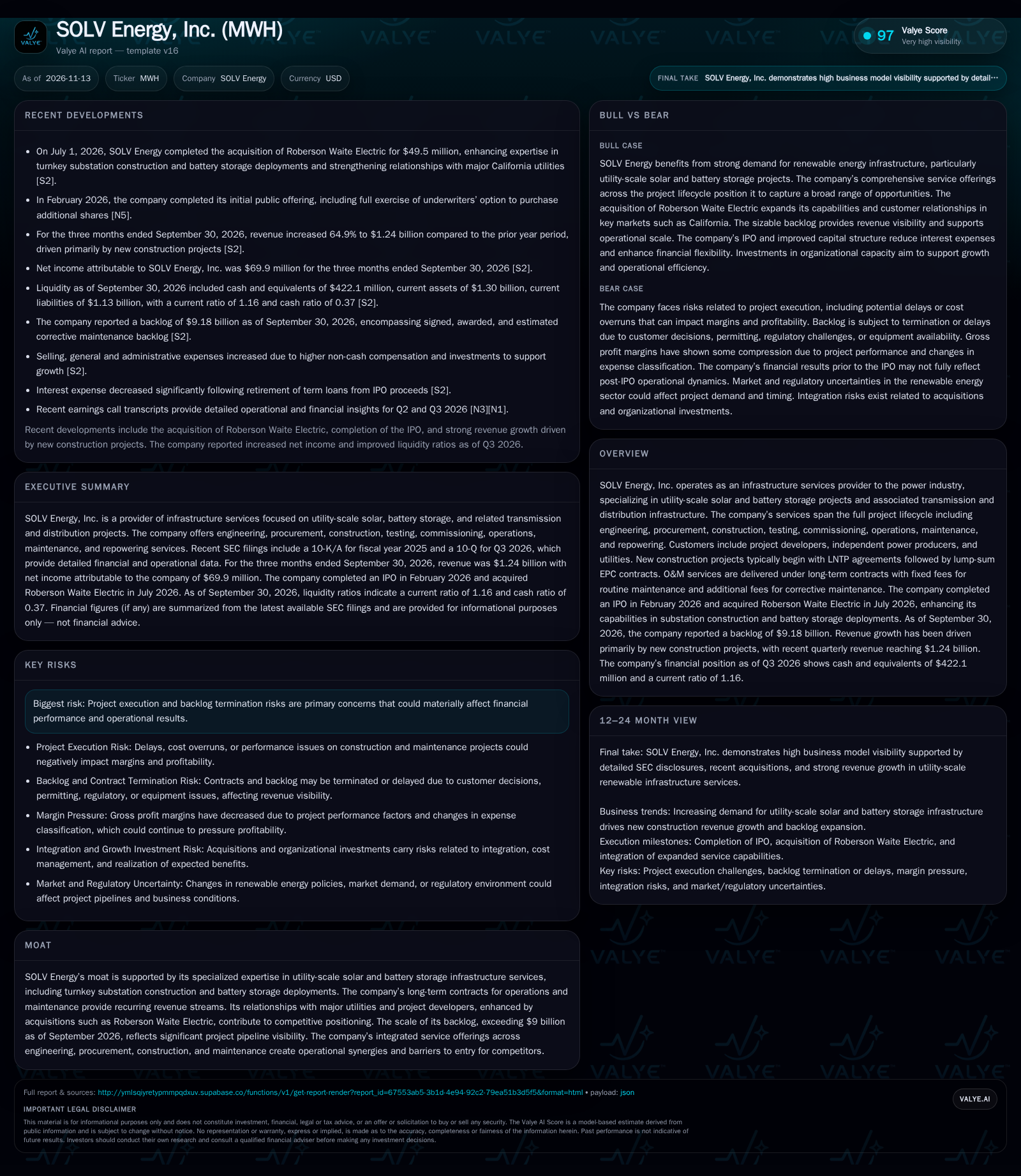
SOLV Energy’s $9.18 billion backlog and 65% revenue growth highlight robust demand for utility-scale solar and battery storage infrastructure. However, gross margin compression, rising SG&A, and backlog realization risks temper the outlook. The company’s acquisition of Roberson Waite Electric and recent IPO improve capabilities and capital structure, but operational execution and contract durability will determine whether the current momentum translates into durable, high-return growth. [S2]
SOLV Energy’s rapid ascent in utility-scale solar and battery storage construction has captured industry attention, with a $9.18 billion backlog and nearly 65% revenue growth in Q3 2026. The company’s recent post-IPO capital structure and acquisition of Roberson Waite Electric have broadened its technical reach and fortified relationships with major utilities. However, beneath the surface of growth lies a complex mix of margin compression, rising operating costs, and the ever-present risk that project delays, cancellations, or execution missteps could erode future profitability. As the renewable infrastructure cycle accelerates, SOLV’s ability to convert backlog into high-quality earnings will be the true test of its business model.
Backlog and Revenue Surge, but Margin Trends Raise Questions
As of September 30, 2026, SOLV Energy reported a $9.18 billion backlog, encompassing signed, awarded, and estimated corrective maintenance projects—a figure that signals both strong demand and significant revenue visibility in the near-to-medium term. For Q3 2026, revenue reached $1.24 billion, up 64.9% from the prior year, with growth primarily attributed to new construction activity. Net income for the quarter stood at $69.9 million. However, gross profit margin declined to 17.8% (from 19.7% a year earlier) due to project performance factors and reclassification of compensation expenses. These facts highlight a company with headline growth but underlying margin pressure, raising questions about the sustainability and quality of its earnings trajectory. [S2]
How SOLV Energy Monetizes the Utility-Scale Renewables Boom
SOLV Energy’s business model is anchored in engineering, procurement, and construction (EPC) contracts for utility-scale solar PV, battery storage, and related transmission and distribution projects. New construction contracts, typically lump-sum EPC agreements, contribute the majority of revenue. These contracts are capital-intensive, requiring upfront mobilization, material procurement, and labor costs, with revenues recognized based on project milestones or percentage-of-completion accounting. The company also provides long-term operations and maintenance (O&M) services, which offer more predictable, fixed-fee revenue streams with additional variable fees for corrective maintenance.
The economics of EPC are inherently volatile: while scale can drive operating leverage, fixed-price contracts expose the company to cost overruns, supply chain disruptions, and labor inflation. Margins are sensitive to project execution quality, material cost fluctuations, and the company’s ability to accurately estimate and manage risks at bid stage. The recent decline in gross margin, alongside a 22.2% rise in SG&A (driven by non-cash compensation and growth investments), suggests that rapid scaling is testing operational discipline. The acquisition of Roberson Waite Electric may enable more vertical integration and margin capture in substation and battery storage construction, but integration costs and realization of synergies remain uncertain. [S2]
Acquisition-Driven Capability Expansion and Sector Rivalry
SOLV Energy operates in a highly competitive landscape, facing national EPCs, regional construction firms, and specialized renewable infrastructure contractors. Its recent $49.5 million acquisition of Roberson Waite Electric adds turnkey substation and battery storage deployment expertise, potentially deepening relationships with major California utilities and strengthening its bid for complex, integrated projects. This expansion may offer a competitive edge in project scope and technical depth, especially as grid modernization and co-located storage become prerequisites for utility-scale solar deployment.
However, barriers to entry in EPC remain moderate, as technical expertise, project track record, and bonding capacity are necessary but not insurmountable for well-capitalized rivals. Pricing is often aggressive due to project-based bidding, and large customers—utilities and independent power producers—exercise significant negotiating leverage. While SOLV’s scale and integrated service offering create some operational synergies and switching friction, customer contracts remain subject to cancellation or renegotiation, and backlog realization is not guaranteed. The most durable advantage may come from demonstrated execution reliability, deep utility relationships, and the ability to deliver on time and on budget as project complexity rises.
If SOLV Converts Backlog into Higher-Margin, Recurring Revenue Streams
The most favorable scenario for SOLV Energy involves successful execution on its $9.18 billion backlog, with minimal project terminations or delays, and realization of new construction projects at or above bid margins. If the company can leverage its expanded substation and battery storage capabilities to win higher-value, technically complex projects, it could drive both revenue growth and margin expansion. Further, if O&M contracts become a larger share of the business, recurring revenue streams could dampen the volatility inherent in EPC work and provide a more stable base for earnings.
Confirmation of this scenario would include sustained or improving gross margins, a rising proportion of O&M revenue, and evidence that recently acquired capabilities are driving incremental wins and improved project economics. Successful integration of Roberson Waite Electric, with cross-selling of services to major utility customers, would further validate the upside thesis. Rapid backlog conversion into recognized revenue and cash flow, with low levels of project cancellations or cost overruns, would be strong confirming evidence.
Execution Gains Offset by Margin Pressure and Backlog Uncertainty
The most plausible outcome is that SOLV Energy continues to deliver robust revenue growth as it converts backlog into projects, but margin pressures persist due to a mix of execution challenges, cost inflation, and competitive pricing. The integration of Roberson Waite Electric may support incremental growth and capability differentiation, but synergies are likely to take time to materialize and may be partially offset by integration costs. O&M revenue provides some earnings stability but remains a smaller percentage of total revenue relative to volatile EPC activity.
In this scenario, gross margins remain below peak levels, and the company periodically experiences project delays or cancellations that impact quarterly results. SG&A grows in line with revenue or slightly faster as the organization scales, limiting operating leverage. Evidence would include continued headline revenue and backlog growth, with only modest gross margin improvement and periodic charges related to project re-estimates or integration expenses. A steady but unexceptional earnings profile emerges, with cash flow generation dependent on project timing and working capital swings.
Project Delays, Cancellations, and Cost Overruns Erode Profitability
The bear case materializes if a significant portion of SOLV’s backlog is delayed, cancelled, or repriced downward due to customer, permitting, or regulatory issues—risks explicitly noted in recent filings. Aggressive bidding and fixed-price contracts could lead to widespread cost overruns, further compressing gross margins or resulting in project losses. Integration of Roberson Waite Electric could prove disruptive, with cultural or operational misalignments leading to project delays or customer dissatisfaction.
In this scenario, gross margin continues to deteriorate, SG&A growth outpaces revenue, and the company faces negative operating leverage. Cash flow becomes lumpy or negative as working capital demands spike and project payments are delayed. Signs confirming this downside would include a rising incidence of project write-downs, backlog attrition, and declining profitability despite headline revenue growth. Persistent margin compression and evidence of customer disputes or failed project delivery would validate the bear thesis.
Evidence That Will Clarify SOLV Energy’s Backlog Quality and Margin Trajectory
Quarterly gross profit margin trends: Sustained improvement or further compression will clarify whether project execution and cost management are stabilizing.
Backlog conversion rate: Tracking the speed and consistency with which backlog is converted into recognized revenue will test the durability of headline backlog growth.
Proportion of recurring O&M revenue: If disclosed, a rising share would indicate progress toward a more stable, less cyclical earnings base.
Project cancellation and delay disclosures: Frequency and magnitude of terminated or postponed contracts will be a leading indicator of revenue and margin risk.
Integration progress and synergies from Roberson Waite Electric: Evidence of cross-selling, incremental project wins, or margin improvement attributable to the acquisition would validate strategic rationale.
SG&A as a percentage of revenue: Monitoring whether operating expenses scale efficiently with growth or erode operating leverage.
Customer concentration and utility contract renewals: New disclosures on major customer relationships or contract extensions would improve visibility into revenue sustainability.
Working capital swings and cash flow from operations: The degree to which cash generation matches earnings will reveal underlying project health and payment discipline.
Disclaimer: This is research-only, informational analysis and not investment advice. It may include AI-generated interpretation and general industry context. Always verify important details using primary sources.

Comments