
Sanara MedTech Refocuses on Surgical Innovation as Merger and Profitability Challenges Loom
Sanara MedTech’s pivot to core surgical products—backed by clinical evidence and broad hospital reach—positions the company at a strategic crossroads, with a pending MiMedx merger, discontinued non-core operations, and persistent losses shaping both its upside and risks.
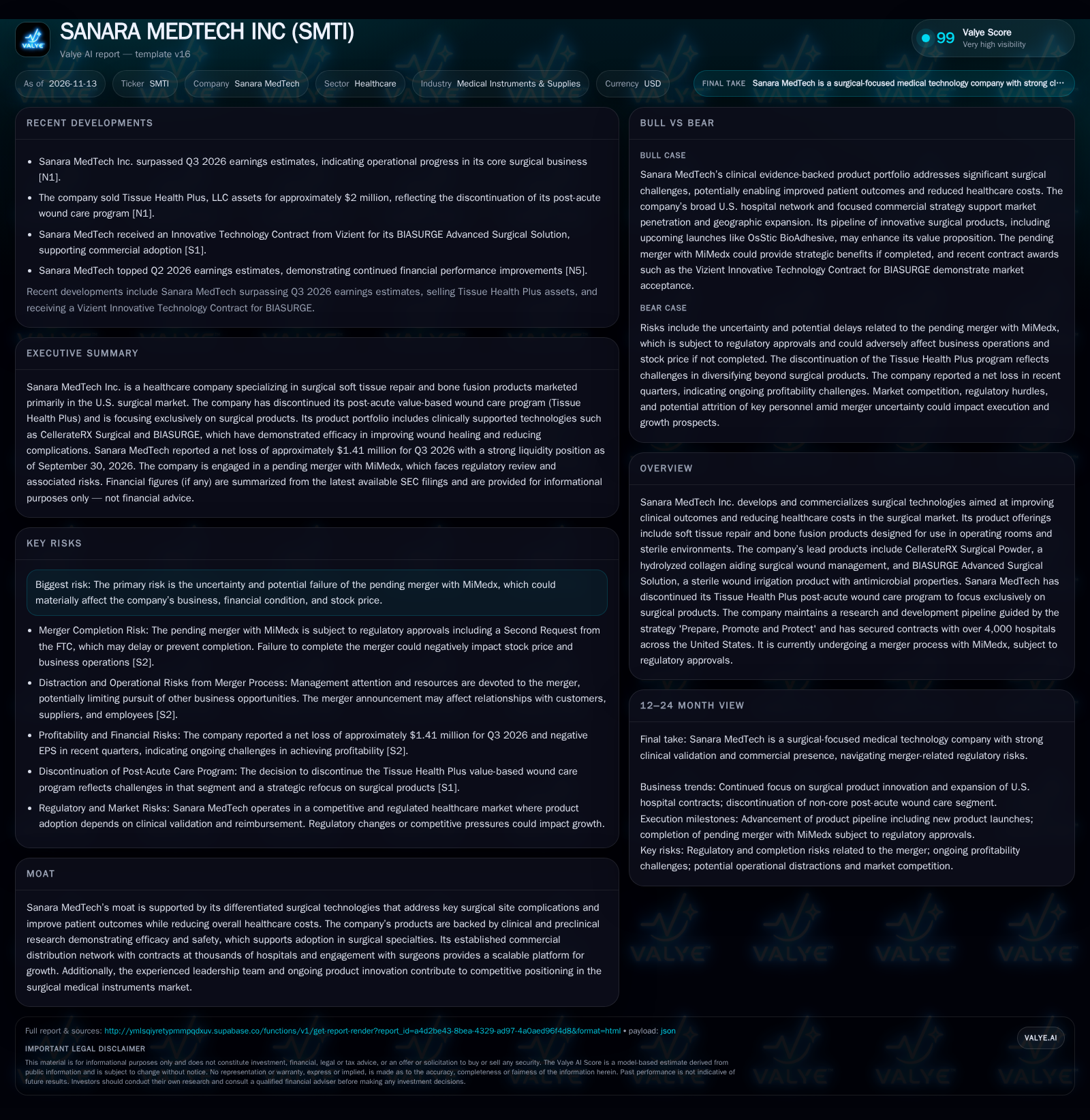
Sanara MedTech has exited its loss-making post-acute wound care business to focus on surgical technologies, securing contracts with over 4,000 U.S. hospitals and receiving recognition for key products like BIASURGE. However, the company faces ongoing net losses, the uncertainty of a major merger with MiMedx, and execution risks tied to regulatory review and operational distractions. Its future may hinge on successful product innovation, deepening market penetration, and the outcome of the merger process.
Sanara MedTech Inc. is undergoing a pivotal transformation, having divested its struggling post-acute wound care operation to double down on its core surgical technology business. The company’s clinically supported product suite, its penetration into thousands of U.S. hospitals, and recent commercial wins underscore its strategic intent. Yet, persistent net losses, the uncertain path of a high-stakes merger with MiMedx, and the operational distractions inherent to such transactions all weigh heavily on the near-term outlook. The coming quarters will test whether Sanara’s focused innovation and commercial execution can overcome structural headwinds and realize the value embedded in its product pipeline.
Strategic Refocus, Merger Uncertainty, and Clinical Validation Define Sanara’s Present
Sanara MedTech has executed a decisive strategic shift by discontinuing its Tissue Health Plus post-acute wound care initiative in mid-September 2025, selling the related assets for approximately $2 million and reclassifying the business as discontinued operations [S1] [N1]. This move signals a commitment to its core strength: surgical soft tissue repair and bone fusion products. The company’s portfolio—including CellerateRX Surgical Powder and BIASURGE Advanced Surgical Solution—has gained traction, with contracts now spanning more than 4,000 U.S. hospitals and a recent Innovative Technology Contract from Vizient for BIASURGE reflecting commercial momentum [S1].
Despite these operational achievements, Sanara continues to report net losses, with a Q3 2026 net income loss of about $1.41 million and cash/equivalents of $16.8 million as of September 30, 2026 [S2]. The company is also navigating a pending merger with MiMedx, which remains subject to regulatory review—including a Second Request from the FTC—and introduces risks ranging from possible delays and management distraction to potential adverse effects on business relationships and retention [S2].
How Sanara’s Surgical Focus Shapes Its Revenue Model and Operating Leverage
Sanara’s core business model revolves around the development and commercialization of proprietary surgical products for tissue repair and bone fusion, targeting hospitals and surgical centers. Revenue generation is likely driven by a mix of product sales—potentially on a per-procedure or supply contract basis—to a large installed base of acute care facilities. The company’s decision to exit the lower-margin, loss-making post-acute wound care segment should help concentrate resources on higher-value surgical offerings, which can command premium pricing when backed by clinical evidence and regulatory endorsements.
The economics of surgical products typically benefit from relatively high gross margins, especially for differentiated, clinically validated technologies. Fixed costs are dominated by R&D, regulatory compliance, and a specialized sales force, while variable costs relate to manufacturing and distribution. The ability to scale across a broad hospital network, as evidenced by contracts with over 4,000 hospitals, may enable operating leverage if sales volumes expand. However, ongoing net losses highlight that current revenues do not yet cover overhead and growth investments, raising questions about the timeline to profitability and the need for continued capital discipline.
The pending merger with MiMedx—if completed—could alter the cost structure, product mix, and revenue base, potentially unlocking synergies but also introducing integration risks and one-time expenses.
Differentiation Anchored in Clinical Evidence Amid Intense Surgical Market Competition
Sanara’s competitive positioning rests on clinically validated products that address critical needs in surgical wound management and bone healing. Peer-reviewed studies supporting CellerateRX Surgical and BIASURGE help differentiate these offerings in a market where surgeons and hospitals demand proven efficacy and safety [S1]. The Vizient Innovative Technology Contract for BIASURGE further signals acceptance by influential hospital purchasing organizations.
However, the U.S. surgical products market is fiercely competitive, with large multinational medical device firms and specialized niche players vying for hospital contracts and surgeon mindshare. Barriers to entry include regulatory approval, clinical validation, and established sales relationships. Sanara’s broad hospital contract base provides a degree of commercial scale, but ongoing innovation, customer engagement, and evidence generation are necessary to defend against competitors introducing newer or more cost-effective solutions.
Switching costs in this industry are moderate: while clinicians may be slow to change established protocols, adoption can accelerate if a product demonstrates superior outcomes or if purchasing groups standardize on a new technology. The discontinuation of the Tissue Health Plus program highlights the challenge of sustaining positions outside the company’s core competency.
Unlocking Value Through Pipeline Execution and a Successful MiMedx Merger
A favorable scenario for Sanara would see the company leveraging its clinical evidence, commercial relationships, and R&D pipeline to drive rapid adoption of its surgical products across existing and new hospital accounts. The launch of next-generation offerings—such as OsStic BioAdhesive or pipeline extensions—could open incremental revenue streams and reinforce the company's value proposition if supported by robust clinical data and favorable reimbursement.
Completion of the MiMedx merger, without significant regulatory or integration delays, could deliver scale, operational synergies, and an expanded product portfolio, potentially accelerating path to profitability. Evidence to confirm this scenario would include sustained revenue growth from the surgical portfolio, successful new product launches, expanding hospital contract coverage, and clear reporting of merger-related synergies post-close.
Falsification would occur if regulatory hurdles indefinitely stall or block the merger, new product launches fail to gain traction, or evidence emerges of deteriorating hospital or surgeon engagement.
Surgical Product Growth Balances Against Persistent Losses and Merger Execution Risks
The most plausible near-term trajectory is a continued focus on core surgical wound and bone fusion products, with incremental gains in hospital penetration and gradual adoption of new pipeline offerings. Revenue growth may be steady but offset by the fixed costs of R&D, regulatory compliance, and a specialized salesforce, keeping net income negative in the absence of a step-change in volume or successful cost rationalization.
The MiMedx merger process is likely to remain a source of uncertainty—potentially closing, but with risk of delay or operational distraction. The discontinuation of the post-acute care business removes a drag on margins but also narrows sources of diversification. Confirmation of this scenario would be stable or modestly improving operating performance, continued clinical data generation, and incremental progress on merger milestones, while falsification would be signaled by a sharp deterioration in financial results, loss of key contracts, or a failed merger outcome.
Merger Breakdown or Execution Missteps Could Compound Financial Strain
A negative outcome for Sanara involves regulatory blockage or significant delay of the MiMedx merger, leading to wasted management bandwidth, disrupted business relationships, and uncertainty among key employees and customers. In this scenario, persistent net losses could force the company to seek additional capital, potentially on unfavorable terms, or trigger cost-cutting that impairs growth initiatives.
Competitive pressure could intensify if rivals launch superior or lower-cost alternatives, eroding Sanara’s market share or forcing price concessions. A failure to successfully launch new products or expand hospital contracts would further undermine the company’s ability to scale and reach profitability. Evidence confirming this scenario would include negative merger news, accelerating cash burn, loss of hospital accounts, legal or regulatory setbacks, or clinical failures in the product pipeline.
Milestones That Will Determine Whether Sanara’s Refocused Strategy Delivers Sustainable Value
Merger progress: Regulatory approvals, Second Request status, and any announced closing or termination of the MiMedx transaction.
Product pipeline milestones: Initiation and outcomes of new clinical trials, regulatory submissions, and commercial launches for next-generation surgical products.
Hospital contract growth: Net change in the number of contracted hospitals and expansion into new surgical specialties or geographic regions, if disclosed.
Revenue and gross margin trends: Quarterly updates on top-line growth and margin expansion as a test of operating leverage and commercial traction.
Cash burn and capital needs: Quarterly cash flow statements and any new financing arrangements, to assess runway and capital discipline.
Surgeon and hospital engagement: Evidence of repeat usage, endorsements, or clinical adoption rates for lead products, if disclosed.
Employee retention and key personnel: Turnover or departures in leadership or critical R&D roles, especially amid merger uncertainty.
Integration planning: Updates on integration strategy and synergy realization if the merger closes.
Disclaimer: This is research-only, informational analysis and not investment advice. It may include AI-generated interpretation and general industry context. Always verify important details using primary sources.

Comments