
Decoy Therapeutics: Navigating Platform Promise and Market Value Pressures in Clinical-Stage Biotech
Decoy Therapeutics is advancing a peptide-conjugate drug platform with early preclinical momentum in antivirals and pan-filovirus candidates, but faces significant financial, regulatory, and commercialization risks as it seeks to transition from R&D-heavy operations to a sustainable business model amid Nasdaq listing uncertainty.
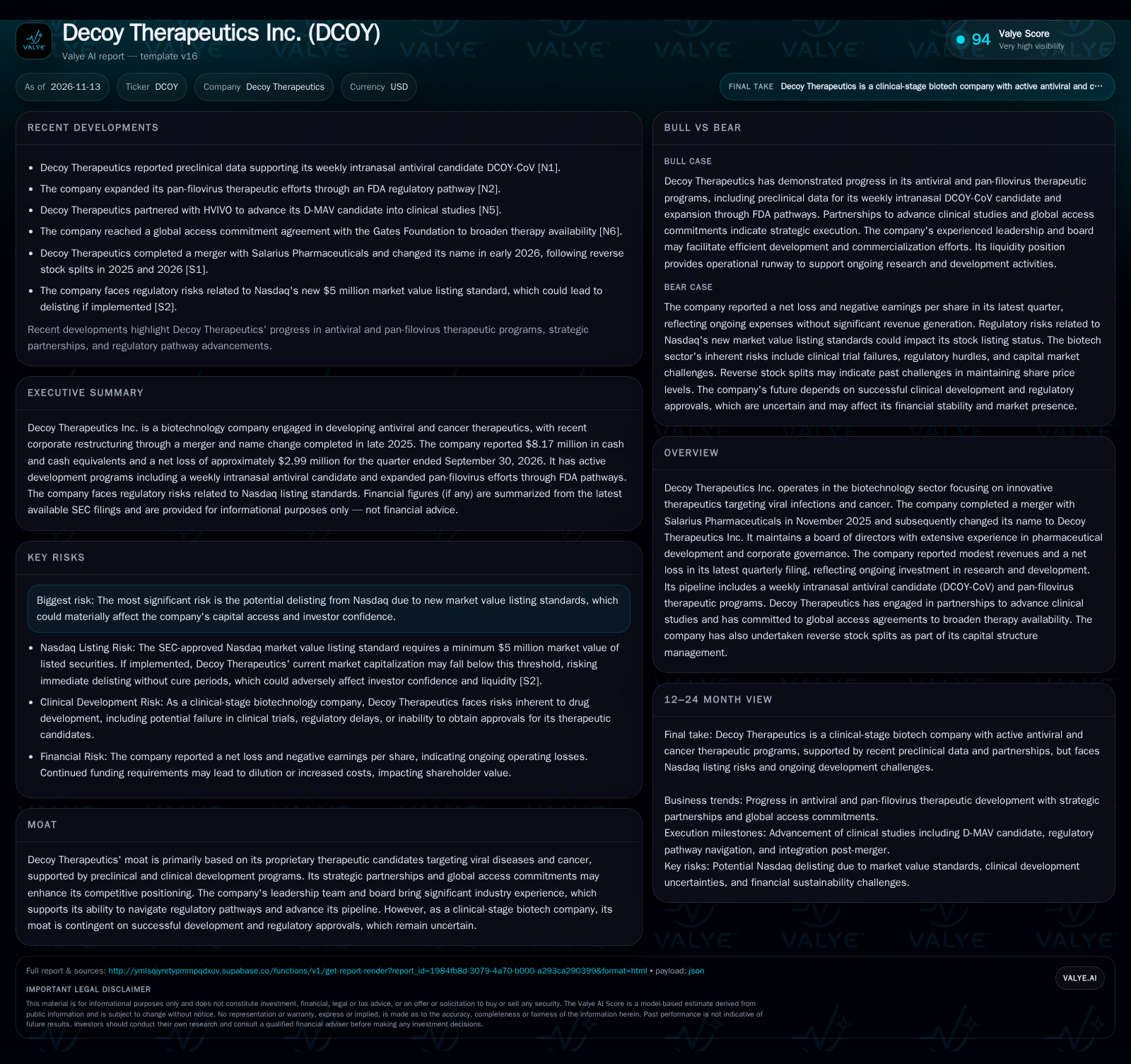
Decoy Therapeutics is a clinical-stage biotech with an AI-driven peptide conjugate platform, early preclinical data for its intranasal antiviral, and a strategic focus on infectious diseases and oncology. [S2] [N1] [N2]
Decoy Therapeutics stands at a critical juncture: armed with an AI-enabled peptide conjugate platform and early-stage pipeline progress, the company is seeking to establish itself in the competitive field of antiviral and oncology therapeutics. This analysis explores the company’s current position, business model mechanics, competitive context, and the scenarios that could define its next chapter.
Recent Pipeline Progress and Financial Snapshot Define the Near-Term Stakes
Decoy Therapeutics’ current profile is shaped by several pivotal developments. The company reported $8.17 million in cash and equivalents as of September 30, 2026, against current liabilities of $4.25 million, yielding a current ratio of 1.97. Quarterly revenues were $307,430, with a net loss of $2.99 million and an EPS of -$3.53, underscoring its status as a pre-commercial, R&D-centric biotech [S2].
On the pipeline front, Decoy has reported preclinical data for its weekly intranasal antiviral candidate, DCOY-CoV, and is expanding its pan-filovirus therapeutic program through the FDA regulatory pathway [N1] [N2].
Strategically, the company executed a merger with Salarius Pharmaceuticals in late 2025 and changed its name to Decoy Therapeutics in early 2026, while also conducting reverse stock splits to maintain compliance with exchange requirements [S1].
A critical external risk is the newly approved Nasdaq continued listing standard requiring a $5 million market value of listed securities. Decoy’s current market cap could fall below this threshold, risking immediate delisting and potential impacts on liquidity, investor confidence, and access to capital [S2].
How the Platform Could Translate R&D Into Commercial Value
Decoy’s economic engine is built around its proprietary IMP³ACT platform, which uses AI and rapid synthesis to generate peptide conjugate drug candidates. The business model typical for clinical-stage biotech involves heavy upfront R&D investment, with the expectation of value inflection on successful clinical progress, regulatory approvals, and subsequent commercialization or out-licensing.
Currently, the company’s revenue is negligible and not from product sales; operating losses are funded by cash reserves and external capital [S2]. If Decoy’s candidates advance to pivotal trials or show strong efficacy/safety signals, the company could monetize its assets through partnerships, licensing agreements, or eventual direct commercialization. In such models, milestone payments and royalties often become the primary revenue streams until direct sales are feasible.
The platform approach—where new peptide conjugate variants can be rapidly designed and synthesized—could enable Decoy to address multiple indications and pivot to emerging threats, theoretically providing scale economies and R&D leverage. However, substantial fixed costs for clinical trials, regulatory filings, and manufacturing scale-up remain, and variable costs only decline meaningfully once a product reaches commercial scale.
Capital requirements will remain high until at least one candidate obtains regulatory approval or a lucrative partnership.
Evaluating Decoy’s Moat: Platform Potential vs. Sector Headwinds
Decoy’s theoretical moat lies in its AI-driven peptide conjugate platform, which aims to accelerate drug discovery and optimize candidate properties more efficiently than traditional methods. The ability to quickly generate and test new variants could provide a speed advantage, especially for rapidly evolving viral threats or niche oncology targets.
However, the competitive landscape is dense: large pharma and established biotech firms are investing heavily in AI-driven drug discovery, peptide engineering, and antiviral pipelines. Many have deeper pockets, broader clinical infrastructure, and established regulatory/commercial expertise.
Switching costs in the pharmaceutical supply chain are low until a candidate reaches clinical or regulatory inflection points; partnerships and collaborations are often non-exclusive, and customer (payer/physician) loyalty is driven by clinical efficacy, safety, pricing, and access rather than platform origin.
Decoy’s collaborative efforts, such as its partnership with HVIVO to advance D-MAV, may help bridge resource gaps and validate its platform externally. However, as a clinical-stage company without approved products, its competitive durability is contingent on successful clinical outcomes and the ability to attract larger partners or acquirers.
What Success Looks Like: Clinical Validation Unlocks Strategic Leverage
In the most favorable scenario, Decoy’s intranasal antiviral or pan-filovirus candidates deliver strong clinical data, leading to a breakthrough therapy designation or accelerated FDA pathway. This could catalyze significant external interest from pharmaceutical partners seeking to bolster antiviral portfolios. A lucrative partnership or out-licensing deal would not only provide non-dilutive funding via upfront payments and milestones but also validate the platform’s versatility.
If the platform demonstrates the ability to generate multiple high-quality candidates across different indications, Decoy could position itself as a partner of choice for both infectious disease and oncology programs, supporting a pipeline of collaboration and licensing agreements.
Evidence confirming this scenario would include positive Phase 1/2 trial results, new partnerships with major pharma or government agencies, and announcements of licensing deals with substantial upfront/milestone payments. A sustained market cap above the $5 million Nasdaq threshold would also signal improved investor confidence and capital access.
Translating Preclinical Promise While Managing Listing and Funding Risk
The most plausible near-term trajectory is one in which Decoy advances one or more candidates into early clinical development, but faces the typical delays, setbacks, and capital challenges of a clinical-stage biotech.
Revenue remains minimal, with continued net losses as R&D and SG&A expenses outpace modest partnership income or grant funding. The company may need to raise additional capital—potentially through dilutive equity offerings or convertible debt—especially if clinical progress is slower than expected or if the Nasdaq market value requirement triggers a delisting.
M&A interest or partnership discussions may provide some optionality, but will likely hinge on the strength and differentiation of early clinical data. The company’s ability to maintain its Nasdaq listing and avoid a forced move to over-the-counter markets will be a critical test of stability and investor confidence.
Confirmation of this scenario would include incremental clinical updates, new or extended partnerships, additional financing rounds, and regulatory progress without clear late-stage clinical breakthroughs.
Failure to Achieve Clinical or Listing Milestones Amplifies Capital Strain
The adverse scenario is characterized by failed or delayed clinical trials, inability to secure new partnerships, and a breach of the Nasdaq $5 million market value requirement. Delisting could significantly impair liquidity, reduce institutional ownership, and limit access to new capital, forcing the company into more dilutive private placements or unfavorable financing terms.
If preclinical or early clinical data fail to differentiate Decoy’s candidates from competitors or reveal safety/efficacy issues, the pipeline may stall, leading to a decline in strategic interest and further erosion of shareholder value.
Confirmation of this scenario would include negative or inconclusive trial results, Nasdaq delisting notices, distressed financing transactions, or a lack of new external partnerships.
Milestones and External Factors That Will Shape Decoy’s Trajectory
Progression of DCOY-CoV and pan-filovirus candidates into and through Phase 1/2 clinical trials, with public disclosure of safety and efficacy data.
Any new strategic partnership, licensing agreement, or government funding that provides non-dilutive capital or validates the platform.
Updates on Nasdaq market value compliance—specifically, whether the company maintains a market capitalization above the $5 million threshold if the new rule is implemented.
Disclosure of additional capital raises, including the terms and dilutive impact of new financings.
Evidence of platform scalability, such as the nomination of new peptide conjugate candidates or expansion into additional infectious disease or oncology indications.
Changes in leadership, board composition, or strategic direction that could affect operational execution or capital allocation.
A useful metric would be the company’s cash runway projection under various clinical development scenarios, if disclosed.
Disclaimer: This is research-only, informational analysis and not investment advice. It may include AI-generated interpretation and general industry context. Always verify important details using primary sources.

Comments