
Park Dental Partners: Dentist-Led Expansion in a Fragmented Dental Services Market
Park Dental Partners leverages a dentist-majority governance model and long-term affiliate contracts to scale its network across the Midwest and Southwest, aiming to balance clinical autonomy with operational efficiency. Recent acquisitions and disciplined expansion underpin steady revenue growth, but the company faces persistent challenges from economic cyclicality, regulatory shifts, and intensifying competition among dental support organizations.
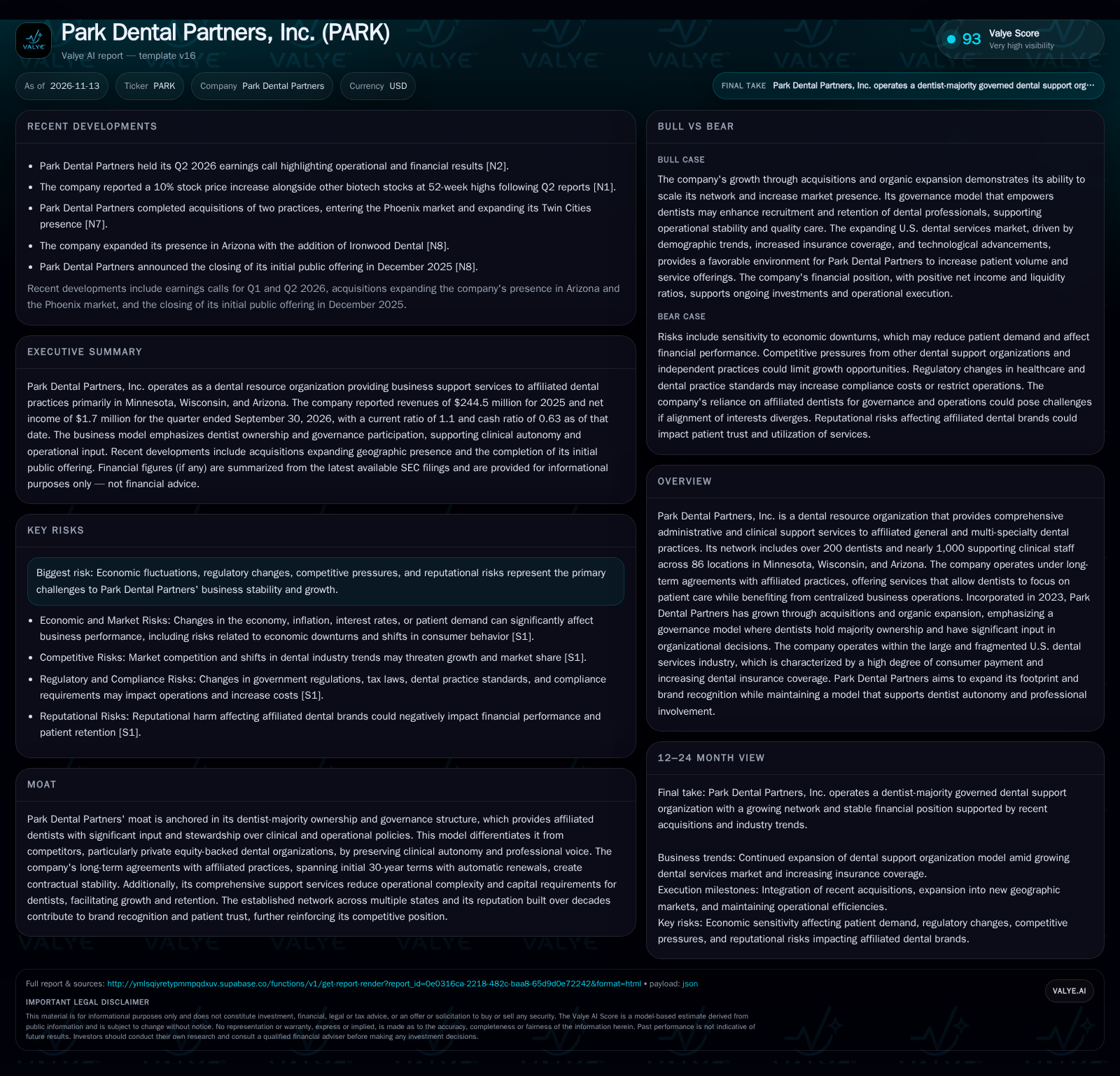
Park Dental Partners operates as a dental resource organization supporting 86 practice locations, reporting $244.5 million in 2025 revenue and recent net income growth. Its dentist-majority governance and 30-year affiliate agreements differentiate its model, supporting expansion into new markets through acquisitions and de novo practices. While the company benefits from industry tailwinds and operational stability, its fortunes remain tied to broader economic conditions, regulatory changes, and the competitive landscape in U.S. dental services. [S1] [S2] [N7] [N8]
Park Dental Partners, Inc. is positioning itself as a dentist-led alternative in the consolidating U.S. dental services industry, supporting over 200 dentists across 86 locations in Minnesota, Wisconsin, and Arizona. The company’s model—anchored by long-term affiliate agreements and a governance structure that prioritizes clinical autonomy—has enabled it to grow both organically and through acquisition, with recent moves into new geographies marking its expansion ambitions. While Park Dental Partners is benefiting from industry growth and stable financials, it must navigate the persistent headwinds of economic cyclicality, evolving regulations, and fierce competition in the dental support sector. [S1] [S2] [N7] [N8]
Recent Acquisitions and Network Growth Shape Park Dental’s Strategic Position
Park Dental Partners reported $244.5 million in revenue for 2025, up from $229.8 million in 2024, and net income of $1.7 million for the third quarter of 2026, signaling ongoing growth and operational profitability. The company now supports 86 practice locations with 214 dentists and nearly 1,000 clinical staff, following the acquisition of two new practices in Phoenix and an expanded presence in the Twin Cities. These acquisitions mark its continued push into new geographies, notably Arizona, and reinforce its dual strategy of acquiring established practices and opening de novo locations. The company reported cash and liquidity metrics for the period; these figures do not by themselves establish operating runway, investment capacity, financial flexibility, or financing capacity. [S1] [S2] [N7] [N8]
Beyond the headline revenue and acquisition activity, a deeper analysis of Park Dental Partners’ growth trajectory requires understanding the integration challenges common in multi-location healthcare models. The company’s ability to standardize operational protocols while preserving the clinical independence of dentists is critical for maintaining quality and efficiency. Additionally, geographic expansion into diverse markets such as the Southwest introduces variability in patient demographics, payer mixes, and competitive dynamics, which may impact practice-level performance and require tailored management approaches. Monitoring the pace at which new acquisitions achieve operational breakeven and contribute positively to consolidated results would provide insight into the scalability of Park Dental’s expansion strategy.
How Park Dental Partners Monetizes Scale and Centralized Support
Park Dental Partners generates revenue by providing comprehensive non-clinical business support—ranging from staffing and scheduling to technology, marketing, and facilities management—to affiliated dental practices. The economic model is built on long-term (30-year initial term, five-year automatic renewal) agreements with affiliated practices, which create contractual stability and revenue visibility. By aggregating administrative functions and purchasing, the company can potentially achieve cost efficiencies, negotiate better supply terms, and improve practice-level margins. Revenue growth may be driven by expanding the number of affiliated dentists, increasing patient volume per site, and broadening the service mix to include specialty dentistry.
The business is capital-intensive at the point of acquisition or new practice launch, with upfront investment in equipment, leasehold improvements, and initial staffing. Once operational, incremental margins may improve as fixed administrative costs are spread across a larger network. However, unlike pure software or digital health models, dental support organizations (DSOs) like Park Dental Partners face ongoing variable costs tied to labor, facilities, and consumables, limiting the degree of operating leverage achievable. Cash generation is also affected by the working capital demands of a multi-location, people-heavy business.
The monetization of scale in dental support organizations hinges not only on cost synergies but also on optimizing revenue streams through enhanced patient throughput and service diversification. Park Dental Partners’ long-term affiliate agreements reduce revenue volatility; however, the extent to which these contracts incorporate performance incentives or revenue-sharing mechanisms could materially affect practice-level economics and motivation. Furthermore, the capital intensity at acquisition underscores the importance of disciplined capital allocation and rigorous due diligence to avoid overpaying for practices with limited growth potential. The network’s ability to leverage centralized data analytics and technology platforms to improve scheduling efficiency, patient retention, and billing accuracy could unlock incremental margin expansion beyond traditional cost savings.
Dentist-Majority Governance as a Differentiator in a Crowded DSO Landscape
Park Dental Partners operates in a fragmented U.S. dental services market where DSOs and independent practices compete for clinical talent, patient loyalty, and local brand equity. The company’s key differentiation is its dentist-majority governance: affiliated dentists hold a majority interest and appoint three directors to the Board, giving them significant influence over operations and clinical standards. This structure may strengthen recruitment and retention by aligning organizational priorities with professional values—contrasting with private equity-backed DSOs, where operational decisions can be more financially driven.
However, the market is highly competitive, with other DSOs aggressively pursuing acquisitions, investing in technology, and leveraging scale to offer better compensation or benefits. Independent practices—while less resourced—can be nimbler or more deeply embedded in their communities. Technology substitution risk is relatively low in dentistry’s core procedures, but telehealth, AI-driven diagnostics, and digital workflows are raising patient expectations and could shift competitive dynamics for administrative efficiency and patient engagement.
The dentist-majority governance model may confer a unique cultural advantage, fostering greater alignment between clinical and administrative stakeholders. However, this structure could also introduce slower decision-making or conflicts if clinical priorities diverge from operational imperatives. In a landscape where DSOs increasingly invest in advanced digital tools and patient engagement platforms, Park Dental Partners’ capacity to integrate technology without alienating its clinical partners will be a key determinant of competitive positioning. Additionally, as consumer expectations evolve towards convenience and transparency, the company’s ability to innovate in patient experience—such as through streamlined appointment scheduling or flexible payment options—may influence its success against both large DSOs and nimble independents.
If Dentist Governance Drives Superior Talent Retention and Expansion
A favorable scenario for Park Dental Partners would see its dentist-majority governance model translating into above-average recruitment and retention of high-quality dental professionals. If the company can continue to add practices—both through acquisition and new openings—while maintaining or improving practice-level economics, its network effect could accelerate.
Evidence that would confirm this upside includes a rising number of affiliated dentists and locations, consistently positive net income, and improved margins as the network grows. Additional proof points would be lower staff turnover compared to peer DSOs (if disclosed), positive patient satisfaction scores, and successful integration of new acquisitions without operational disruption.
Sustained Expansion Amid Economic and Regulatory Crosscurrents
The most plausible trajectory is that Park Dental Partners continues to expand at a moderate pace, balancing acquisitions and de novo practice launches. Revenue and net income may grow in line with the broader dental services market, supported by demographic trends (aging population, rising insurance coverage) and gradual increases in patient volume. The company’s governance model likely remains a recruiting advantage, but competition for talent and patients persists.
This scenario would be confirmed by steady growth in affiliated practices, stable or slightly improving margins, and continued positive net income. Watch for evidence of successful integration of new practices and avoidance of major regulatory or reputational setbacks. If operating costs outpace revenue growth, or if the company struggles to recruit/retain dentists at new sites, the base case could weaken.
Economic Downturn or Regulatory Shift Disrupts Practice Economics
A negative scenario could unfold if a regional or national economic downturn reduces discretionary dental spending, leading to lower patient volumes and revenue shortfalls at affiliated practices. Regulatory changes—such as new compliance requirements or reimbursement cuts—could further compress margins or increase operating complexity. Intensified competition may also drive up costs for recruiting and retaining dentists or force higher marketing spend to maintain patient flow.
Evidence supporting this downside would include declining same-practice revenues, contraction in the network, negative net income, or a need to raise additional capital to fund operations. Rising staff turnover, negative patient feedback, or failure to integrate acquisitions could also signal weakening fundamentals.
Milestones That Will Test Park Dental Partners’ Growth and Resilience
Growth in the number of affiliated dentists and locations—particularly the pace and success of expansion in new markets like Arizona.
Practice-level revenue and margin trends, especially same-practice growth versus acquired or de novo sites (if disclosed).
Dentist and staff retention rates compared to industry benchmarks, which would help assess the effectiveness of the governance model (if disclosed).
Integration timelines and performance of newly acquired practices, including patient retention and operational continuity.
Regulatory or reimbursement developments affecting dental practice economics in core states (Minnesota, Wisconsin, Arizona).
Operating expense growth relative to revenue, as cost inflation could erode margins even amid top-line expansion.
Patient satisfaction and brand reputation metrics, especially in newly entered markets or following acquisitions (if disclosed).
Disclaimer: This is research-only, informational analysis and not investment advice. It may include AI-generated interpretation and general industry context. Always verify important details using primary sources.

Comments