
Franklin Covey’s Profitability Amidst Market Competition
Franklin Covey posted modest profitability for fiscal 2026 and continues to launch new frameworks, but faces short-term liquidity pressures and intense competition. The company’s recurring service model and proprietary content underpin its value proposition, yet execution and potential financial flexibility will be tested as the professional development sector evolves.
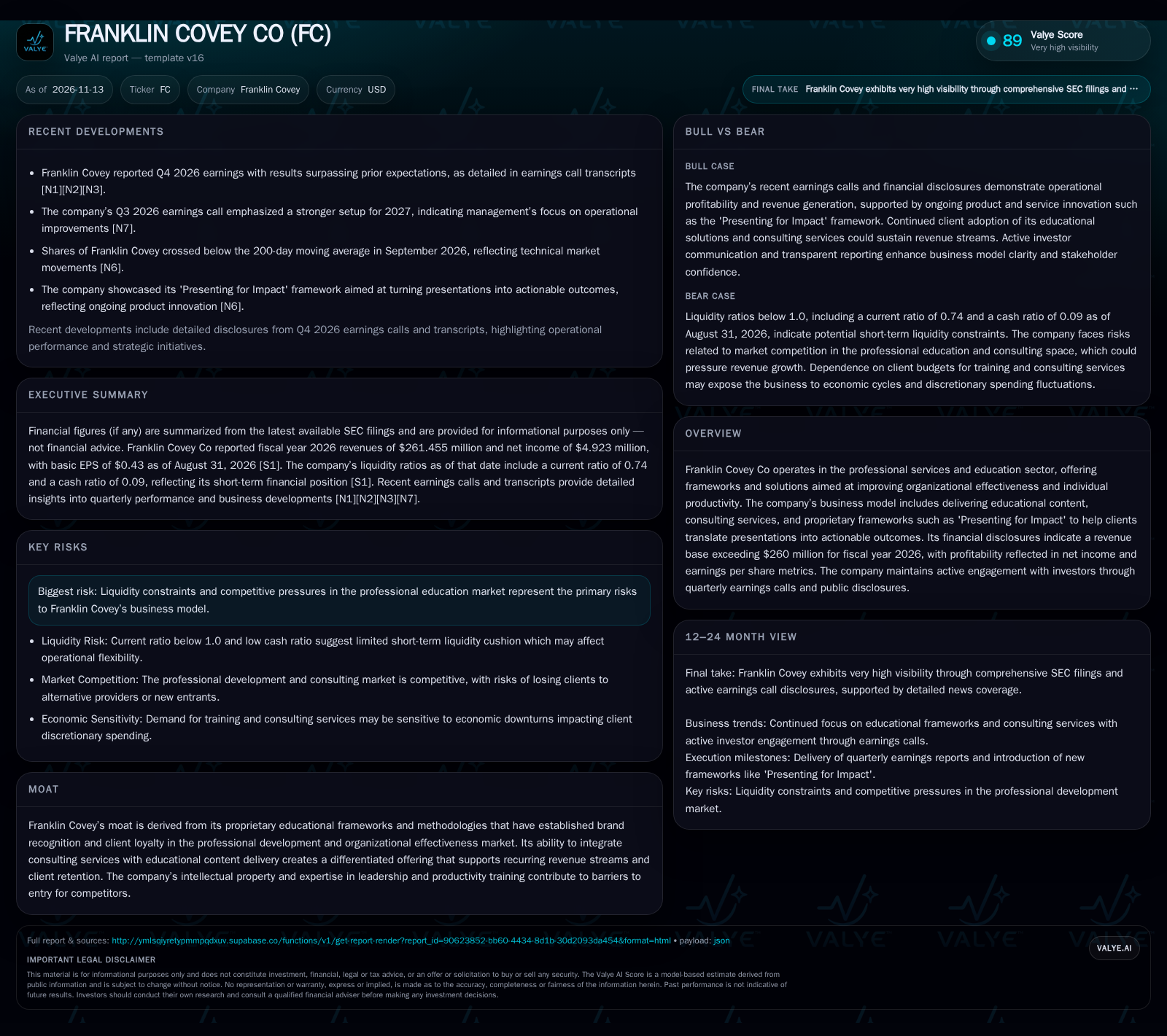
Franklin Covey reported fiscal 2026 revenues of $261.5 million and net income of $4.9 million, showing continued profitability. Ongoing product innovation, such as the 'Presenting for Impact' framework, and active investor communication are positives, but the company remains exposed to economic cycles and aggressive competition in the professional training and consulting arena. Execution on new solutions and improving potential financial flexibility are critical watchpoints for the coming year. [S1] [N1] [N2] [N3] [N6]
Franklin Covey Co enters fiscal 2027 with a profile marked by steady, if modest, profitability and a continued push for product innovation. As Franklin Covey rolls out new frameworks like 'Presenting for Impact' and maintains active investor engagement, its ability to balance operational execution, potential financial flexibility, and competitive differentiation will be central to its trajectory in the evolving professional development market. The interplay between recurring service revenues, proprietary intellectual property, and sector-wide pressures sets the stage for a pivotal year ahead.
Profitability Gains Accompanied by Liquidity Challenges
Franklin Covey reported fiscal 2026 revenues of $261.455 million and net income of $4.923 million, translating to basic and diluted EPS of $0.43 and $0.42, respectively [S1]. These figures confirm that the company remains profitable on a GAAP basis. The company reported cash and liquidity metrics for the period; these figures do not by themselves establish operating runway, investment capacity, financial flexibility, or financing capacity. [S1] This marks a notable short-term liquidity constraint, raising questions about operational flexibility. Meanwhile, recent news coverage and earnings calls indicate robust investor engagement and a focus on new frameworks such as 'Presenting for Impact' [N1] [N2] [N3] [N6]. The interplay between modest profitability, constrained liquidity, and ongoing innovation sets the stage for Franklin Covey’s near-term strategic decisions.
Monetizing Intellectual Property Through Recurring Revenue Models
Franklin Covey’s business model centers on monetizing proprietary educational frameworks and consulting services, targeting organizations seeking to boost productivity and leadership capabilities. Revenue is generated through a blend of in-person and digital content delivery, licensing, and customized consulting engagements. The company’s offerings—including the recently emphasized 'Presenting for Impact' framework—are designed to drive repeat engagement and embed Franklin Covey’s intellectual property within client organizations. This model has the potential to support recurring revenue, especially if clients adopt annual training cycles or multi-year service agreements.
From a cost structure perspective, the company likely faces a mix of fixed costs (content development, platform maintenance, staff) and variable costs (consultant delivery, travel, event logistics). As digital delivery grows, variable costs per client could decline, increasing the potential for operating leverage if revenue expands. However, the need to continually refresh content and maintain a high-quality consulting bench means capital allocation remains important.
Standing Out and Facing Risks in Professional Development
Franklin Covey’s primary competitive advantage comes from its well-established brand, proprietary frameworks, and a legacy of thought leadership in organizational effectiveness. The integration of consulting with content delivery allows the company to position itself as more than just a training provider—potentially fostering deeper client relationships and higher switching costs. However, the professional education and consulting sector is intensely competitive, with a mix of global consultancies, boutique firms, digital learning platforms, and in-house corporate training departments all vying for share.
Digital transformation in the training industry introduces new substitutes and pricing pressures, as clients increasingly expect flexible, scalable, and cost-effective solutions. The proliferation of online learning platforms and modular content delivery could erode Franklin Covey’s pricing power if its offerings are not perceived as uniquely valuable. Furthermore, client budget cycles and discretionary spending on training remain highly sensitive to broader economic conditions, intensifying the risk of contract delays or cancellations during downturns.
Scaling Up Through Framework Innovation and Client Retention
The most favorable outcome for Franklin Covey would be a scenario in which continued innovation—such as the successful adoption of the 'Presenting for Impact' framework—leads to increased client retention, expansion into new accounts, and the signing of multi-year or enterprise-wide agreements. If the company can demonstrate that its new frameworks deliver measurable business outcomes for clients, it may be able to command premium pricing and embed its solutions more deeply across organizations.
Confirmation of this scenario would come from evidence such as an uptick in deferred revenue, disclosures of large contract wins or multi-year agreements (if disclosed), and sustained or accelerating revenue growth despite broader economic headwinds. Additional signals would include improved operating margins, as higher-margin digital delivery scales, and commentary from management regarding pipeline visibility and client renewal rates. Falsification would occur if new frameworks fail to gain traction, or if client churn increases despite product launches.
Managing Growth and Liquidity Under Current Market Conditions
The most likely trajectory for Franklin Covey is continued modest revenue growth with profitability remaining positive, but little near-term relief on liquidity. The company may achieve incremental gains through ongoing product refreshes and deeper client engagement, but competitive pressures and sensitivity to client budget cycles could limit pricing power and volume growth. Operating leverage may be modest unless digital content adoption accelerates or client mix shifts toward larger, recurring contracts.
Confirmation of this outcome would include steady (but not accelerating) revenue and profit growth, continued product innovation, and maintenance of client relationships. However, unless the company is able to improve its working capital position or secure additional financing, liquidity constraints could persist, potentially leading to tighter cost controls or delayed investment in new initiatives. Evidence to the contrary would include a marked improvement in the current ratio, an announced capital raise, or a sudden acceleration in digital revenue streams.
Potential Financial Flexibility Tested by Liquidity Pressures and Competition
The bear case materializes if Franklin Covey’s liquidity constraints intensify, limiting its ability to invest in sales, marketing, or product development at a time when competitors are ramping up their digital offerings. In this scenario, the company could face delayed payments to suppliers, difficulty retaining key talent, or even covenant breaches if debt is present (if disclosed). Heightened competition and economic sensitivity could lead to contract losses, compressed margins, or revenue declines.
Additional warning signs would be layoffs, asset sales, or management commentary signaling belt-tightening and a focus on short-term survival over long-term growth. Recovery would require either a rapid turnaround in cash generation or successful external financing.
Events That May Influence Franklin Covey’s Outlook in 2027
Revenue mix evolution—disclosures around recurring versus one-time project revenue would help clarify business model resilience (if disclosed).
Adoption rates and client retention for new frameworks such as 'Presenting for Impact'—early traction would support the upside scenario [N6].
Operating margin trends—expansion would indicate successful scalability or cost discipline (if disclosed).
Management commentary on pipeline visibility, contract renewal rates, and enterprise agreement wins during earnings calls [N1] [N2] [N3] [N7].
Any announced capital raises, debt refinancing, or working capital initiatives to address liquidity risks (if disclosed).
Competitive responses—news of new entrants, pricing shifts, or major client wins/losses in the professional development sector.
Disclaimer: This is research-only, informational analysis and not investment advice. It may include AI-generated interpretation and general industry context. Always verify important details using primary sources.

Comments