
INNOVATE Corp. After the DBM Global Sale: Portfolio Transition, Liquidity Pressure, and Strategic Uncertainty
Following the divestiture of its principal revenue-generating businesses, INNOVATE Corp. now operates as a holding company with minority investments and a diminished operating base. A sharp shift in income sources, substantial near-term debt, and unresolved preferred obligations define a precarious transition period in which strategic alternatives and liquidity management will determine enterprise value.
Execution of strategic alternatives and management of legacy obligations will be critical to future value creation or preservation. The company's next phase depends on its ability to monetize remaining assets or secure value-accretive deals under challenging capital structure dynamics. [S2]
INNOVATE Corp. stands at a pivotal crossroads after divesting its principal revenue engines—DBM Global and the Spectrum segment—in 2026. This transformation leaves the company as a holding entity with exposure to minority investments, a small Life Sciences operation, and a sharply reduced income base. With substantial debt maturities looming, preferred equity obligations unmet, and cash reserves critically low, the company’s ability to engineer a successful transition hinges on the monetization of illiquid assets, external dealmaking, or a fundamental restructuring. The coming quarters will test whether INNOVATE can stabilize its capital structure or whether financial and operational constraints will erode remaining equity value.
A Company Transformed: Asset Sales, Revenue Loss, and Looming Obligations
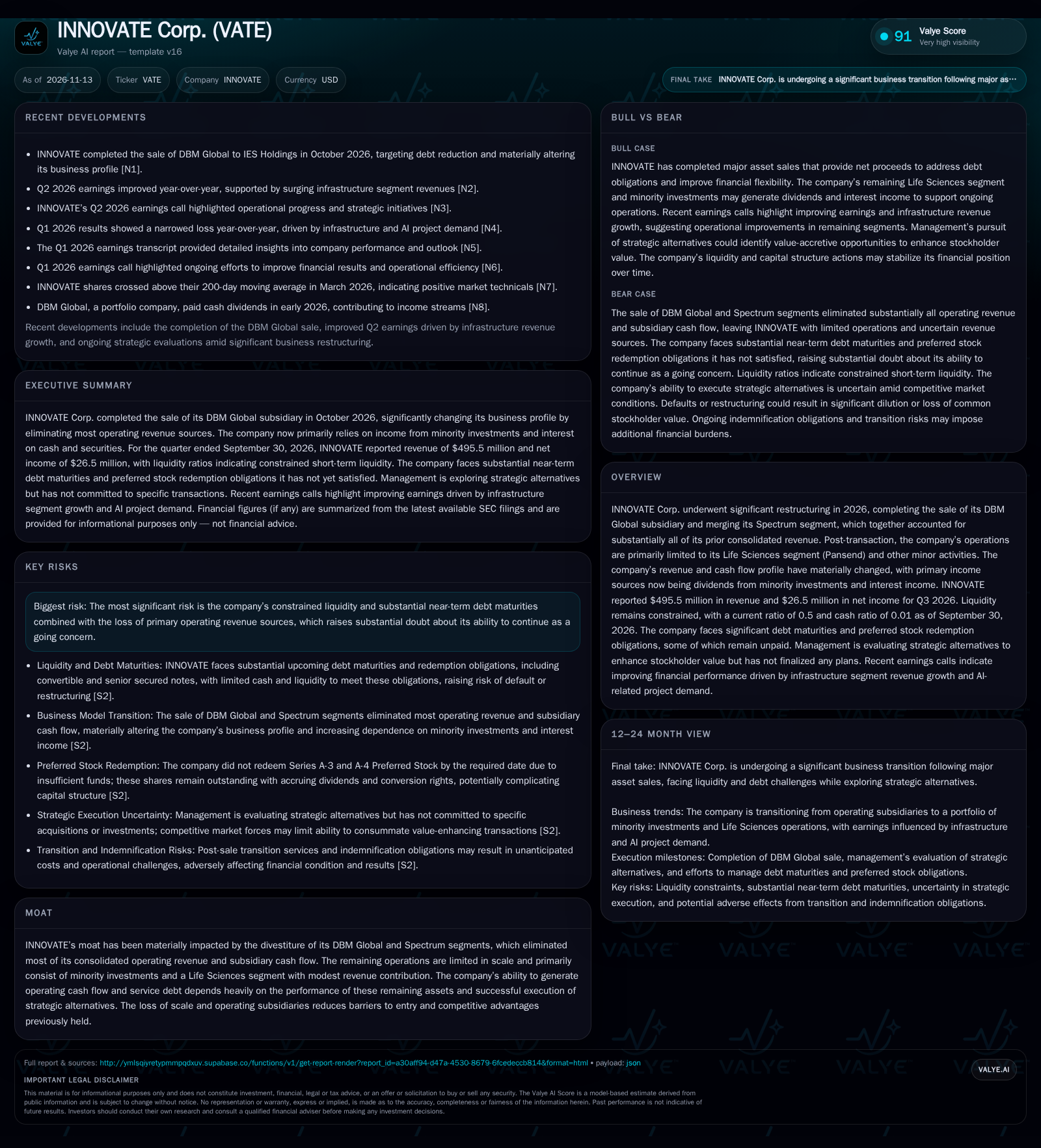
INNOVATE Corp. completed the sale of its DBM Global subsidiary in October 2026 and merged its Spectrum segment, actions that eliminated nearly all of its consolidated operating revenue and cash flow from these businesses. Following these transactions, the company’s primary sources of income are now dividends or distributions from minority investments and interest on marketable securities and cash equivalents. The operating base is reduced mainly to the Life Sciences segment (Pansend) and minor other activities, which together generate only a small fraction of prior revenue. For the quarter ended September 30, 2026, INNOVATE reported $495.5 million in revenue and $26.5 million in net income, but these figures do not reflect the full impact of the asset sales and are not likely to be indicative of future performance. [S2] [N1]
The company’s liquidity is severely constrained: as of September 30, 2026, it reported only $4.9 million in cash and cash equivalents, a current ratio of 0.5, and a cash ratio of 0.01. Substantial debt maturities loom, including $58.9 million in 2027 Convertible Notes and $75.9 million in 10.50% 2027 Senior Secured Notes, as well as preferred stock redemption obligations that remain unpaid past their contractual dates. Management is evaluating strategic alternatives but has not committed to specific investments or asset acquisitions. [S2]
Post-Divestiture Economics: Minority Income, Capital Structure, and Operating Leverage
INNOVATE’s business model has shifted from active, consolidated operating subsidiaries to a holding company reliant on income from minority investments and interest on cash and securities. The sale of DBM Global and the Spectrum merger have removed most recurring operating cash flow, leaving the company dependent on the timing and magnitude of distributions from portfolio holdings—over which it has limited influence—as well as returns on a shrinking pool of cash equivalents.
The remaining Life Sciences segment (Pansend) and limited other activities are unlikely to generate significant positive operating leverage given their modest scale. Fixed corporate costs and interest expenses on outstanding debt now consume a larger share of available cash. The ability to service debt and preferred obligations increasingly depends on asset monetization or external capital, rather than internal cash generation.
The company’s capital structure is highly stressed: with a current ratio of 0.5 and a cash ratio of 0.01 as of September 30, 2026, INNOVATE is exposed to near-term liquidity shortfalls. Significant debt maturities and preferred redemptions require either asset sales, refinancing, or equity dilution. The economics of any new investments or acquisitions will be constrained by these balance sheet realities and by the risk tolerance of counterparties.
Diminished Moat and the Challenge of Portfolio-Only Competition
The divestiture of DBM Global and the Spectrum segment has stripped INNOVATE of its former scale, operating synergies, and market differentiation. The company’s competitive position is now largely defined by its ability to source, structure, and extract value from minority investments—a field where it faces competition from private equity firms, diversified holding companies, and activist investors with deeper pools of capital and specialist expertise.
Without operating scale or a strong proprietary pipeline, INNOVATE’s remaining Life Sciences activities are unlikely to command pricing power or create meaningful switching costs for partners or clients. The loss of consolidated revenue and cash flow also reduces the company’s capacity to act opportunistically in competitive bidding for new investments. Meanwhile, the capital structure stress may further deter attractive counterparties, who may view INNOVATE as a forced seller or a partner with limited staying power.
The company’s ability to maintain or rebuild any durable advantage now depends on its success in dealmaking, its ability to manage transition risks and indemnification exposures, and its capacity to unlock value from illiquid or underperforming holdings before creditors or preferred shareholders capture most of the upside.
Unlocking Value: Monetizing Holdings and Strategic Transactions
A favorable outcome for INNOVATE would require management to successfully monetize minority investments—such as the retained interest in Spectrum or other portfolio holdings—at valuations sufficient to cover near-term debt and preferred obligations. If these asset sales or distributions exceed expectations, the company could repay or refinance its outstanding notes, retire preferred shares, and potentially redeploy remaining capital into new, higher-return investments or share repurchases.
Confirmation of this scenario would include: announcements of portfolio asset sales at attractive multiples, material debt reductions, successful preferred redemptions, or the identification and execution of value-accretive acquisitions. Evidence that would falsify this scenario would include failed asset sales, proceeds below carrying value, or an inability to negotiate refinancing on favorable terms.
Navigating a Prolonged Transition: Income Volatility and Restructuring Risk
The most plausible outcome is that INNOVATE enters a prolonged transition period characterized by volatile and insufficient income from minority investments, ongoing liquidity pressure, and piecemeal attempts to restructure or extend debt and preferred obligations. Asset sales may be required but could occur under distressed conditions, limiting proceeds and potentially impairing equity value.
In this scenario, the company may secure waivers or amendments from creditors to delay defaults, but at the cost of dilution or more onerous terms. Operating income from the Life Sciences segment and investment interest would likely remain insufficient to cover fixed costs and interest expense, necessitating further asset sales or capital raises.
This scenario would be confirmed by disclosures of covenant waivers, distressed asset sales, or ongoing delays in satisfying preferred or debt redemption requirements. It would be falsified if the company were able to quickly and profitably monetize key holdings or secure a transformative transaction that re-establishes a sustainable operating base.
Liquidity Shock and Value Erosion: Default and Forced Restructuring
In the adverse case, INNOVATE’s constrained liquidity and inability to monetize assets in time could trigger defaults or cross-defaults on debt and preferred obligations. Creditors may accelerate repayment, forcing the sale of illiquid holdings at fire-sale prices or leading to an in-court or out-of-court restructuring that wipes out much of the remaining equity value.
Other risks include transition and indemnification costs from the DBM Global and Spectrum transactions, which could drain remaining cash or create contingent liabilities. The company may also face higher vendor costs, loss of key personnel, or operational dis-synergies as a result of losing its former scale and integrated operations.
Evidence confirming this scenario would include formal default notices, failed attempts at refinancing or asset sales, or announcements of restructuring advisors being engaged. Conversely, avoidance of default and the ability to meet obligations through asset monetization or new capital would falsify the worst-case scenario.
Milestones That Will Clarify INNOVATE’s Transition and Value Prospects
Announcement and terms of any asset sales, particularly the monetization of minority interests such as the retained Spectrum stake or other portfolio holdings.
Disclosure of new or amended credit agreements, waivers, or extensions on 2027 Convertible Notes and Senior Secured Notes.
Progress toward redemption or restructuring of Series A-3 and A-4 Preferred Stock, including any changes to accrued dividends or conversion rights.
Cash flow and earnings contributions from the Life Sciences segment (Pansend), if disclosed, to assess the viability of remaining operations.
Actual distributions or dividends received from minority investments, and their sufficiency relative to fixed obligations.
Any guidance or updates on management’s pursuit of strategic alternatives, including announced acquisitions, mergers, or liquidation plans.
Material changes in working capital, contingent liabilities, or transition/indemnification costs related to recent asset sales.
Board or management changes that may indicate a shift in strategy or approach to restructuring or asset monetization.
Disclaimer: This is research-only, informational analysis and not investment advice. It may include AI-generated interpretation and general industry context. Always verify important details using primary sources.

Comments