
Scribe Therapeutics: Early Clinical Progress, Capital Strength, and the Realities of High-Stakes Gene Editing
Scribe Therapeutics enters the public markets with reported liquidity position, early clinical development in cardiometabolic gene editing, and notable institutional backing. The company’s future now hinges on clinical proof-of-concept, regulatory navigation, and the scalability of its proprietary CRISPR platforms.
Scribe Therapeutics (SCTX) has completed its IPO, secured a strategic partnership with Sanofi, and maintains reported liquidity position with $172 million in cash and $7 million in short-term investments as of September 2026. The company’s lead asset, STX-1150, is in a Phase 1 trial targeting LDL-C reduction via epigenetic gene silencing for cardiovascular disease.Insider transaction activity was reported in the cited source; this activity does not by itself establish insider confidence.
Scribe Therapeutics has emerged from its July 2026 IPO with a fortified balance sheet, a strategic industry partnership, and growing institutional interest—signals of market confidence in its proprietary CRISPR-based gene editing platforms. With its lead candidate now in early clinical trials targeting the large and underserved market of atherosclerotic cardiovascular disease, Scribe’s trajectory will be determined by its ability to translate preclinical promise into clinical and commercial reality.
IPO Proceeds, Strategic Partnerships, and Early Clinical Momentum Define the Current State
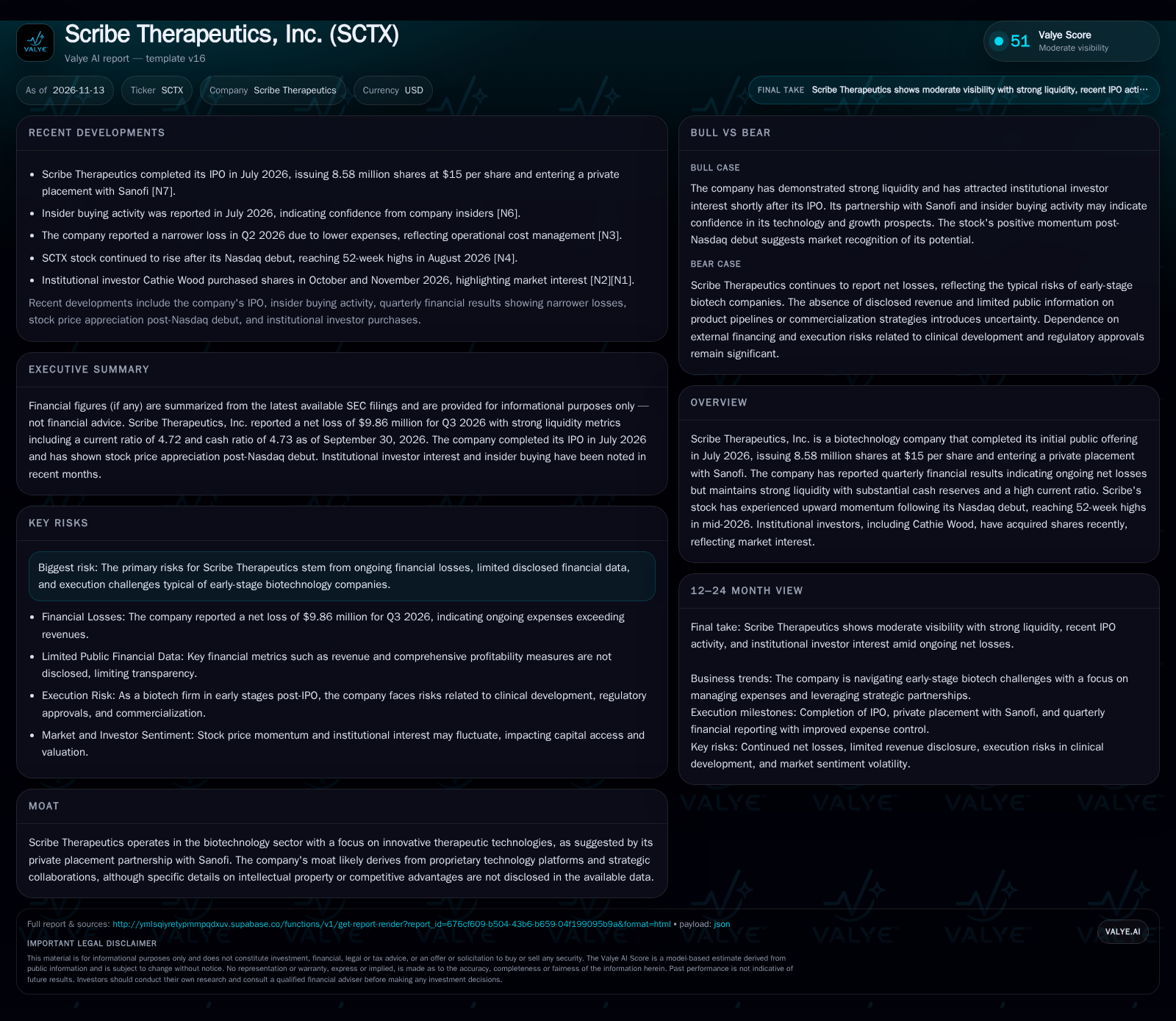
Scribe Therapeutics completed its IPO in July 2026, issuing 8.58 million shares at $15 per share, and entered a private placement with Sanofi—moves that not only fortified its cash position but also signaled industry validation for its technology platform [N7]. As of September 30, 2026, the company reported $172.05 million in cash and $7.42 million in short-term investments, resulting in a current ratio of 4.72 and a cash ratio of 4.73 [S1]. The company reported cash and liquidity metrics for the period; these figures do not by themselves establish operating runway, investment capacity, financial flexibility, or financing capacity. Scribe’s lead candidate, STX-1150, is in a Phase 1 clinical trial for LDL-C lowering in adults at risk for cardiovascular disease, with initial data anticipated in the first half of 2027. Despite ongoing net losses—$9.86 million for Q3 2026—the company has attracted institutional investors and seen insider buying since the IPO, underlining external confidence in its prospects [N6].
Gene Editing Economics: Capital Intensity, Long Timelines, and the Promise of Durable Therapies
Scribe Therapeutics operates as a clinical-stage biotechnology company with no disclosed revenue, reflecting the archetype of early-stage gene editing ventures. The economic model in this space is characterized by high upfront R&D and regulatory costs, long development cycles, and binary outcomes linked to clinical trial success or failure. The company’s cash burn—evidenced by a $9.86 million net loss in the most recent quarter—will likely remain substantial as it advances its pipeline [S1].
If Scribe’s therapies advance successfully, the commercial opportunity could be significant: single-administration genetic medicines targeting chronic diseases can command premium pricing and may be eligible for value-based reimbursement models, especially if they demonstrate durable efficacy and reduced lifetime healthcare costs. However, the initial addressable market is contingent on regulatory approval, safety profile, and payer acceptance. Fixed costs are high during clinical and early commercial stages, but successful therapies could exhibit operating leverage as manufacturing and distribution are scaled. The capital requirements remain substantial, and future fundraising may be necessary if clinical development timelines extend or if additional programs are accelerated.
The capital intensity of gene editing ventures like Scribe is further compounded by the necessity to invest in scalable manufacturing processes early in development. Given the complexity of CRISPR-based therapies, establishing robust, reproducible production methods that meet regulatory standards is critical yet costly. This requirement introduces an additional layer of financial risk, as manufacturing scale-up must be carefully timed to align with clinical validation to avoid premature expenditure. Moreover, the economics of gene editing therapeutics are influenced by reimbursement landscapes that remain nascent and uncertain; payers may require compelling long-term outcome data to justify premium pricing, which can delay revenue realization and affect valuation.
Another economic consideration is the potential for platform versatility to drive pipeline expansion and diversify risk. If Scribe’s proprietary ELXR and XE platforms can be adapted efficiently to multiple indications, the company may achieve economies of scope that improve capital efficiency over time. However, this advantage depends on the platforms’ modularity and regulatory acceptability across different therapeutic areas, which can vary significantly. Additionally, the company’s reliance on single-administration durable effects means that post-market surveillance and long-term safety monitoring will be essential, potentially increasing ongoing operational costs and influencing payer and physician adoption.
Proprietary Platforms and Strategic Collaborations: Assessing Scribe’s Position in a Rapidly Evolving Field
Scribe’s competitive position is anchored in its proprietary ELXR (epigenetic silencing) and XE (precision editing) platforms, which aim to address limitations of first-generation CRISPR systems—specifically, the risks of permanent DNA modifications and the challenge of achieving durable, single-dose effects. The company’s focus on cardiometabolic indications like LDL-C and Lp(a) lowering places it in competition with both established pharmaceutical approaches (e.g., statins, PCSK9 inhibitors) and emerging gene-editing biotechs targeting similar pathways.
The private placement with Sanofi adds strategic heft, potentially offering access to development resources, regulatory expertise, and future commercialization channels [N7]. However, Scribe faces formidable competition from other CRISPR-focused companies, large-cap pharma with established cardiovascular franchises, and newer entrants leveraging alternative gene-editing platforms. Barriers to entry include intellectual property, clinical trial know-how, and the ability to navigate regulatory scrutiny. Scribe’s differentiation will depend on demonstrating superior safety, durability, and efficacy in its clinical programs.
Scribe’s competitive landscape is shaped not only by direct gene editing rivals but also by the evolving regulatory environment that governs genome modification technologies. Regulatory agencies are increasingly scrutinizing off-target effects, immunogenicity, and long-term safety, which raises the bar for clinical data and may extend development timelines. In this context, Scribe’s emphasis on epigenetic silencing as opposed to permanent DNA edits could confer a regulatory advantage if it demonstrates a more favorable safety profile. However, this also introduces scientific risk related to the durability and reversibility of therapeutic effects, which competitors employing alternative editing mechanisms may address differently.
Strategic collaborations, such as the one with Sanofi, can be a double-edged sword. While they provide access to resources and expertise that can accelerate development and commercialization, they may also impose constraints on decision-making and profit sharing. The success of such partnerships depends on alignment of interests, clear governance structures, and effective integration of capabilities. Furthermore, as the gene editing field matures, larger pharmaceutical companies may pursue similar alliances or acquisitions, intensifying competition for high-potential platforms and potentially impacting Scribe’s bargaining power and valuation.
Clinical Proof and Partnership Leverage Could Accelerate Scribe’s Ascent
A favorable scenario for Scribe would see its lead program, STX-1150, deliver positive safety and efficacy data in its ongoing Phase 1 trial, validating the ELXR platform’s ability to achieve durable LDL-C lowering without permanent DNA modification. This clinical proof-of-concept could catalyze further industry partnerships, non-dilutive funding, and potentially rapid progression into later-stage trials. If the company can leverage its Sanofi relationship into broader co-development or commercialization agreements, it could mitigate commercial execution risk and accelerate market entry.
Evidence that would confirm this upside includes robust LDL-C reductions with a strong safety profile in initial clinical readouts, expansion of the Sanofi partnership, and additional strategic collaborations or licensing deals. Upward stock momentum and further institutional buying would likely follow successful clinical milestones.
Advancing Through Early Clinical Stages While Managing Cost and Execution Risk
The most plausible path for Scribe is steady advancement through early clinical development, with incremental data from STX-1150’s Phase 1 trial informing the likelihood of future success. Operating expenses will likely remain elevated, and the company may need to prioritize its pipeline to conserve capital.
Confirmation of this scenario would be continued expense control, timely achievement of clinical milestones, and transparent updates on pipeline progress. Falsification would come from unexpected safety signals, delays in clinical readouts, or unexpectedly high cash burn that accelerates the need for further financing.
Clinical Setbacks or Regulatory Barriers Could Jeopardize Scribe’s Trajectory
The principal risk to Scribe is clinical failure—either safety concerns or lack of efficacy for STX-1150 or its other pipeline assets. Such setbacks could erode investor confidence, limit access to future capital, and force the company to curtail development or seek strategic alternatives. Regulatory delays or adverse feedback (e.g., clinical holds, additional data requirements) could also prolong timelines and increase cash burn.
Downside confirmation would include negative or inconclusive Phase 1 data, announcement of clinical holds, or a sharp increase in quarterly net losses without offsetting progress. A deterioration in stock price momentum and waning institutional interest would likely follow such developments.
Milestones and Metrics That Will Shape Scribe’s Investment Thesis
Initial clinical data from the Phase 1 trial of STX-1150, especially LDL-C reduction and safety outcomes.
Updates on the scope and depth of the Sanofi partnership, including any expansion into co-development or commercialization.
Cash burn rate and quarterly net loss trends, which will determine the company’s financial runway and fundraising needs, if disclosed.
Progress on pipeline candidates STX-1200 and STX-1400, including preclinical data and plans for clinical entry.
Intellectual property developments, such as new patents or legal challenges, which could impact long-term defensibility.
Any additional insider or institutional buying activity, which may signal shifting market sentiment.
Regulatory feedback or milestones, such as IND submissions, clinical hold notices, or breakthrough designations, if disclosed.
Disclaimer: This is research-only, informational analysis and not investment advice. It may include AI-generated interpretation and general industry context. Always verify important details using primary sources.

Comments