
Crown Crafts: Licensing Reliance, Retail Concentration, and the Sourcing Dilemma in Infant Products
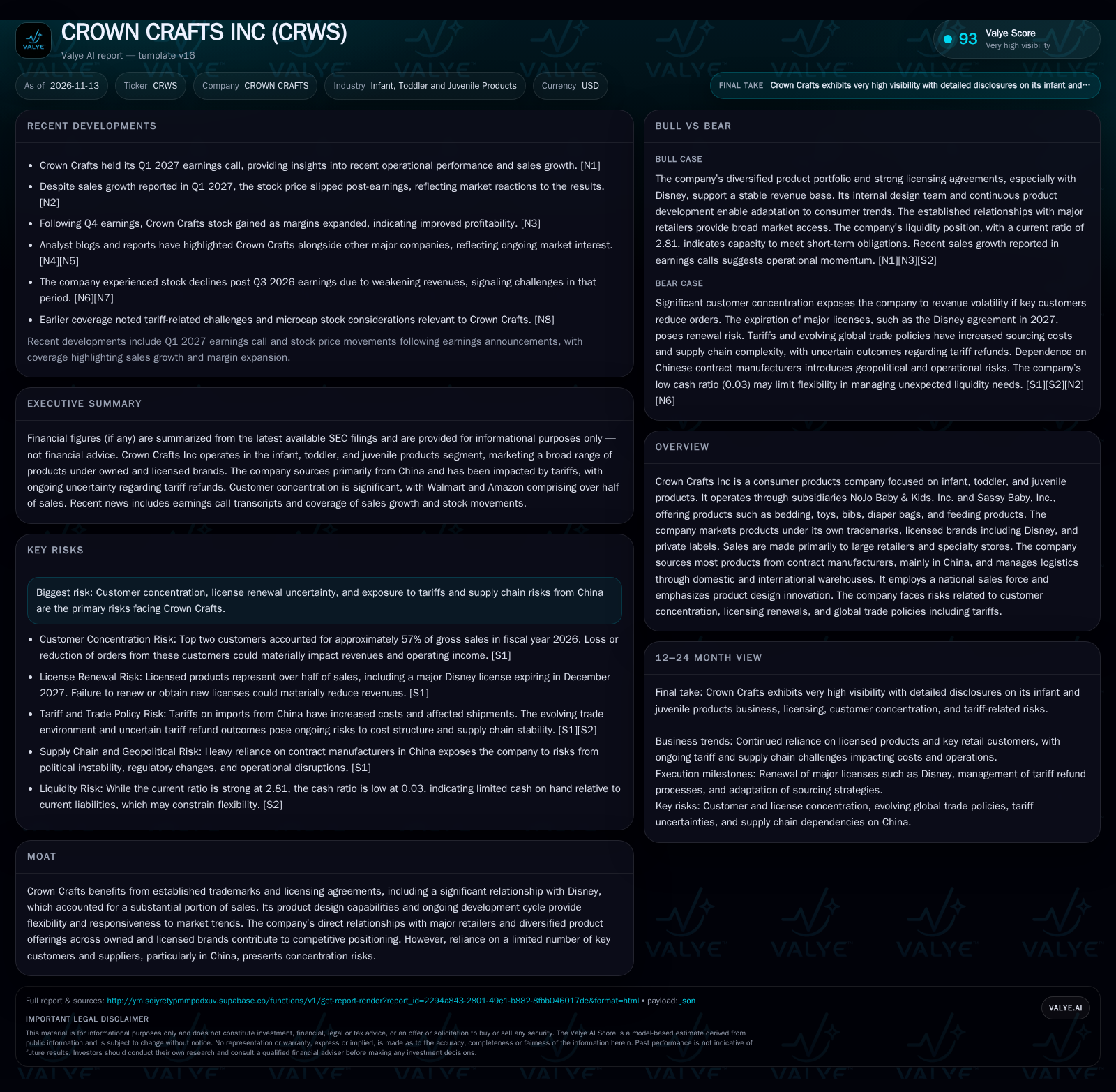
With over half its sales tied to licensed brands and 57% of revenue concentrated in Walmart and Amazon, Crown Crafts’ future hinges on license renewals, retailer relationships, and tariff-exposed sourcing from China. The company’s design agility and broad product range provide adaptation levers, but customer and supplier concentration risks shape both upside and downside scenarios.
Crown Crafts’ dependence on Disney licensing and its two largest retail partners defines its risk and opportunity profile. The next 12-24 months will be shaped by licensing negotiations, sourcing strategy adaptation, and the ability to deepen retailer relationships or diversify customer exposure. [S1] [S2]
Crown Crafts Inc. sits at the intersection of licensing leverage, retail consolidation, and global supply chain risk in the infant and juvenile products sector. The company’s financial and operational footing is shaped by its dependence on a handful of key retail partners—most notably Walmart and Amazon—and its heavy use of licensed brands, with Disney alone constituting a significant revenue stream set for renewal in 2027. While product development and design agility offer some insulation, the company’s reliance on Chinese sourcing leaves it vulnerable to tariff and geopolitical shocks. The coming quarters will test whether Crown Crafts can mitigate these concentration risks through strategic license management, customer diversification, and supply chain adaptation. [S1] [S2]
Recent Performance: Concentration, Licensing, and Sourcing Pressures
Crown Crafts’ latest disclosures reveal several critical facts: Walmart and Amazon together accounted for 57% of gross sales in fiscal 2026, underscoring acute customer concentration risk. Licensed products comprised 52% of gross sales, with 23% coming from a Disney agreement set to expire at the end of 2027. Most products are sourced from Chinese contract manufacturers, and the company is navigating the uncertainty of tariff refund requests after a Supreme Court ruling. These facts frame the company’s near-term outlook and strategic vulnerability. [S1] [S2]
How Crown Crafts Generates Profits—and Where Margin Pressure Lurks
Crown Crafts’ economics are driven by the design, sourcing, and distribution of branded and licensed infant and juvenile products, with revenue realized through direct sales to major retailers and specialty stores. Gross margin is highly sensitive to input costs—primarily determined by contract manufacturing (mainly in China) and by the royalty structure of licensing agreements. The company’s fixed cost base is moderate, as most production is outsourced, but warehousing and logistics (domestic and international) add semi-fixed overhead.
Operating leverage is present but not extreme: incremental volume gains at major retailers can drive margin expansion, as seen in recent quarters, but sales declines (such as Q3 2026) can quickly erode profitability. The mix of owned versus licensed brands, and private label versus branded sales, impacts both gross margin and pricing power. The business is capital-light in manufacturing, but working capital needs can fluctuate with inventory cycles and retailer payment terms. [S2]
Renewal terms for major licenses (especially Disney) and the company’s ability to pass through tariff-driven cost increases will shape future margin resilience. If licensing royalties rise or major licenses are not renewed, the company’s economics could shift quickly toward lower margin, commoditized offerings.
Brand Portfolio Strengths versus Retailer and Supplier Dependency
Crown Crafts’ competitive position is anchored by its portfolio of company-owned and licensed brands, including Sassy®, Manhattan Toy®, NoJo®, and prominent licenses such as Disney. These brands provide shelf presence and consumer recognition but also tether the company’s fortunes to the licensing ecosystem. The ability to secure and renew high-visibility licenses, and to refresh product lines through internal design, offers some insulation from pure price competition.
However, the company’s reliance on two retail giants—Walmart and Amazon—limits its bargaining power and exposes it to the strategic whims of those partners. In an environment where mass merchants increasingly favor private label or push for lower supplier margins, Crown Crafts’ negotiating position is inherently fragile. Competitor categories include other branded infant goods suppliers, private label manufacturers, and direct-to-consumer startups targeting millennial parents with digital-first offerings.
On the supply side, heavy dependence on Chinese contract manufacturers introduces cost and continuity risks not easily mitigated by brand strength alone. While the company operates representative offices in China to manage quality and logistics, its exposure to tariffs and geopolitical instability remains a critical vulnerability.
What a Successful License Renewal and Retailer Deepening Could Unlock
In a favorable scenario, Crown Crafts successfully renews its Disney license on comparable or improved terms, maintaining its access to a high-margin, high-velocity product line that underpins over a fifth of total sales. The company leverages its internal design capabilities to secure additional licenses or develop proprietary brands that gain incremental shelf space at key retailers, reducing dependency on any single license or customer.
If tariff refunds are received and used to offset input costs, near-term margin improvement could fund further product innovation or selective marketing investment. Deepened relationships with Walmart and Amazon—potentially through exclusive offerings or retailer-driven product development—could yield greater volume and improved slotting, driving scale benefits.
Confirmation of this scenario would come from announcements of major license renewals, evidence of new retailer agreements or expanded shelf presence, and improved gross margins alongside stable or rising revenue. Conversely, failure to renew Disney or a retrenchment by Walmart or Amazon would falsify the upside thesis. [S1] [S2]
Managing Concentration While Navigating Sourcing and Licensing Headwinds
The most plausible trajectory is one of cautious management of existing risks: Crown Crafts maintains its core licenses (perhaps with less favorable economics) and retains its shelf space at Walmart and Amazon, but growth remains modest and margins are pressured by ongoing tariff exposure and competitive retailer dynamics. The company continues to rely on Chinese sourcing, making incremental adjustments to mitigate cost increases but unable to fully diversify supply chains due to scale and cost constraints.
Product design initiatives sustain relevance, but neither new licenses nor owned brands fully offset the expiration or downgrading of existing agreements. Confirmation would come from stable revenue, modestly fluctuating margins, and continued customer and license concentration in financial reporting. Evidence of meaningful diversification away from top customers or suppliers would challenge this scenario. [S1] [S2]
If License Loss or Retailer Retrenchment Triggers Revenue Compression
The adverse scenario unfolds if Crown Crafts loses its Disney license or fails to replace it with a comparably powerful brand, leading to an immediate and substantial hit to both revenue and gross margins. If Walmart or Amazon reduce order volumes—whether due to competitive pressure, a strategic shift to private label, or supply chain disruptions—the company’s top-line could contract rapidly.
If tariff refund requests are denied and further trade barriers emerge, input costs could spike, compressing already thin margins and straining working capital.
Evidence confirming the downside would include the non-renewal of major licenses, declining shelf presence or order volumes from key retailers, and a marked deterioration in gross margin or liquidity metrics. Resilience would require either rapid customer diversification or a pivot to owned brands—neither of which is easily executed given current dependencies. [S1] [S2]
Milestones That Will Shape Crown Crafts’ Resilience and Growth Options
Renewal or renegotiation outcome of the Disney license, with terms and duration disclosed.
Changes in the concentration of revenue from Walmart and Amazon—either further consolidation or evidence of diversification.
Gross margin trends, particularly in relation to tariff refunds, input cost inflation, or shifts in licensing mix.
Any disclosure of new major licensing agreements or the launch of successful proprietary brands.
Updates on sourcing strategy—such as diversification away from China or new manufacturing partners.
Cash flow from operations and changes in working capital, especially as they relate to inventory cycles and retailer payment terms.
Resolution and financial impact of tariff refund requests and ongoing trade policy developments.
Turnover or expansion within the sales force, which could signal a push for new retailer relationships or channels.
Disclaimer: This is research-only, informational analysis and not investment advice. It may include AI-generated interpretation and general industry context. Always verify important details using primary sources.

Comments