
Codexis at an Inflection Point: RNA Manufacturing Ambitions, Liquidity, and Execution Risk
Codexis is leveraging its proprietary enzyme engineering platforms to address the growing demand for RNA therapeutics manufacturing.
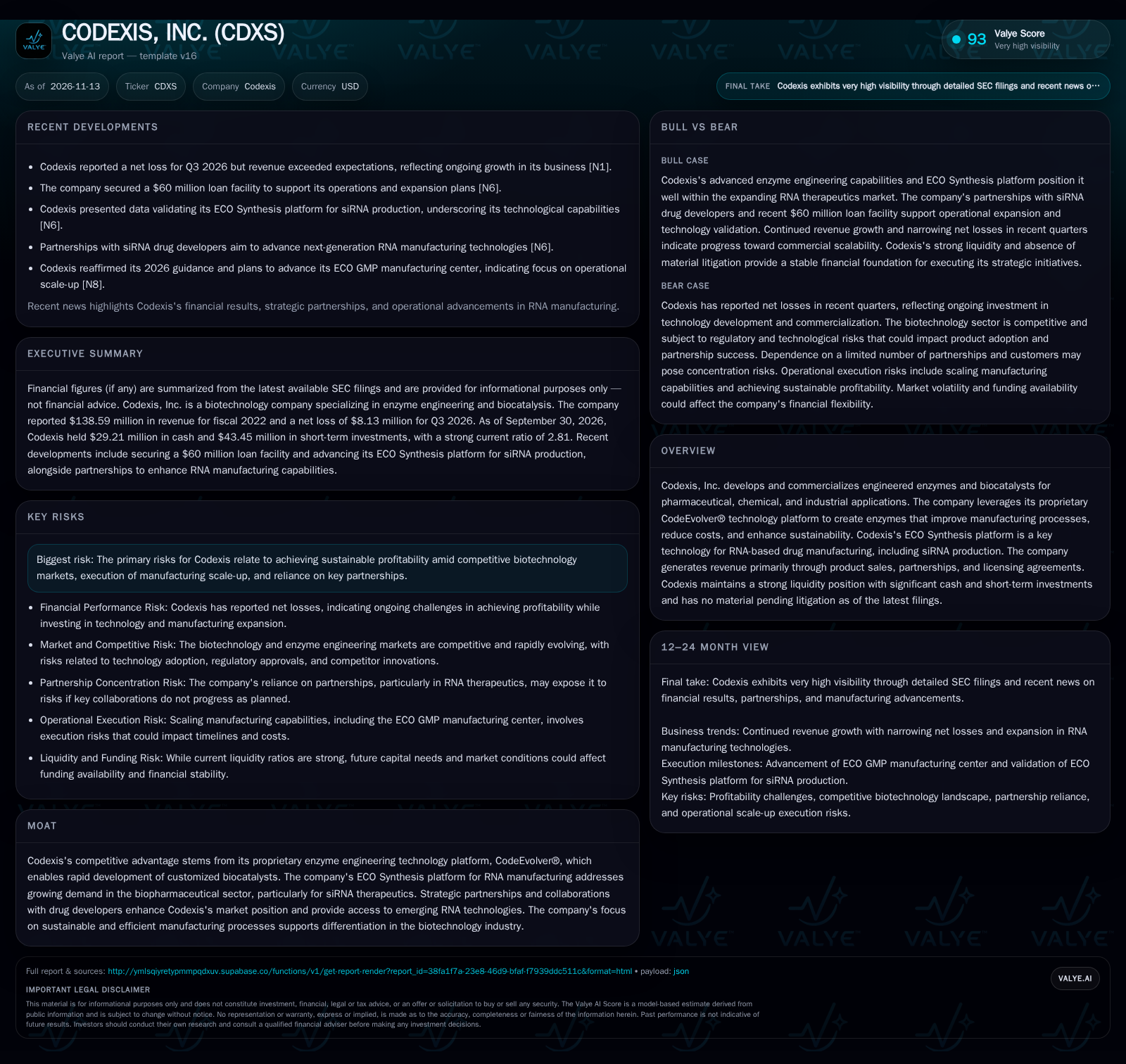
Codexis is advancing its enzyme engineering and RNA manufacturing platforms, supported by reported liquidity position and a new $60 million loan facility. Recent partnerships and progress in siRNA capabilities underscore market relevance, but sustained net losses and execution risks highlight the need for commercial scale and operational discipline. The company's ability to convert technological validation and partnerships into recurring, high-margin revenue will determine its trajectory in the competitive biotech landscape. [S2] [N6] [N8]
Codexis, Inc. stands at a strategic juncture in 2026, leveraging proprietary enzyme engineering to target the rapidly expanding RNA therapeutics manufacturing market. With over $72 million in liquid assets and a new $60 million loan facility, the company has bolstered its financial resources to scale its ECO Synthesis and ECO GMP platforms. However, persistent net losses and the operational demands of scaling advanced manufacturing highlight a classic biotech tension: can Codexis convert technical promise and partnerships into sustainable, high-margin revenue before competitive and execution risks erode its advantage? The next phase will test not only its technology but also its commercial discipline.
Recent Financials and Strategic Moves Set the Stage for Codexis’s Next Phase
As of September 30, 2026, Codexis reported $29.21 million in cash and $43.45 million in short-term investments, giving it $72.66 million in liquid assets and a current ratio of 2.81. The company posted a net loss of $8.13 million in Q3 2026, with basic and diluted EPS of -$0.08 per share, reflecting ongoing investment in technology and commercialization. Codexis’s recent focus has been on advancing its ECO Synthesis platform for siRNA production and operationalizing its ECO GMP manufacturing center, aiming to establish itself as a key enabler in next-generation RNA manufacturing. These developments, coupled with new partnerships with siRNA drug developers, position Codexis for potential growth, but also heighten the importance of execution and commercial adoption in the coming quarters. [S2] [N6] [N8]
Revenue Streams, Cost Structure, and the Scale-Up Challenge
Codexis’s business model is anchored in three main revenue streams: product sales of engineered enzymes and biocatalysts, licensing of its CodeEvolver® technology, and collaborative partnerships—particularly in pharmaceuticals and RNA therapeutics. Historically, revenue is driven by a mix of upfront licensing fees, milestone payments, and recurring product sales to partners. The company’s cost structure includes significant R&D expenditure, manufacturing scale-up costs, and commercial development expenses, all of which have contributed to ongoing net losses as Codexis invests ahead of revenue.
The economics of enzyme and RNA manufacturing platforms like ECO Synthesis are highly sensitive to volume and mix. Once commercial scale and process validation are achieved, the marginal cost of producing additional enzyme batches tends to decrease, potentially driving operating leverage. However, fixed costs—especially for GMP-compliant manufacturing facilities and specialized personnel—remain high until utilization ramps. The $60 million loan facility signals a continued need for external capital to bridge the gap between R&D-heavy early phases and commercial profitability. The key economic question is whether Codexis can convert partnerships and technical validation into multi-year, high-margin product sales and licensing streams before competitive or market risks materialize.
Positioning in the Enzyme Engineering and RNA Manufacturing Ecosystem
Codexis’s competitive position is built on its proprietary CodeEvolver® platform, enabling rapid and targeted enzyme engineering for pharmaceutical and industrial processes. This technology differentiation, especially as applied to the ECO Synthesis platform for RNA manufacturing, is a potential moat—if it translates into superior process economics, partner retention, and adoption rates.
The competitive landscape includes other enzyme engineering firms, contract development and manufacturing organizations (CDMOs), and in-house pharmaceutical manufacturing teams developing their own biocatalysis capabilities. Barriers to entry include the complexity of protein engineering, customer switching costs (due to process integration), and regulatory hurdles for GMP manufacturing. However, the sector is marked by rapid innovation and the risk that competitors could introduce alternative enzyme solutions, improved RNA synthesis chemistries, or vertically integrated offerings. Codexis’s reliance on partnerships with siRNA drug developers is a double-edged sword: it provides access to growing markets but exposes the company to concentration and execution risk if partners delay, switch technologies, or scale in-house.
Unlocking High-Margin Growth Through Platform Adoption and Manufacturing Scale
In a favorable scenario, Codexis’s ECO Synthesis and ECO GMP platforms become the preferred solutions for siRNA and broader RNA therapeutic manufacturing. Successful validation with key partners leads to multi-year, recurring licensing and product sales agreements, with increasing volumes as the RNA therapeutics market expands. As manufacturing utilization rises, fixed costs are leveraged, margins expand, and cash flow turns positive.
Evidence that would confirm this scenario includes the announcement of long-term commercial supply agreements, disclosure of multi-year licensing contracts, and material increases in recurring revenue reported across multiple quarters. Additional signals would be positive partner commentary about process performance, regulatory approvals for drugs manufactured using Codexis enzymes, and a sustained trend of narrowing net losses or positive operating cash flow. Conversely, delays in partner commercialization, lack of recurring revenue growth, or continued reliance on external financing would falsify this upside path.
Sustained Investment, Gradual Revenue Uptick, and Execution-Driven Volatility
The most plausible near-term outcome is that Codexis continues to invest heavily in scaling its manufacturing and refining its RNA platform, while revenue growth is gradual and lumpy, tied to partnership milestones and technology validation. Profitability remains elusive as the company absorbs fixed costs and R&D expenses ahead of full commercial adoption.
This scenario would be confirmed by ongoing net losses, intermittent milestone revenue, and periodic drawdowns on the loan facility to fund operations and capital projects. Evidence of incremental progress—such as new partnerships, successful pilot runs at the ECO GMP center, and consistent reaffirmation of guidance—would support this middle path. However, any sign of partnership attrition, major regulatory or technical setbacks, or a need for additional dilutive financing would suggest downside pressure.
Commercial Delays and Competitive Displacement Threaten Financial Viability
In the adverse scenario, Codexis faces delays in partner commercialization or fails to convert technical validation into sustained product sales or licensing revenue. Increased competitive intensity or technological shifts in RNA manufacturing could erode demand for Codexis’s platforms, while fixed manufacturing costs and R&D expenditures continue to weigh on the bottom line. If the loan facility proves insufficient to cover ongoing losses, the company could be forced into additional dilutive fundraising or cost-cutting measures that further constrain growth.
Confirmation of this scenario would include missed partnership milestones, declining or stagnant revenue, widening net losses, and management signaling concerns about runway or funding needs. Loss of key partnerships or public disclosures of customer defections would further substantiate downside risk. The absence of new licensing deals or recurring supply contracts, combined with rising competitive announcements, would suggest structural challenges to Codexis’s business model.
Signals That Will Determine Codexis’s Trajectory in RNA Manufacturing and Enzyme Commercialization
Quarterly trends in recurring revenue from product sales and licensing agreements—especially growth attributable to the ECO Synthesis and RNA-related partnerships—would help test the commercial adoption thesis.
Public disclosure of long-term commercial supply or licensing contracts, including explicit multi-year commitments, would indicate successful partner conversion and improved revenue visibility.
Utilization rates and operational milestones for the ECO GMP manufacturing center, if disclosed, would provide insight into manufacturing scale-up and fixed-cost leverage.
Progress on regulatory approvals or commercial launches of partner drugs manufactured using Codexis enzymes would validate the platform’s relevance and stickiness.
Announcements regarding new partnerships, customer wins, or expansions with existing partners would indicate market traction and diversification beyond current relationships.
Any disclosure of partnership attrition, technology adoption delays, or competitive wins/losses would help falsify or confirm the durability of Codexis’s market position.
A useful metric would be the breakdown between milestone, licensing, and recurring product revenue, to assess revenue quality and sustainability.
Disclaimer: This is research-only, informational analysis and not investment advice. It may include AI-generated interpretation and general industry context. Always verify important details using primary sources.

Comments