
ImmuCell’s Cattle Health Strategy: Operational Leverage, Sales Expansion, and Scaling Niche Strengths
ImmuCell’s recent profitability and double-digit sales growth highlight its operational progress in the cattle health market. However, execution risks in manufacturing refits, a concentrated product portfolio, and sensitivity to market sentiment may shape the company’s ability to sustain momentum and defend its niche.
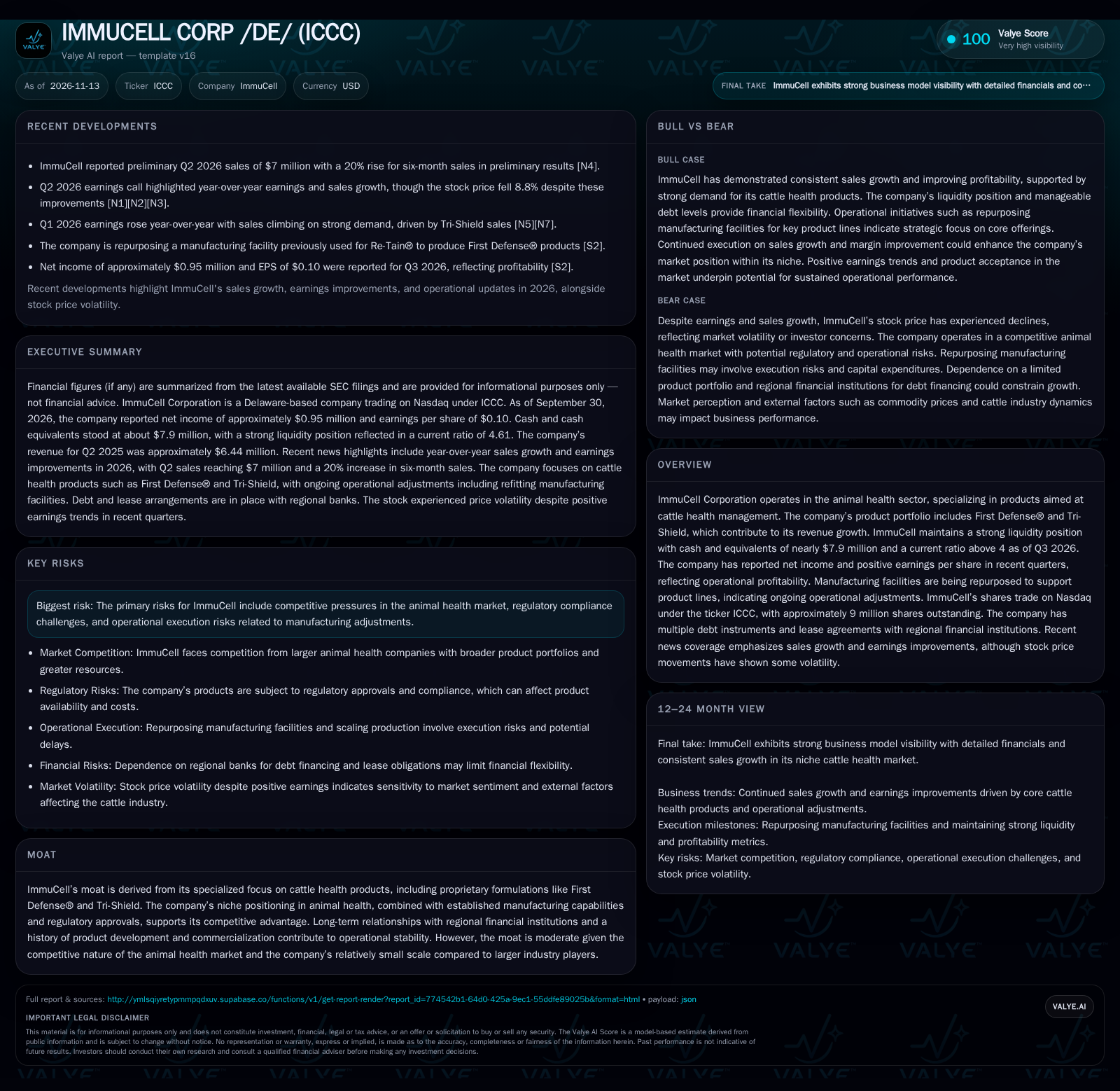
ImmuCell has demonstrated profitable operations, with Q3 2026 net income and reported liquidity position, driven by strong demand for its First Defense® and Tri-Shield cattle health products. Sales growth has been notable, but execution risks from facility repurposing and a limited product lineup remain. The company’s challenge will be to extend its niche advantage while managing operational complexity and market volatility. [S2] [N4] [N5] [N1]
ImmuCell has entered late 2026 with clear operational improvements, reporting both profitability and a reported liquidity position cushion. Its core cattle health products, First Defense® and Tri-Shield, have supported double-digit sales growth, even as the company undertakes a significant facility repurposing to concentrate on its most proven offerings. While this strategy could amplify operating leverage and reinforce ImmuCell’s niche, a narrow product focus and persistent market volatility remain core challenges. The coming quarters will test whether the company can translate its recent gains into durable, scalable advantage in the competitive animal health landscape.
Profitability Gains and Sales Growth Reflect Operational Momentum
ImmuCell reported net income of $952,510 for Q3 2026, with basic and diluted earnings per share of $0.10, marking a period of profitability after prior years of narrower margins and net losses. The company’s cash and cash equivalents totaled $7.9 million as of September 30, 2026, supporting a current ratio of 4.61 and a cash ratio of 1.9, signaling a reported liquidity position. Preliminary Q2 2026 sales reached $7 million, and six-month sales increased by 20% year-over-year, driven by demand for Tri-Shield and First Defense®. Despite these financial improvements, ImmuCell’s stock price declined 8.8% following its Q2 earnings call, reflecting investor caution or skepticism about sustainability or future growth. [S2] [N4] [N1] [N5]
Financial Impact of ImmuCell’s Product Mix and Manufacturing Adjustments
ImmuCell’s core business revolves around proprietary cattle health products, notably First Defense® and Tri-Shield, which are positioned as preventive solutions for bovine diseases. The economics of these products likely benefit from premium pricing relative to generic alternatives, especially if clinical efficacy and regulatory approvals support differentiation. Volume growth, as evidenced by recent sales increases, can drive operating leverage in a manufacturing-heavy model, where fixed plant and equipment costs are amortized over higher unit output.
The company’s decision to repurpose an idle facility—previously used for Re-Tain®—to expand First Defense® production suggests a capital-efficient pivot toward higher-demand lines. However, the costs and execution risks of such a refit (including downtime, regulatory re-approval, or ramp-up inefficiencies) could temporarily pressure margins or cash flows.
ImmuCell’s funding model includes debt arrangements and lease obligations with regional banks, which may carry moderate interest costs but also impose repayment discipline. The company’s current liquidity appears sufficient for near-term needs, but further scaling or product diversification could eventually require new investment or external funding. Overall, ImmuCell’s business model is characterized by moderate fixed costs, potential for operating leverage with sales growth, and a product mix concentrated in a specific segment of animal health.
Niche Defense: Strengths and Boundaries in Cattle Health Focus
ImmuCell’s competitive position is anchored in its specialized focus on cattle health, particularly through proprietary offerings such as First Defense® and Tri-Shield. This specialization may create a moderate moat, as regulatory approvals, established distribution networks, and veterinary relationships can deter new entrants and build customer loyalty. The company’s manufacturing capabilities and track record of product development contribute to its credibility in a market where efficacy and safety are critical.
However, ImmuCell operates in a landscape dominated by larger animal health companies with broader portfolios and global reach. These competitors can leverage economies of scale, more extensive salesforces, and greater R&D budgets to challenge niche players. Substitution risk exists if alternative prevention or treatment options (including generics or new biotechnologies) gain traction or if cattle producers consolidate purchasing with larger suppliers.
While ImmuCell’s niche focus offers some insulation, its relatively small scale and concentrated product lineup limit its bargaining power and could expose it to volatility if demand for core products fluctuates. Strategic partnerships, successful new product launches, or expansion into adjacent segments could help reinforce its competitive position.
Potential Growth from Sustained Profitability and Scaling Efforts
If ImmuCell successfully completes its facility refit and ramps up First Defense® production without major delays or cost overruns, the company could capture further sales growth and margin expansion. The underlying driver would be continued strong demand for its core products, supported by effective distribution and customer retention among cattle producers and veterinarians. Additional upside could come from new product extensions or geographic expansion, particularly if regulatory approvals are secured efficiently.
Confirmation of this scenario would include several consecutive quarters of rising sales and earnings, improving gross and operating margins, and stable or growing market share within its target segment. Evidence of successful facility utilization—such as higher throughput, lower per-unit costs, and minimal operational disruptions—would further validate the company’s ability to scale. Announcements of new distribution partnerships or meaningful product pipeline progress would strengthen the case for longer-term growth.
Market Realities Temper Operational Advances in Base Outlook
The most likely scenario is that ImmuCell maintains moderate sales growth and periodic profitability, driven by ongoing demand for First Defense® and Tri-Shield. The facility repurposing is completed with manageable disruption, but incremental gains in profitability may be tempered by rising input costs, competitive pricing pressure, or regulatory hurdles. The company continues to serve its core cattle health customer base while exploring, but not immediately realizing, significant diversification or expansion.
This scenario would be confirmed by steady quarterly revenue and earnings, with gross margins fluctuating within a stable range. Absence of major product recalls or regulatory setbacks, coupled with continued liquidity above key thresholds, would support this outlook. However, persistent stock price volatility or muted investor response to positive results would indicate ongoing market skepticism and the need for further proof of durable advantage.
Risks from Execution and Customer Concentration Could Undermine Progress
A negative scenario could unfold if the manufacturing facility repurposing faces significant delays, cost overruns, or regulatory complications, leading to supply disruptions or margin compression. Simultaneously, increased competition or a shift in cattle health management practices could erode demand for ImmuCell’s flagship products. The company’s limited product diversification would exacerbate this vulnerability, as any setback in First Defense® or Tri-Shield would have an outsize impact on financial performance.
Downside confirmation would come from declining or stagnant sales, contracting margins, or a return to net losses. Negative cash flow from operations or the need to raise dilutive capital would signal further stress. Regulatory actions, such as product holds or adverse findings, or a loss of key customer relationships, would also validate this scenario. Prolonged stock price declines, especially if accompanied by negative analyst commentary or reduced trading liquidity, would reinforce concerns about long-term viability.
Milestones and External Factors Influencing ImmuCell’s Future Path
Quarterly sales growth rate for First Defense® and Tri-Shield—especially year-over-year comparisons—would help test whether demand momentum is sustainable or waning.
Gross and operating margin trends, particularly through and after the facility repurposing, would clarify the impact of operational adjustments and scale.
Facility utilization rates and time-to-completion for the Re-Tain® to First Defense® conversion (if disclosed) would provide early warning of execution risk or upside.
Customer concentration and retention levels—e.g., the percentage of revenue from top accounts or repeat buyers—would reveal vulnerability to churn or pricing pressure (if disclosed).
Regulatory developments, including any new approvals, compliance findings, or manufacturing site inspections, could alter both risk and growth profiles.
Product pipeline progress, especially announcements of new product candidates or expanded indications, would indicate potential for longer-term diversification.
Stock price and trading volume response to earnings releases and operational updates may signal shifts in market perception or latent investor concerns.
Disclaimer: This is research-only, informational analysis and not investment advice. It may include AI-generated interpretation and general industry context. Always verify important details using primary sources.

Comments