
VolitionRx: Clinical Progress and Commercial Ambitions Constrained by Liquidity and Market Realities
VolitionRx’s blood-based diagnostics platform demonstrates compelling clinical potential, but the company’s reported liquidity position, persistent net losses, and challenging market environment pose significant hurdles to commercial success.
VolitionRx has made clinical strides with its Nu.Q and Capture-Seq diagnostic technologies, including validation in sepsis and early-stage cancer detection. While reimbursement submissions and strategic partnerships may eventually drive adoption, near-term potential financial flexibility is highly limited, making operational execution and external financing critical to the company’s future.
VolitionRx stands at a critical juncture: its proprietary blood-based diagnostic platforms have achieved notable clinical milestones, including high detection rates for early-stage cancers and validated biomarkers for sepsis. Yet the company’s commercial ambitions are sharply limited by acute liquidity pressures, with current liabilities vastly exceeding assets and ongoing net losses. As VolitionRx seeks regulatory and reimbursement breakthroughs to unlock market adoption, the immediate challenge is securing the potential financial flexibility to survive and scale in a fiercely competitive diagnostics arena.
Liquidity Squeeze Meets Clinical Milestones: The 2026 Snapshot
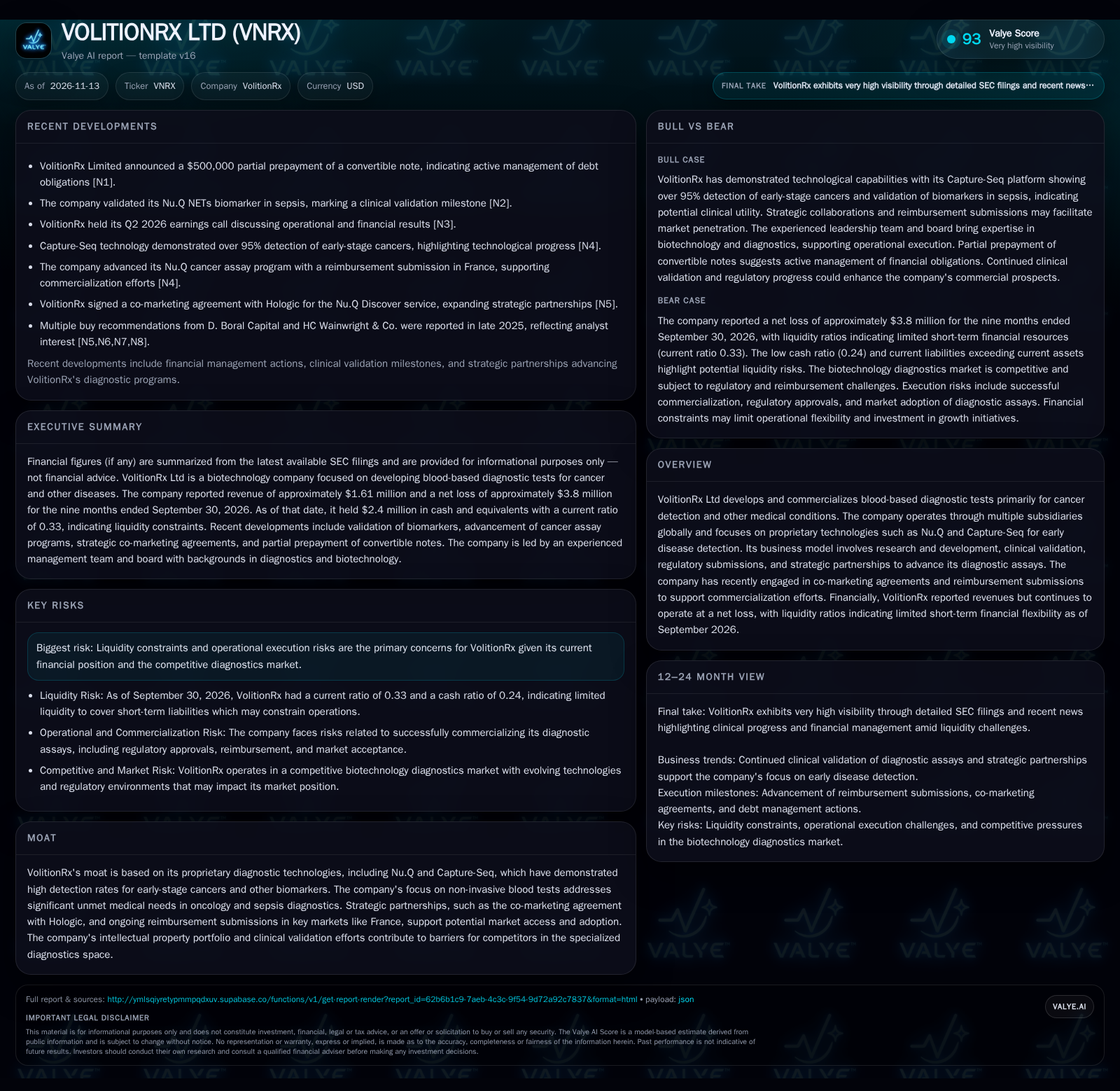
VolitionRx reported approximately $1.61 million in revenue and a net loss of $3.8 million for the nine months ended September 30, 2026. At the same date, the company held $2.4 million in cash and equivalents, with current assets of $3.23 million versus current liabilities of $9.89 million—resulting in a current ratio of 0.33 and a cash ratio of 0.24 [S2]. This acute liquidity imbalance raises immediate operational and financing questions.
Despite these pressures, VolitionRx achieved notable technical progress: its Capture-Seq platform demonstrated over 95% detection of early-stage cancers, while the Nu.Q NETs biomarker was validated in sepsis. The company also advanced its cancer assay program with a reimbursement submission in France.
A $500,000 partial prepayment of a convertible note signals some active debt management, but the scale of liabilities relative to cash remains problematic [N1].
The acute liquidity imbalance not only pressures near-term operational continuity but also constrains strategic flexibility. In such scenarios, companies often face trade-offs between accelerating commercialization efforts to generate revenue and conserving cash to extend runway. For VolitionRx, prioritizing clinical validation and regulatory submissions may delay revenue generation but is essential to unlocking reimbursement pathways that underpin sustainable commercial models. Conversely, aggressive commercialization without reimbursement can lead to inefficient capital deployment and limited market penetration, exacerbating financial strain. This tension highlights the critical importance of timing and sequencing in capital allocation decisions under liquidity stress.
How VolitionRx’s Model Could Capture Value—If Commercialization Takes Hold
VolitionRx’s core economic model centers on the development, clinical validation, and commercialization of proprietary diagnostics, primarily through its Nu.Q and Capture-Seq platforms. These are blood-based assays aimed at early detection of cancer and other diseases—a high-value segment if clinical efficacy translates into regulatory approval and market adoption.
Revenues to date remain modest relative to R&D and operational costs. The company’s $1.61 million in revenue for the first nine months of 2026 is dwarfed by its net loss, reflecting the typical biotech pattern of high fixed R&D and regulatory costs ahead of commercial inflection. If reimbursement approvals are secured, revenue could shift toward higher-margin recurring streams, particularly if the tests are adopted for broad screening or clinical monitoring.
Capital intensity remains high, with ongoing investment required for clinical trials, regulatory submissions, and market development. Operating leverage could emerge if test adoption scales, as the marginal cost of additional tests is likely much lower than the fixed costs of R&D and regulatory. However, the acute liquidity shortfall means VolitionRx is likely dependent on external financing or partnership milestones to maintain operations and invest for growth.
A critical economic consideration is the potential shift from development-phase expenses to a commercial-phase cost structure characterized by higher gross margins and lower incremental costs. If VolitionRx successfully transitions to scaling test volumes, fixed R&D costs become increasingly diluted, improving operating leverage. However, this positive leverage effect depends heavily on achieving sufficient market penetration to cover sales, marketing, and distribution expenses, which can be substantial in diagnostics. Additionally, reimbursement rates and payer mix will materially influence realized margins, as negotiated prices vary widely across healthcare systems. Thus, the company’s long-term profitability hinges on both volume growth and favorable reimbursement terms.
Proprietary Platforms in a Crowded Diagnostics Landscape
VolitionRx’s competitive position is anchored in its proprietary Nu.Q and Capture-Seq technologies, which have shown high sensitivity in early-stage cancer detection and specificity in sepsis biomarker validation. The company’s focus on non-invasive, blood-based diagnostics addresses significant unmet needs, particularly for early detection where outcomes can be dramatically improved.
However, the diagnostics market is intensely competitive, with large established players, emerging startups, and academic labs all pursuing similar molecular and liquid-biopsy approaches. Key differentiators for VolitionRx may include assay performance, cost-effectiveness, regulatory and reimbursement status, and the breadth of clinical utility. Intellectual property and data exclusivity provide some barriers to entry, but rapid technological advances and competing platforms could erode any early lead.
The company’s ability to capture value will depend on how it navigates commercialization pathways, which could include direct sales, laboratory partnerships, or strategic collaborations. Without disclosed details on established commercial traction or recurring revenue contracts, VolitionRx’s defensibility currently rests on continued clinical validation and successful navigation of regulatory and payer hurdles.
Breakthroughs in Reimbursement and Adoption Unlock Commercial Flywheel
The strongest upside for VolitionRx arises from a virtuous cycle of regulatory and reimbursement wins: successful approval and broad payer coverage for its Nu.Q and Capture-Seq assays could drive rapid clinical adoption, particularly if early-stage cancer detection rates and sepsis biomarkers are validated in larger, real-world studies.
In this scenario, recurring test volume would increase, unlocking operating leverage and potentially attracting strategic partnerships or acquirers. Additional upside could come from leveraging the platform for new indications or expanding geographic reach, especially in markets with high unmet diagnostic needs.
Evidence that would confirm this scenario includes: positive reimbursement decisions (such as the pending French submission), new commercial partnerships or distribution agreements with major labs, material increases in recognized revenue from clinical testing, and published peer-reviewed data demonstrating superior clinical outcomes in independent studies.
Incremental Progress Amid Capital Constraints and Execution Risks
The most plausible near-term trajectory for VolitionRx is one of incremental progress: ongoing efforts to validate its platforms, pursue regulatory and reimbursement approvals, and seek commercial partners, all while managing significant liquidity stress. Modest revenue growth may continue as pilots or early adopters come online, but scaling will be gated by access to capital and the pace of payer acceptance.
Execution risk remains high, as delays in reimbursement, regulatory setbacks, or clinical trial disappointments could slow momentum. The company may need to raise additional capital through equity, debt, or partnerships to sustain operations and fund commercialization.
Confirmation of this scenario would include continued small-scale revenue, additional reimbursement or partnership announcements, and periodic financing events. Falsification would be indicated by missed payroll, material adverse events, or a strategic sale under distress.
Liquidity Crisis or Clinical Setbacks Force Value Destruction
The most acute risk for VolitionRx is a liquidity crunch—where current assets and cash prove insufficient to meet obligations, forcing distressed financing, asset sales, or even bankruptcy. [S2]
Additional downside catalysts include negative clinical trial results, regulatory rejections, or reimbursement denials—any of which could undermine the commercial thesis and erode confidence among potential partners or investors.
Confirmation of this scenario would be signaled by going-concern warnings, failed or highly dilutive capital raises, layoffs, or a halt in R&D and commercial activities due to lack of funds.
Milestones That Will Validate or Challenge VolitionRx’s Commercialization Ambitions
Progress or outcome of the French reimbursement submission for the Nu.Q cancer assay, as payer coverage is critical for commercial adoption.
Disclosure of any large-scale commercial agreements, distribution partnerships, or multi-center adoption that would signal real market traction.
Publication of independent, peer-reviewed clinical data confirming the efficacy and utility of Nu.Q and Capture-Seq in target indications.
Revenue growth from diagnostic assays, particularly recurring or multi-period sales, if disclosed, as a signal of sustainable demand.
Any regulatory approvals or rejections in key markets, as these directly impact addressable market size and adoption pace.
Changes in leadership, board composition, or strategic direction, as these could indicate shifts in risk tolerance or operational priorities.
Disclaimer: This is research-only, informational analysis and not investment advice. It may include AI-generated interpretation and general industry context. Always verify important details using primary sources.

Comments