
SoundThinking’s Financial Strain and Cybersecurity Governance: Can Operational Discipline and Risk Management Attract a Buyer or Enable a Turnaround?
With recurring operating losses, a sub-1.0 current ratio, and revenue misses across 2026, SoundThinking faces acute financial pressure. Its robust cybersecurity governance framework may support operational credibility, but questions remain about the sustainability of its business model and the pathways to value creation—either through a strategic acquisition or internal turnaround.
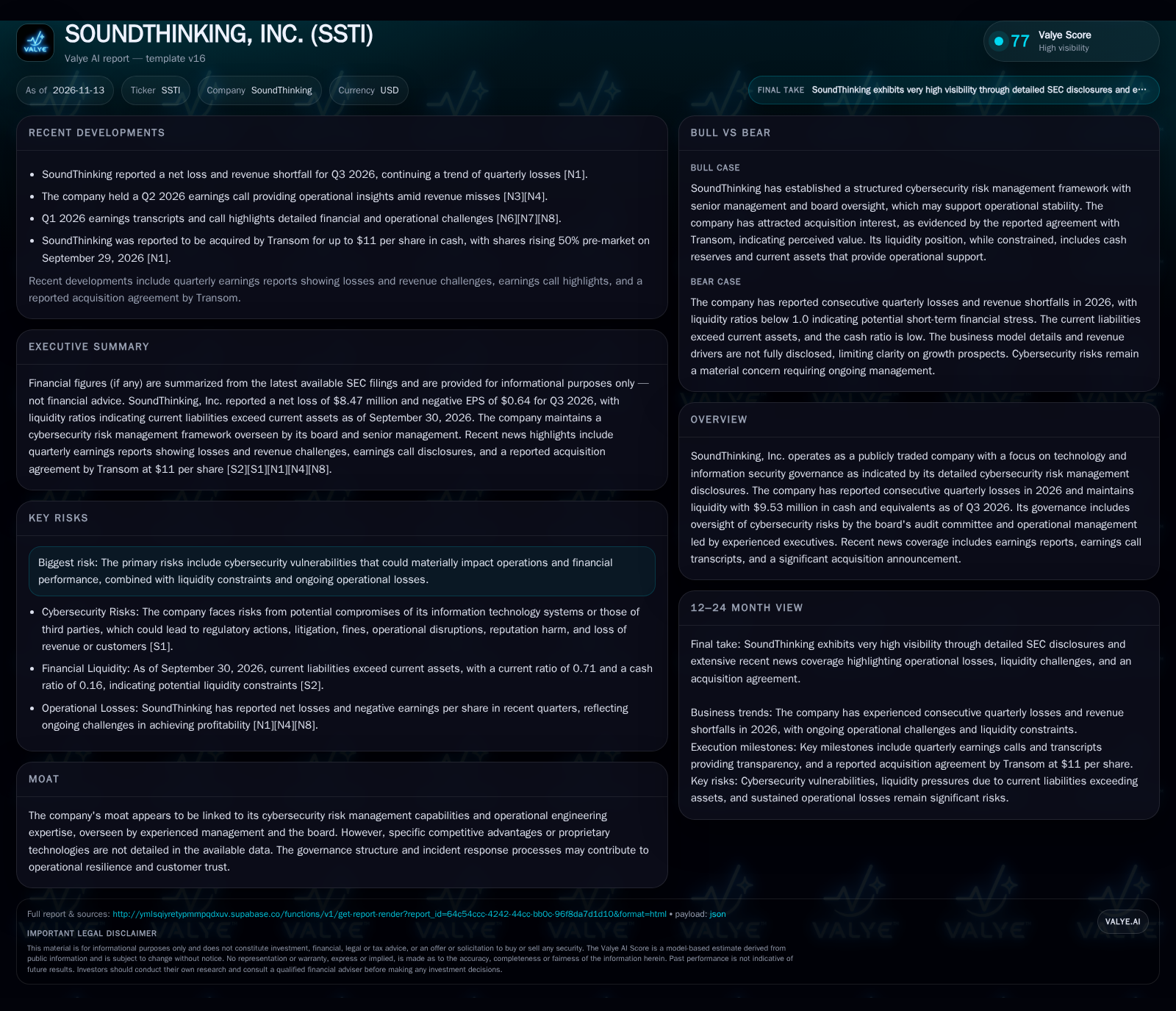
Despite comprehensive cybersecurity oversight, the company’s underlying business economics and revenue reliability remain unclear. An acquisition agreement at $11 per share has been reported, but the long-term outlook hinges on either a successful sale or a credible plan to restore profitability and balance sheet strength. [S2] [S1] [N1] [N4] [N8]
SoundThinking, Inc. enters the final quarter of 2026 facing a convergence of financial and operational pressures. With a current ratio below 1.0 and ongoing net losses, the company’s near-term liquidity is in question. At the same time, its governance and cybersecurity frameworks are robust and may enhance its appeal to acquirers or partners wary of operational risk. The reported acquisition agreement at $11 per share offers a possible escape route for investors, but the underlying business model’s sustainability remains uncertain—raising the stakes for both turnaround efforts and M&A negotiations.
Recent Losses and Liquidity Shortfall Define SoundThinking’s Current Reality
As of September 30, 2026, SoundThinking reported a net loss of $8.47 million for the quarter, with basic and diluted EPS of -$0.64 [S2] [N1]. These losses continue a multi-quarter trend, with earnings call transcripts and news coverage highlighting recurring revenue shortfalls throughout 2026 [N3] [N4] [N6] [N7] [N8].
The company’s liquidity position is challenged: it held $9.53 million in cash and equivalents, with current assets of $43.55 million against current liabilities of $61.06 million, yielding a current ratio of 0.71 and a cash ratio of just 0.16 [S2]. This configuration points to immediate pressure to either raise capital, restructure obligations, or find a buyer.
SoundThinking’s cybersecurity risk management program stands out for its board-level oversight and operational leadership by an executive with over 30 years of IT and information security experience [S1]. This may support customer and partner confidence, even as the company navigates financial distress.
Analyzing Revenue Sustainability and Cost Structure Under Financial Duress
The company’s persistent net losses and revenue misses indicate that its current cost structure likely exceeds its recurring revenue base [S2] [N1] [N4] [N8]. Without visibility into contract terms, customer concentration, or renewal rates, it is plausible that SoundThinking’s model involves a mix of upfront hardware/software deployments and ongoing service or platform fees—common in technology-driven security and analytics businesses.
Fixed costs in such businesses often include R&D, cybersecurity compliance, and customer support. These costs can be partially offset by operating leverage if customer volume or pricing can be increased, but the ongoing losses suggest that either volume is stagnant or pricing power is weak. Variable costs may include cloud infrastructure, data processing, and customer acquisition expenses, which could become burdensome if revenue is not scaling.
The company reported cash and liquidity metrics for the period; these figures do not by themselves establish operating runway, investment capacity, financial flexibility, or financing capacity. This could force short-term prioritization of cash flow over long-term innovation unless new external capital or acquisition proceeds are secured.
Cybersecurity Governance as a Differentiator—But Not a Moat
SoundThinking’s board-level cybersecurity oversight and experienced operational management may instill confidence among institutional customers, particularly in regulated or risk-sensitive sectors [S1]. This could provide a reputational edge relative to less mature competitors, and may be a factor in acquisition discussions.
However, the lack of disclosed proprietary technology, recurring revenue mechanics, or customer lock-in mechanisms limits the evidence of a strong competitive moat. In the technology-enabled security and analytics sector, barriers to entry can be modest unless protected by unique data assets, advanced analytics IP, or high switching costs.
Peer companies in this space often compete on breadth of data integration, analytics accuracy, and reliability of service. If SoundThinking’s offering is not demonstrably superior or more cost-effective, it could face pricing pressure from larger, better-capitalized rivals, as well as technology substitution from cloud-native or AI-driven security providers.
Acquisition or Strategic Pivot Could Unlock Value—If Execution Aligns
The most favorable outcome is that the reported acquisition agreement at $11 per share closes, allowing shareholders to exit at a premium and transferring operational and financial risk to a better-capitalized parent [N1] [N8]. For this to occur, due diligence must confirm the integrity of SoundThinking’s cybersecurity controls, customer relationships, and potential for integration.
Alternatively, a strategic pivot—such as focusing on a higher-margin service segment or leveraging the cybersecurity governance framework to win new enterprise contracts—could stabilize revenue and restore operating leverage. This would require clear evidence of new contract wins, margin expansion, or a reduction in cash burn.
Confirmation of this scenario would include regulatory approval and closing of the acquisition, or public disclosure of major new customer contracts, improved revenue growth, and narrowing losses in subsequent quarters.
Ongoing Losses and Tight Liquidity Drive Urgency for Restructuring or Sale
The most plausible trajectory is continued operational and financial strain, with SoundThinking actively pursuing a sale or external capital infusion to address its liquidity gap [S2] [N1] [N8]. If the acquisition agreement stalls or is repriced, the company may be forced to restructure debt, cut costs, or seek alternative buyers.
Absent a dramatic business model shift or substantial new revenue streams, ongoing losses and sub-1.0 liquidity ratios suggest that the company’s bargaining position will remain weak. Incremental improvements in revenue or operational efficiency could slow the cash burn, but may not be sufficient to restore long-term viability.
Evidence supporting this scenario would include further disclosures on restructuring efforts, bridge financing, or additional signals of distress such as delayed payments, layoffs, or renegotiated contracts. Conversely, rapid progress toward closing the acquisition would challenge this view.
Acquisition Falls Through and Operational Losses Force Drastic Measures
If the acquisition fails to close and no alternative buyer or capital source emerges, SoundThinking could face acute liquidity stress, leading to emergency cost cuts, asset sales, or even bankruptcy proceedings if obligations cannot be met [S2].
A further decline in revenue—whether from customer churn, pricing pressure, or competitive losses—would exacerbate the shortfall and could trigger covenant violations or loss of supplier/customer confidence.
This scenario would be confirmed by public withdrawal of the acquisition offer, regulatory or legal delays, missed interest or principal payments, or abrupt reductions in workforce and R&D investment. Any public indication of going-concern risk by auditors would be a strong negative signal.
Evidence That Will Clarify SoundThinking’s Path Forward
Acquisition closing progress, including regulatory approvals and final transaction terms, will determine whether shareholders realize the reported $11 per share exit.
Quarterly revenue growth or stabilization, if disclosed, would help test whether the business is regaining momentum or continuing to lose ground.
Gross margin trends, if disclosed, would indicate whether cost structure improvements or pricing actions are having an impact.
Updates on customer wins, renewals, or churn rates would clarify the stickiness and growth potential of the core business.
Cash burn rate and updated liquidity disclosures will be essential to assess near-term solvency risk.
Disclosures of any bridge financing, debt restructuring, or covenant waivers would signal how management is addressing the liquidity gap.
Board or management commentary on strategic alternatives—including additional asset sales, pivots, or partnership discussions—would provide insight into the range of possible outcomes.
Any public disclosures of cybersecurity incidents, regulatory actions, or legal proceedings would test the strength of the company’s risk management framework.
Disclaimer: This is research-only, informational analysis and not investment advice. It may include AI-generated interpretation and general industry context. Always verify important details using primary sources.

Comments