
Lineage Cell Therapeutics: Capital Needs and Milestone Revenue Shape Cell Therapy Prospects
Lineage Cell Therapeutics faces persistent losses and milestone-dependent revenue as it develops cell therapy candidates, relying on a mix of government grants, collaborations, and capital-raising activities to sustain operations.
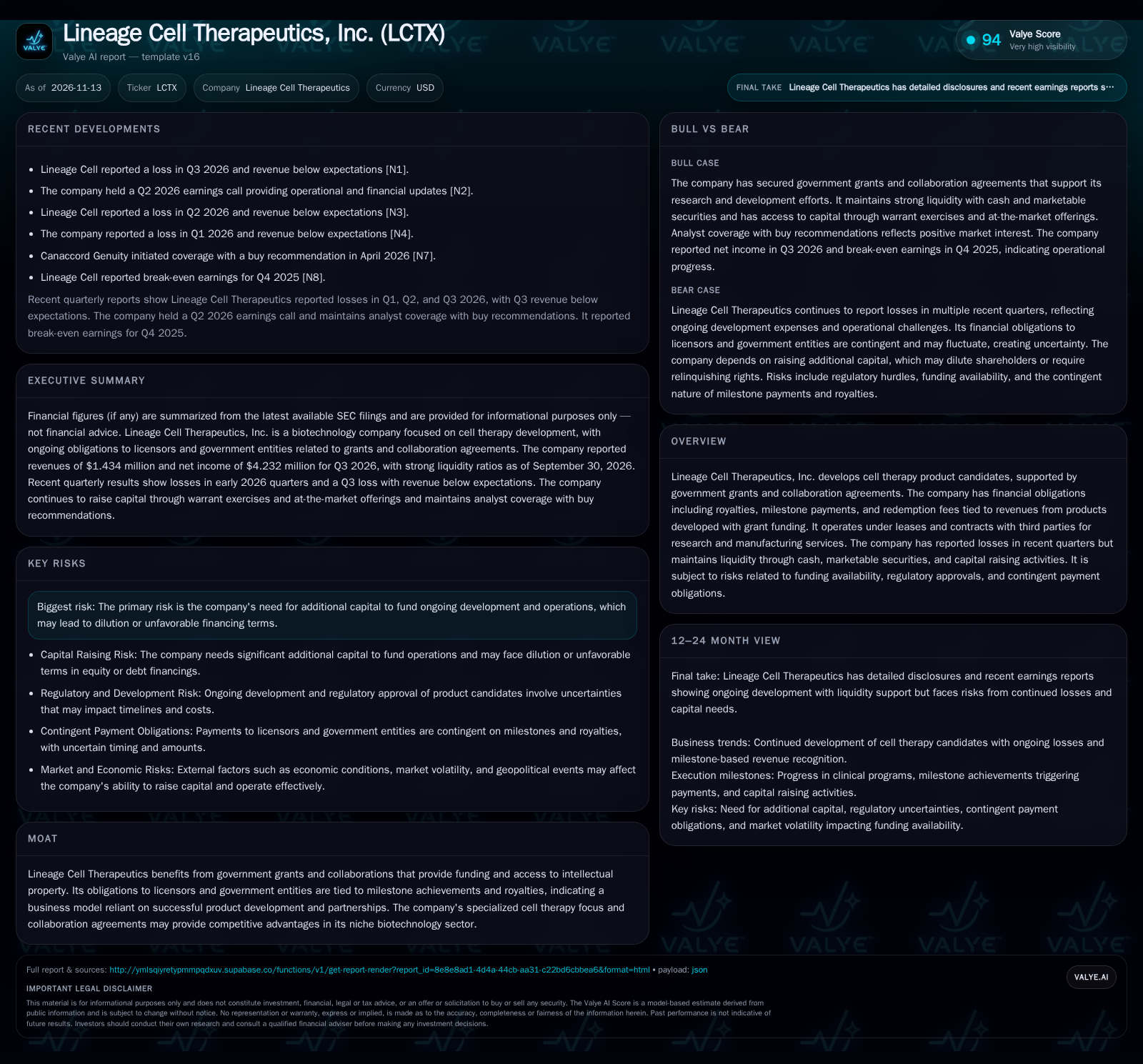
Lineage Cell Therapeutics continues to report quarterly losses and revenue below expectations, despite maintaining reported liquidity position and raising capital through warrants and at-the-market offerings. Its business model is highly dependent on successful R&D, milestone payments from collaborations, and future access to capital. The company’s ability to transition from research to revenue-generating products remains the central question as it faces contingent payment obligations and a challenging funding environment. [S1] [S2] [N1] [N3] [N4]
Lineage Cell Therapeutics, a clinical-stage biotechnology company, is at a pivotal juncture: it possesses significant liquidity and a pipeline supported by government grants and collaborations, yet continues to face quarterly losses and revenue shortfalls as it advances its cell therapy candidates. The company’s financial architecture is shaped by milestone-driven agreements, contingent obligations, and a persistent need for fresh capital. Ultimately, Lineage’s future will be dictated by its ability to achieve clinical and regulatory breakthroughs that unlock milestone payments and set the stage for commercial revenue.
Lineage’s Position at the End of 2026: Performance and Financing Overview
Lineage Cell Therapeutics reported revenues of $1.434 million and net income of $4.232 million for the third quarter of 2026, but continued to post quarterly losses and revenue below expectations throughout the year. The company ended 2025 with $55.8 million in cash, cash equivalents, and marketable securities, and maintains access to additional capital via outstanding warrants (potentially up to $30.2 million) and a $17.4 million at-the-market offering program. Despite these resources, Lineage expects to incur losses for several more years as it advances its cell therapy pipeline and seeks regulatory approvals. The company’s obligations under government grants and collaboration agreements mean future revenues will trigger royalty and milestone payments, with contingent liabilities that remain difficult to forecast. [S1] [S2] [N1] [N3] [N4]
The Impact of Milestones, Grants, and R&D on Lineage’s Financial Structure
Lineage’s business model is built around the high-risk, high-reward economics typical of pre-commercial biotech: years of R&D investment with the hope of achieving clinical and regulatory milestones that unlock significant payments or future product revenue. The company’s revenue mix is currently dominated by milestone payments and grants rather than product sales. This structure introduces considerable variability and lumpiness in revenues, as payments are triggered by the achievement of specific development milestones rather than by recurring sales. Variable costs are driven by clinical trial progression, manufacturing partnerships, and regulatory submissions, while fixed costs are anchored in R&D personnel and facilities.
With operating expenses expected to rise as pipeline programs advance, Lineage’s ability to scale operating leverage is inherently deferred until late-stage clinical results or commercialization. The company’s capital needs are persistent: it must continually raise funds to cover negative cash flows from operations, often through equity offerings, warrant exercises, or partnering deals. Each capital raise can introduce dilution or require relinquishing economic or commercialization rights. The economics of future marketed products—should any reach approval—would be shaped by royalty rates, cost-sharing agreements, and any government-mandated paybacks tied to grant funding, such as the $96.2 million aggregate cap on potential IIA royalties and redemption fees. [S1]
Lineage’s Competitive Edge: Collaboration, Intellectual Property, and Cell Therapy Focus
Lineage operates in the intensely competitive field of cell therapy, where success depends on both scientific innovation and the ability to form strategic collaborations. Its competitive advantages may stem from specialized intellectual property, exclusive or first-mover agreements with large pharma partners, and access to non-dilutive funding through government grants. The company’s collaboration with Roche and its ties to the Israel Innovation Authority suggest access to resources and networks that some peers may lack.
However, counterforces include the presence of large, well-capitalized pharmaceutical competitors, rapid advances in adjacent technologies (such as gene editing or allogeneic therapies), and the uncertain path to regulatory approval for novel cell therapies. The company’s reliance on milestone payments and royalties, rather than recurring product revenue, also limits its ability to build durable customer relationships or pricing power at this stage. Switching frictions are low for partners and payers until products reach late-stage development or commercial approval, at which point clinical differentiation and real-world outcomes could become more important determinants of competitive position.
Potential Gains from Clinical or Regulatory Advancements
The most favorable scenario for Lineage is the achievement of key clinical or regulatory milestones that trigger substantial milestone payments under collaboration agreements and accelerate the path to commercialization. Success in pivotal trials or regulatory submissions could validate the company’s technology, increase its bargaining power in partnership negotiations, and potentially attract new licensing deals or non-dilutive capital. This, in turn, could enable Lineage to fund further development without excessive dilution and to negotiate more favorable economics in future deals.
Concrete evidence that would confirm this scenario includes the announcement of successful late-stage clinical trial results, regulatory approvals or fast-track designations, and the receipt of large milestone payments. Additional signs would be the initiation of new strategic collaborations with major industry players or the successful out-licensing of pipeline assets at attractive terms. Falsification would include clinical trial failures, regulatory setbacks, or the inability to secure milestone payments when anticipated.
Milestone-Linked Progress Despite Ongoing Losses and Funding Requirements
The most plausible trajectory for Lineage over the next 12-24 months is a continued cycle of advancing clinical candidates toward milestones, generating sporadic revenue from collaborations and grants, and raising external capital to fund ongoing operations. Losses are likely to persist as operating expenses increase with clinical progress, and the timing of revenue recognition will remain unpredictable due to the milestone-based nature of agreements. The company will likely continue to rely on warrant exercises, at-the-market offerings, and the pursuit of new grants or partnerships to extend its cash runway.
Confirmation of this scenario would include continued reporting of quarterly losses, periodic capital raises, and occasional milestone or grant revenue without a major inflection in product sales. Evidence to the contrary would be an unexpected acceleration in commercial revenue, a sustained string of clinical or regulatory setbacks, or a failure to secure needed capital on reasonable terms.
Risks from Funding Shortfalls and Clinical Challenges
Lineage’s greatest risks lie in the intersection of clinical failure, regulatory delay, and constrained access to capital. If key clinical programs fail to meet endpoints or encounter safety concerns, or if regulatory timelines slip, the company could miss out on anticipated milestone payments and struggle to raise non-dilutive capital. In such a scenario, Lineage may be forced to accept highly dilutive financings, relinquish valuable rights to pipeline assets, or reduce investment in its core programs.
Confirmation of the downside would be announcements of failed or halted trials, material delays in regulatory submissions, the need to raise capital at steep discounts, or the sale/partnering of assets under distressed terms. A liquidity crunch or negative going-concern language in future filings would also signal this scenario materializing.
Milestones and Capital Access Are Central to Lineage’s Upcoming Developments
Progress or setbacks in key clinical trials, including any top-line data releases or regulatory submission announcements.
The timing and amount of milestone payments or royalties received from collaboration and grant agreements.
Updates on capital-raising activities, including warrant exercises, at-the-market offering utilization, or new equity/debt financings.
Any changes to the company’s forecasted cash runway in future filings or earnings updates.
Announcements of new or expanded strategic collaborations, licensing deals, or government grant awards.
Shifts in analyst coverage or target price changes, which may indicate changing market perception of execution risk.
Material changes in contingent payment obligations—such as updates to the IIA royalty cap or new milestone structures.
If disclosed, the company’s internal projections for operating expense growth and the timeline to potential break-even.
Disclaimer: This is research-only, informational analysis and not investment advice. It may include AI-generated interpretation and general industry context. Always verify important details using primary sources.

Comments