
Star Equity Holdings After the Hudson Merger: Integration, Segment Diversity, and the Search for Sustainable Profitability
Star Equity Holdings’ transformation through its merger with Hudson Global, Inc. creates a multi-segment platform spanning RPO, building materials, and energy services. The company faces the challenge of integrating diverse operations while working to reverse persistent net losses and improve cash flow.
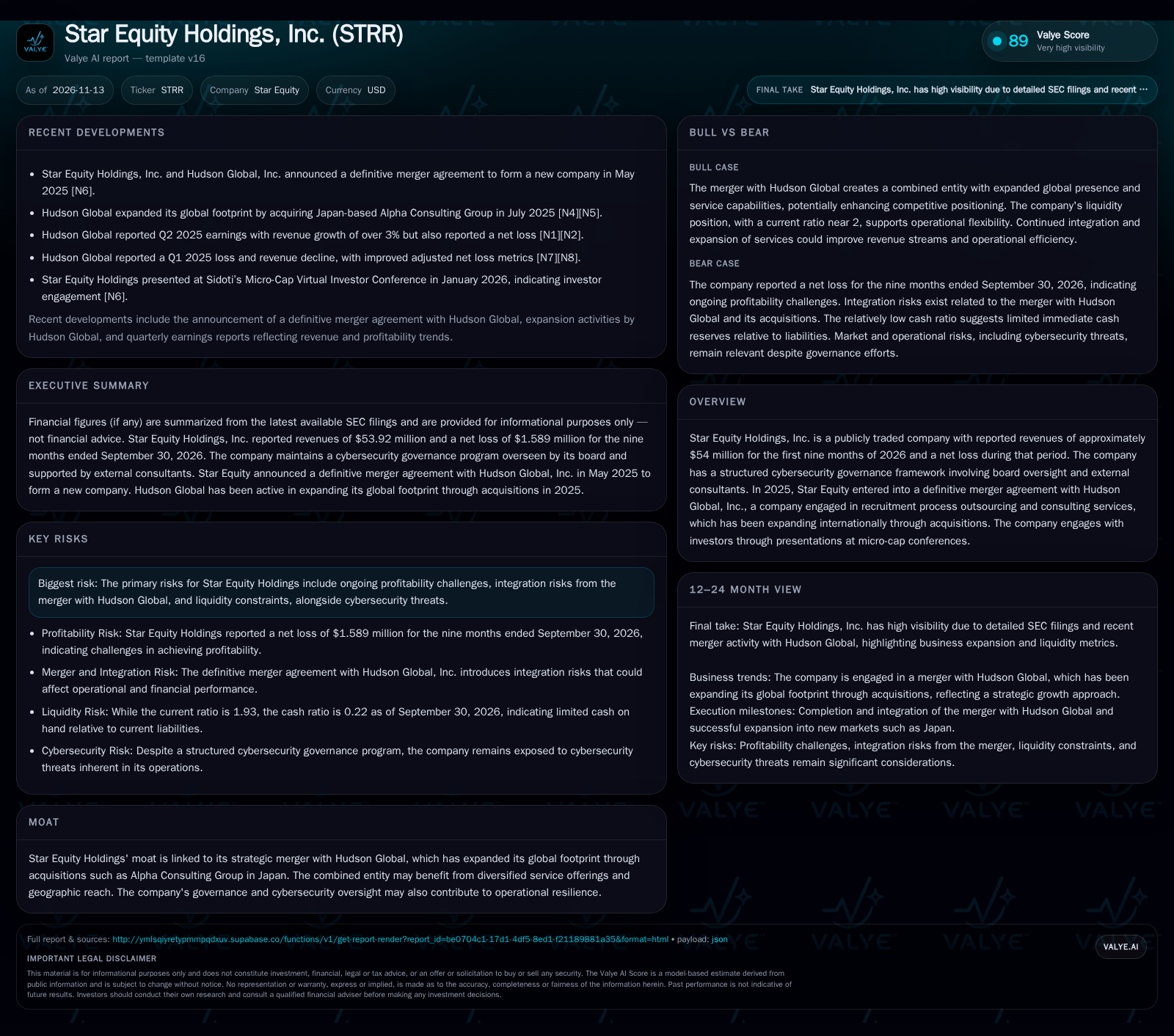
Star Equity Holdings, Inc. completed its merger with Hudson Global, Inc. in August 2025, resulting in a diversified holding company with major segments in recruitment process outsourcing, building solutions, and energy services. The combined entity reported $53.92 million in revenue and a net loss of $1.589 million for the nine months ended September 30, 2026.While reported liquidity position on a current ratio basis, the company’s reported cash ratio and continuing losses highlight the importance of successful integration, margin improvement, and realization of cross-segment synergies. Near-term performance will hinge on merger execution and the ability to convert segment breadth into durable earnings.[S2] [N6]
Star Equity Holdings, Inc. has undergone a significant transformation by merging with Hudson Global, Inc., resulting in a multifaceted holding company with exposure to recruitment process outsourcing, building materials, and energy services. Despite a healthy revenue base, the company continues to post net losses and faces integration challenges as it absorbs new acquisitions and expands geographically. The next phase for Star Equity will likely be defined by its ability to harmonize operations, manage liquidity, and translate its diversified structure into consistent profitability.
Recent Merger, Segment Expansion, and Financial Snapshot Define the Present
Star Equity Holdings, Inc. completed the acquisition of Star Operating Companies (formerly Star Equity Holdings) by Hudson Global (now renamed Star Equity Holdings) in August 2025, following a definitive merger agreement announced in May 2025. This transformative merger created a diversified holding company with four primary segments: Building Solutions, Business Services (notably recruitment process outsourcing, or RPO), Energy Services, and Investments.[S2] [N6]
The combined company reported $53.92 million in revenue for the nine months ended September 30, 2026, but continued to run at a net loss of $1.589 million, with basic and diluted EPS of -$0.43 for the period.[S2] Liquidity metrics are mixed: current assets of $54.29 million versus current liabilities of $28.15 million yield a current ratio of 1.93, while a cash ratio of 0.22 highlights limited immediate cash reserves.[S2]
Star Equity’s business model now spans RPO and consulting (with an international footprint), U.S.-focused building solutions, and energy services, including recent acquisitions in the oilfield tools and machine shop space. This diversity creates both opportunity for cross-segment synergies and complexity in integration and management.
How Segment Breadth Could Drive Earnings—If Integration and Margin Management Succeed
Star Equity’s economics are now defined by a blend of fee-based and asset-heavy businesses. The Business Services segment (RPO and consulting) typically operates on contractual, project-based, or retainer revenue structures, with variable costs tied to placement activity and consultant compensation. Margins in RPO can be attractive with scale and process differentiation but are vulnerable to client churn and macro labor-market swings.
The Building Solutions segment is capital-intensive, involving manufacturing and distribution of construction materials. Gross margins here are often pressured by commodity input costs, logistics, and competitive pricing, but can benefit from operational leverage if volume increases. Success in this segment depends on efficient asset utilization and disciplined working capital management.
Energy Services (e.g., drilling tools and machine shops) is cyclical and generally operates on a mix of tool sales, rentals, and services. The cost structure allows for some variable cost pass-through to customers, particularly in rentals and repairs, but demand volatility can impact utilization rates and pricing power. Capital needs in this segment are ongoing, given the wear and tear of physical assets.
The company reported cash and liquidity metrics for the period; these figures do not by themselves establish operating runway, investment capacity, financial flexibility, or financing capacity. Profitability will depend on the combined entity’s ability to rationalize overhead, realize merger synergies, and improve margin discipline across diverse business lines.
Diversification as Double-Edged Sword: Competitive Prospects and Integration Headwinds
The merger has positioned Star Equity as a diversified platform spanning industries with varying competitive dynamics. In RPO and consulting, the company faces global and regional players that compete on process, technology, and relationship depth. Scale, proprietary recruitment methodologies, and international reach are potential sources of competitive advantage, but switching costs for clients remain moderate and pricing pressure is commonplace.
Building Solutions contends with fragmented, regional competition in construction materials and specialty products. Relationships with professional builders and the ability to offer specialized products (like glulam timber) may confer some stickiness, but price sensitivity and input cost volatility are persistent threats.
In Energy Services, Star Equity competes with specialized tool providers and regional service shops. Proximity to key basins (e.g., Permian, Rockies) offers logistical advantages, and the ability to pass certain costs to customers provides some margin defense. However, the segment is exposed to commodity cycles and customer capital spending trends.
The principal counterforce to Star Equity’s breadth is integration risk: coordinating disparate business cultures, systems, and incentive structures could erode operational focus and dilute competitive edge if not managed effectively.
Integration Unlocks Synergies and Margin Expansion Across Segments
A favorable outcome hinges on successful integration of the Hudson and Star platforms, enabling the company to standardize processes, eliminate redundant costs, and cross-sell services across geographies and customer bases. In this scenario, the RPO segment leverages global delivery teams and proprietary recruitment methods to win larger, multi-country contracts, while the Building and Energy segments benefit from shared services, procurement efficiencies, and improved asset utilization.
Evidence that would confirm this scenario includes sequential margin improvement, positive operating cash flow, and increased contract wins or renewals in RPO. Successful expansion into new geographies (such as Japan, via the Alpha Consulting Group acquisition) and demonstrable cross-segment customer activity would further support the thesis.
Managing Complexity, Seeking Stability: Star Equity’s Probable Near-Term Trajectory
The most plausible outcome is a period of operational adjustment as the company works through merger integration, with modest revenue growth but continued pressure on margins as synergies take time to materialize. The company may experience lumpy performance as acquired businesses are absorbed and management rationalizes the cost base.
Progress would be confirmed by stable or improving gross margin and SG&A ratios, steady or reduced net losses, and evidence of working capital discipline (e.g., improved cash conversion cycle). Conversely, persistent negative cash flow, widening losses, or turnover in key management roles would suggest ongoing integration challenges.
Integration Stumbles, Margin Erosion, and Liquidity Strain Threaten the Combined Platform
A negative outcome could result if integration proves more difficult than anticipated, leading to operational dis-synergies, customer attrition, and margin compression across segments.
Warning signs would include deteriorating gross margins, rising SG&A as a percent of revenue, sequential declines in segment revenue, and negative trends in cash flow from operations. If the company needs to seek external financing or divest assets to shore up liquidity, this would further validate the downside risk.
Milestones and Metrics That Will Shape Star Equity’s Post-Merger Narrative
Sequential trend in consolidated operating cash flow: Positive movement would indicate improved underlying economics and working capital management.
Gross and segment margin progression: A useful metric would be margin improvement in both RPO and building materials, providing evidence of synergy realization or operational discipline.
SG&A as a percentage of revenue: If disclosed, a declining ratio would suggest effective overhead rationalization post-merger.
Revenue and contract win/loss trends in the RPO segment, particularly in new international markets entered via recent acquisitions.
Turnover rate in key management and integration teams, as high personnel churn could signal integration difficulties.
Progress on cross-segment service adoption or bundled contracts, if disclosed, would indicate success in leveraging platform breadth.
Disclaimer: This is research-only, informational analysis and not investment advice. It may include AI-generated interpretation and general industry context. Always verify important details using primary sources.

Comments