
Talphera, Inc.: Clinical Progress, Capital Constraints, and the Unforgiving Math of Biopharma Development
With its lead candidate advancing through late-stage trials and a reported cash balance that may not outlast its ambitions, Talphera faces the classic tension of clinical-stage biopharma: operational progress versus relentless capital requirements. Can recent financing and pipeline momentum bridge the gap to value creation before the next raise?
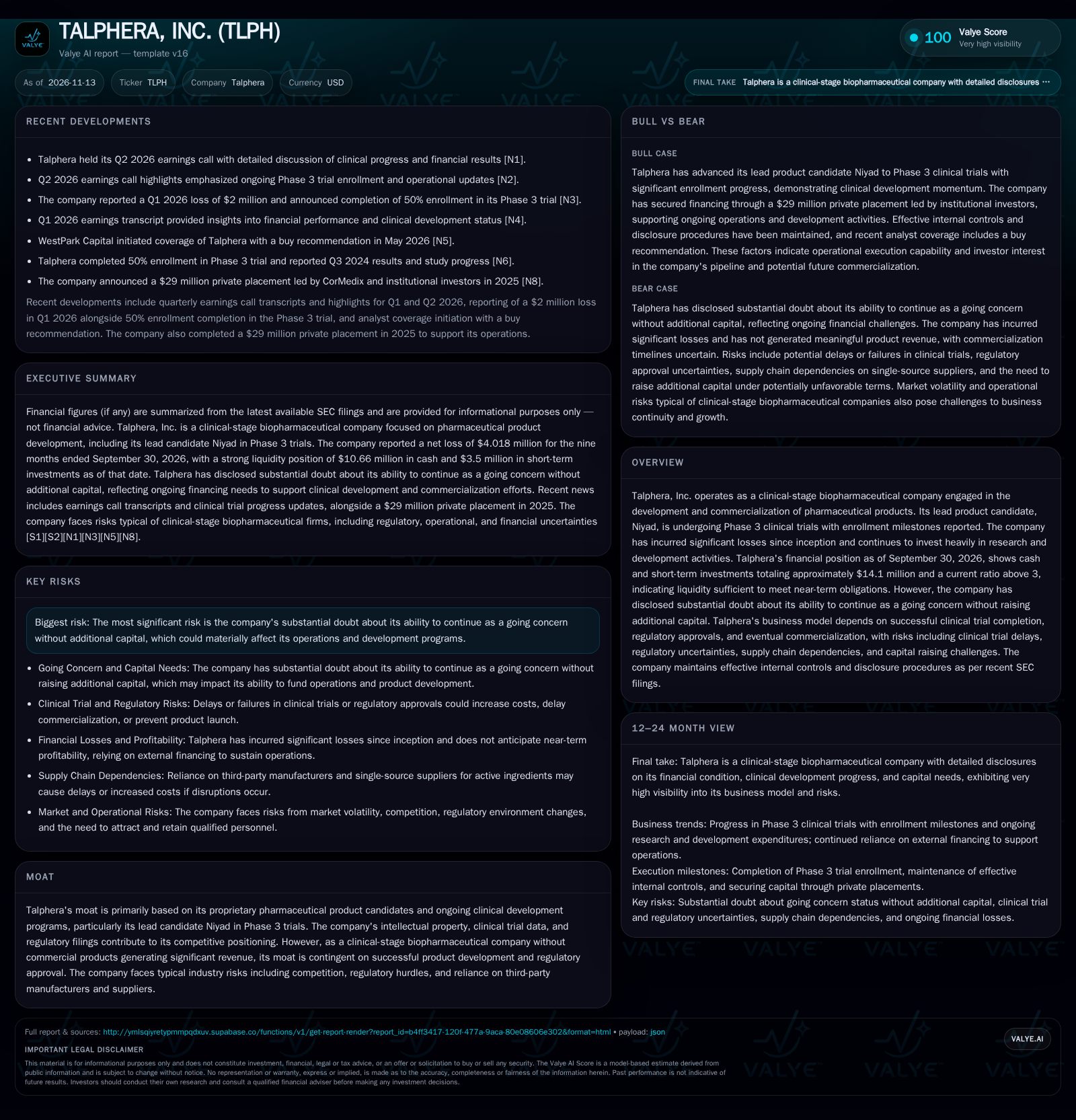
Talphera is a clinical-stage biopharmaceutical company with a lead asset in late-phase development and recently bolstered liquidity. Despite a $29 million private placement in 2025 and current cash plus investments of about $14.1 million, the company warns of substantial doubt about its ability to continue as a going concern without further capital. Ongoing operating losses, dependence on third-party suppliers, and lack of near-term product revenue underline the urgency of successful clinical and regulatory outcomes, as well as timely access to new funding. Investor interest is evident, but future trajectory hinges on both execution and capital markets conditions. [S1] [S2] [N3] [N8]
Talphera, Inc. exemplifies the high-wire act of clinical-stage biopharmaceutical development—balancing the promise of late-stage pipeline progress against the realities of persistent losses and finite cash. The next year will test whether Talphera’s clinical, operational, and financing execution can converge before the unforgiving economics of drug development force a strategic pivot or dilutive raise.
Clinical Progress and Capital Position Set the Stage for a Crucial Year
Talphera exited Q3 2026 with $10.66 million in cash and $3.5 million in short-term investments, supporting a current ratio of 3.19 and a cash ratio of 3.06—metrics that would typically suggest short-term liquidity is not an immediate concern. The company reported cash and liquidity metrics for the period; these figures do not by themselves establish operating runway, investment capacity, financial flexibility, or financing capacity. This tension is heightened by ongoing operating losses of $4.018 million for the first nine months of 2026, reflecting continued investment in R&D and the absence of meaningful product revenue. The company’s lead drug candidate has reached 50% enrollment in its Phase 3 trial as of Q1 2026, demonstrating pipeline progress but also underscoring the capital intensity and time required to reach regulatory milestones. The $29 million private placement completed in 2025 provided a temporary capital buffer but has not eliminated the necessity for ongoing external funding. [S2] [N3] [N8]
How Talphera’s Model Converts Science Into Potential Value—If Funded
Talphera’s economic engine is classic high-risk, high-reward biopharma: large upfront R&D and regulatory expenses with the hope of eventual high-margin revenue from approved drugs. Until regulatory approval is achieved and commercialization begins, the company’s cost base is dominated by fixed expenses—clinical trial costs, regulatory filings, and G&A—while revenue remains minimal. This operating leverage means that even modest delays or cost overruns can rapidly erode runway. If its lead candidate succeeds, gross margins could be substantial, in line with industry standards for novel pharmaceuticals, but the path to those margins is uncertain and punctuated by capital raises that may dilute existing shareholders. Talphera’s reliance on third-party and single-source suppliers for active ingredients adds both cost variability and operational risk, as disruptions or price increases cannot easily be absorbed or offset. Without near-term revenue, the company’s ability to invest in pipeline expansion or commercial infrastructure is strictly gated by its access to equity or partnership capital.
Intellectual Property and Pipeline Progress Offer Promise, But Barriers Remain
Talphera’s competitive profile is defined by its intellectual property estate and clinical progress, but as a pre-commercial company, its moat is contingent rather than realized. Proprietary clinical data and regulatory filings can create defensible positions if the lead asset is approved, but until then, differentiation from rival biopharmas pursuing similar targets or indications is tenuous. The company’s dependence on single-source suppliers exposes it to risks that more vertically integrated or better-capitalized competitors may be able to mitigate. Meanwhile, larger pharmaceutical companies and late-stage biotechs with similar focus areas represent both direct competition and potential acquirers or partners. The absence of meaningful product revenue and lack of commercial infrastructure make Talphera vulnerable to competitive displacement unless its clinical and regulatory execution outpaces peers. The question is whether its current pipeline can deliver data compelling enough to attract partner interest or justify premium pricing in crowded therapeutic categories.
A Path to Value Creation if Clinical Milestones and Capital Access Align
The most favorable scenario for Talphera is a confluence of positive Phase 3 data, timely regulatory submission, and either a lucrative partnership or successful capital raise before cash runs low. Strong clinical results could attract licensing or co-development deals, providing non-dilutive capital and commercial resources. If the company can demonstrate clear differentiation—such as superior efficacy, safety, or ease of use—relative to competitors, payer acceptance and pricing power may follow, accelerating the ramp to profitability post-approval. Evidence that would confirm this scenario includes rapid completion of Phase 3 enrollment, positive topline data, initiation of regulatory filings, and announcements of strategic partnerships or licensing agreements. Signs of investor confidence, such as oversubscribed financings or analyst upgrades, would further validate this trajectory. The scenario would be falsified by significant trial delays, inconclusive or negative data, or inability to secure funding on acceptable terms.
Most Likely Outcome: Clinical Progress Continues, Funding Remains a Bottleneck
In the most plausible scenario, Talphera advances its lead asset through the remainder of its Phase 3 trial, but faces a narrowing cash runway and must seek additional capital before commercialization. This is typical for clinical-stage biopharma firms, where even well-executed programs often require several rounds of equity or partnership financing before revenue materializes. Modest trial delays or cost overruns could necessitate a raise under less favorable terms, potentially diluting shareholders. Evidence confirming this scenario would be continued progress updates—such as reaching full enrollment or interim data releases—accompanied by shelf registration statements, ATM programs, or partnership negotiations. The scenario would be challenged if the company unexpectedly secures a major upfront licensing payment, achieves regulatory approval ahead of schedule, or faces a severe operational setback.
Adverse Outcomes: Clinical, Regulatory, or Funding Setbacks Force Strategic Retreat
The downside for Talphera is defined by a combination of negative or inconclusive clinical data, prolonged trial delays, or an inability to raise necessary capital before liquidity is exhausted. In this scenario, the company may be forced to halt or scale back development, pursue asset sales, or seek a distressed merger. Supply chain disruptions or loss of key suppliers could exacerbate these risks, as could broader market volatility that shuts the window on biotech funding. Signs that would confirm this scenario include public disclosure of material trial delays, withdrawal of regulatory filings, layoffs, or announcements of strategic alternatives. Inability to close a needed financing round, or raising capital at punitive terms, would also be red flags. The scenario would be falsified by unexpectedly strong clinical outcomes or rapid, well-supported new financing.
Milestones and External Forces That Will Shape Talphera’s Trajectory
Progress updates on Phase 3 trial enrollment and completion rates—these will determine how close the company is to pivotal data.
Disclosure of topline or interim clinical results, which would directly impact the likelihood of regulatory success and partnership interest.
Announcements regarding additional capital raises, shelf registrations, or partnership deals—timing and terms will reveal the company’s negotiating leverage and runway.
Any changes in the status of key suppliers or manufacturing partners, as disruptions could force costly delays or reformulations.
Cash burn trends and updated liquidity disclosures in quarterly filings, which will indicate whether the going concern risk is rising or receding.
Regulatory interactions, such as acceptance of filings or feedback from agencies, as these can signal both timing and probability of approval.
Analyst coverage changes, investor conference presentations, or unusual trading volumes may suggest shifting market sentiment or new developments.
Disclaimer: This is research-only, informational analysis and not investment advice. It may include AI-generated interpretation and general industry context. Always verify important details using primary sources.

Comments