
AnaptysBio’s Royalty-Only Model: Leverage, Dependency, and the Jemperli Bet
With a stripped-down operating structure and heavy reliance on GSK’s Jemperli franchise, AnaptysBio exemplifies both the efficiencies and vulnerabilities of a pure-play royalty company. The thesis now hinges on GSK’s oncology priorities, ongoing litigation outcomes, and the evolving competitive landscape in immuno-oncology.
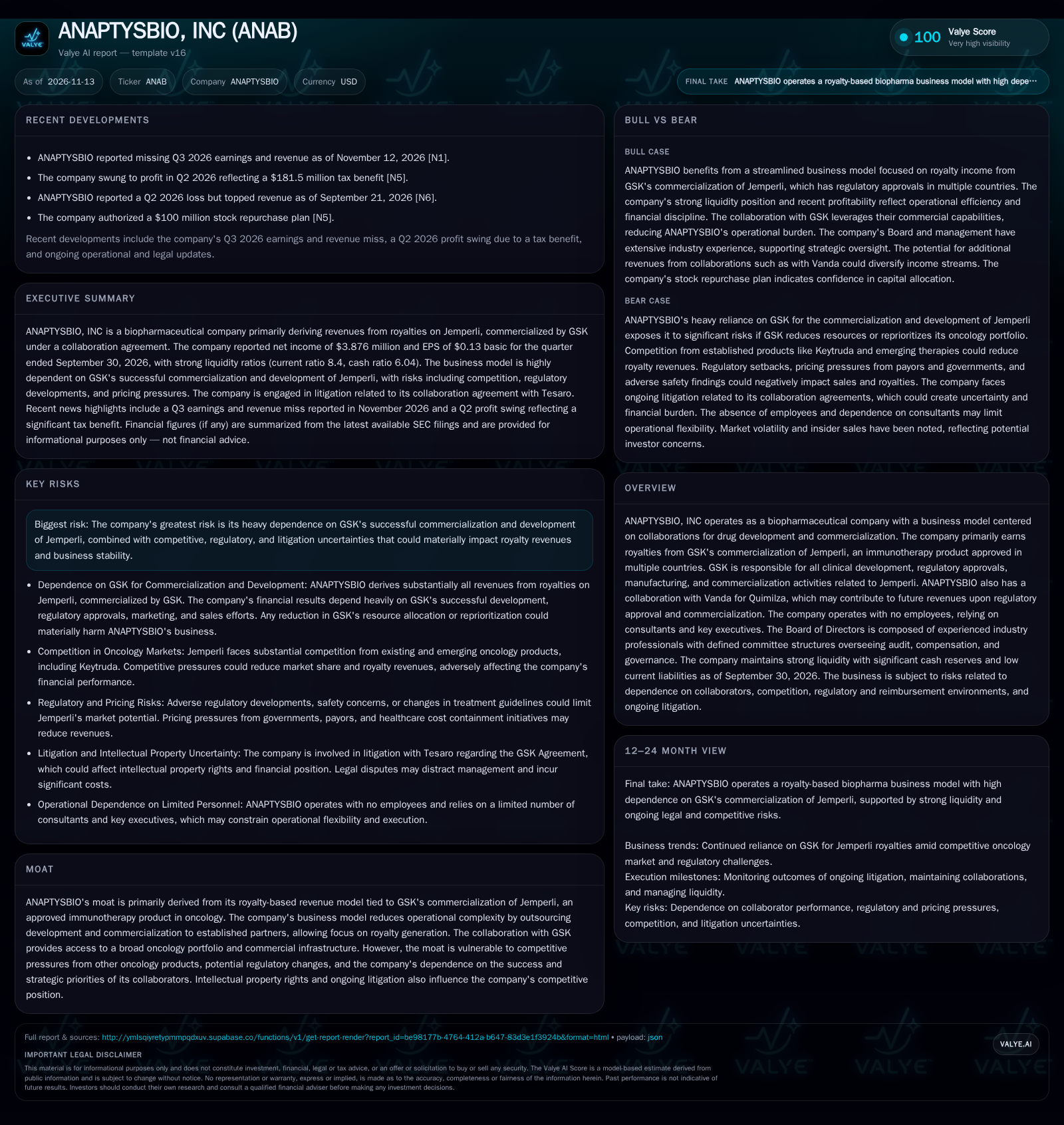
AnaptysBio operates as a royalty-focused biopharma with no employees, substantial cash reserves, and a business model almost entirely dependent on GSK’s commercialization of Jemperli. Q3 2026 results missed estimates, and ongoing litigation with Tesaro clouds IP certainty. The core question is whether Jemperli can sustain or grow its market position against entrenched competitors and regulatory headwinds, given AnaptysBio’s lack of operational control and diversification options. [S2] [N1]
AnaptysBio’s shift to a royalty-only model after spinning off its operating assets has streamlined its cost base and insulated the company from the capital intensity typical of drug development. However, this minimalism brings acute concentration risk: nearly all revenues depend on GSK’s commercialization of Jemperli, an immunotherapy agent in a fiercely competitive oncology market.
Recent Performance, Legal Overhang, and the GSK Reliance Question
As of September 30, 2026, AnaptysBio reported $135.4 million in cash and cash equivalents, a current ratio of 8.4, and net income of $3.876 million for the quarter, with basic EPS of $0.13. The company missed Q3 2026 earnings and revenue estimates, underscoring the volatility in its royalty-driven revenue stream. [S2] [N1]
Nearly all current revenues come from royalties on Jemperli, commercialized by GSK, with GSK controlling all development, regulatory, and commercial activities. AnaptysBio is also embroiled in ongoing litigation with Tesaro over the GSK agreement, raising questions about the durability and ownership of the royalty stream. [S2]
The company operates with no employees, relying on consultants and executives, and has spun off its biopharma operations to focus exclusively on royalty income. This structure minimizes costs but also limits AnaptysBio’s ability to influence its own revenue trajectory. [S2]
Royalty Economics: Fixed Costs, Variable Outcomes, and the Limits of Leverage
AnaptysBio’s economics are defined by its near-total reliance on a single royalty stream from Jemperli. The company bears almost no R&D, manufacturing, or commercialization costs, as these are shouldered by GSK. This means AnaptysBio’s cost base is extremely lean: with no employees and only consulting and executive expenses, nearly every royalty dollar flows through with high margin after minimal overhead. [S2]
However, this model also means AnaptysBio has little to no control over the commercial fate of its core asset. Revenue growth or decline is determined by GSK’s investment, pricing, and execution, as well as market acceptance and competitive dynamics. The company reported cash and liquidity metrics for the period; these figures do not by themselves establish operating runway, investment capacity, financial flexibility, or financing capacity. [S2]
Long-term, this structure maximizes financial leverage to royalty performance but exposes the business to binary risks: any material change in Jemperli’s commercial success, regulatory status, or IP position could sharply alter AnaptysBio’s economics.
The royalty-only model inherently limits AnaptysBio’s ability to engage in strategic maneuvers such as product lifecycle management, direct marketing initiatives, or pricing negotiations. Because AnaptysBio lacks operational control, its revenue is largely a passive function of GSK’s commercial decisions and external market forces. This dependency creates a scenario where AnaptysBio’s financial outcomes are highly sensitive to GSK’s risk tolerance and prioritization among competing assets. Moreover, the absence of reinvestment into R&D or pipeline development restricts the company’s capacity to hedge against potential declines in the royalty stream, making its financial health vulnerable to shifts in the oncology landscape or patent expirations.
Competitive Pressures and the Fragility of a Single-Asset Royalty Moat
AnaptysBio’s competitive position is almost entirely a derivative of Jemperli’s standing in the immuno-oncology market. Jemperli faces entrenched competition from blockbuster agents such as Keytruda and other PD-1/PD-L1 inhibitors. These therapies benefit from broad indications, entrenched prescriber familiarity, and significant commercial investment from their sponsors.
Unlike diversified royalty companies or those with multiple partnered assets, AnaptysBio’s moat is narrowly tied to GSK’s willingness to prioritize, resource, and defend Jemperli. Regulatory setbacks, payer pushback, or shifts in treatment guidelines could erode market share. The company’s ongoing litigation over IP rights further clouds the security of its royalty stream. [S2]
Potential expansion of the royalty base—such as through the Vanda collaboration for Quimilza—could eventually diversify revenues, but this is speculative and contingent on regulatory approval and market adoption.
The competitive environment in immuno-oncology is characterized by rapid innovation cycles and aggressive market penetration strategies from multiple large pharmaceutical companies. Jemperli’s ability to maintain or grow its market share depends not only on clinical efficacy but also on GSK’s capacity to navigate payer negotiations and reimbursement frameworks, which vary significantly across regions. AnaptysBio’s reliance on GSK’s execution means that any misalignment between GSK’s strategic focus and evolving market demands could materially impact royalty inflows. Additionally, the emergence of next-generation immunotherapies or combination regimens may alter treatment paradigms, potentially diminishing Jemperli’s relevance and, consequently, AnaptysBio’s revenue base.
How GSK’s Oncology Commitment Could Unlock Royalty Upside
If GSK sustains or increases its commercial investment in Jemperli—expanding indications, achieving greater market penetration, and defending pricing—the royalty stream to AnaptysBio could grow meaningfully. Upside would be reinforced if Jemperli gains new regulatory approvals, demonstrates superior outcomes in head-to-head studies, or captures share from competitors. Successful resolution of the Tesaro litigation in AnaptysBio’s favor would further solidify the IP foundation and reduce risk to future royalties.
Confirmation of this scenario would come from reported growth in Jemperli sales, positive regulatory developments, GSK public statements committing resources to the franchise, and legal outcomes affirming AnaptysBio’s rights. Additional upside would be signaled by progress on Quimilza or new collaborations that diversify the company’s royalty base.
Sustained Royalty Streams Amid Oncology Market Headwinds
The most plausible scenario is that Jemperli maintains a steady but modest share of the immuno-oncology market, generating relatively stable (but potentially lumpy) royalties for AnaptysBio. GSK may continue to support Jemperli, but competitive pressure from established products and pricing headwinds from payors and governments could limit upside.
Litigation may persist, creating an overhang but not immediately disrupting royalties. The company’s lean structure and reported liquidity position allow it to weather moderate volatility, but without new assets or collaborations, revenue growth is constrained.
Evidence supporting this scenario would include quarterly royalty revenues tracking with Jemperli’s reported sales, absence of major regulatory or commercial setbacks, and a continued lack of pipeline diversification.
Under a scenario of sustained but constrained royalty streams, AnaptysBio’s financial stability would depend on maintaining low operational costs and preserving liquidity to manage potential fluctuations in royalty payments. The company’s lack of diversification means that any incremental growth would likely arise from GSK’s success in incremental indication approvals or modest market share gains rather than organic expansion. Furthermore, the ongoing litigation introduces an element of legal risk that could intermittently affect investor sentiment and valuation, even if it does not immediately disrupt cash flows. This underscores the importance of monitoring not only commercial metrics but also legal developments as integral components of the company’s risk profile.
Litigation, Loss of Commercial Focus, or Regulatory Setback Could Erode the Royalty Base
A negative turn could result if GSK deprioritizes Jemperli in favor of other oncology assets, reduces commercial investment, or if Jemperli loses share to competitors like Keytruda. Adverse regulatory developments—such as new safety concerns, label restrictions, or unfavorable reimbursement decisions—could also sharply reduce sales and thus royalties. An unfavorable outcome in the Tesaro litigation could jeopardize the company’s rights or lead to costly settlements.
This scenario would be evidenced by declining royalty revenues, GSK public disclosures of reduced focus on Jemperli, regulatory warnings or negative clinical data, or legal outcomes that undermine AnaptysBio’s IP claims.
Milestones and Metrics Most Likely to Shift the AnaptysBio Thesis
Quarterly royalty revenue trends tied to Jemperli sales, as reported by GSK or AnaptysBio.
Updates on the status, timeline, and outcome of ongoing litigation with Tesaro.
Evidence of GSK’s commercial commitment to Jemperli, including new indication launches, marketing spend, or explicit portfolio prioritization.
Regulatory developments affecting Jemperli, such as new approvals, safety findings, or changes in reimbursement/guidelines.
Progress on Quimilza (Vanda collaboration), including regulatory submissions, approvals, or launch milestones.
Any material change in AnaptysBio’s cost structure, consulting spend, or board/executive composition that could signal a strategic pivot.
Announcements of new royalty-generating collaborations or asset acquisitions that could diversify the revenue base.
Insider trading activity or major changes in share ownership that may reflect shifting expectations or confidence.
Disclaimer: This is research-only, informational analysis and not investment advice. It may include AI-generated interpretation and general industry context. Always verify important details using primary sources.

Comments