
Innovative Food Holdings: Specialty Distribution, Customer Concentration, and the Economics of Niche Sourcing
Innovative Food Holdings’ differentiated sourcing and multi-channel distribution model positions it in a defensible foodservice niche, but high customer concentration and persistent operating losses highlight the fragility of its economic engine. The next phase hinges on diversifying revenue streams, integrating acquisitions, and translating operational scale into sustainable profitability.
Innovative Food Holdings serves the specialty foodservice market through a blend of local warehouses, national logistics, and digital channels, sourcing unique products for professional chefs. While its distribution model and certifications offer differentiation, the business remains highly dependent on a few major customers and continues to post losses despite a reported liquidity position as of late 2026. The core questions are whether the company can broaden its customer base, extract operating leverage from recent acquisitions, and withstand pressure from larger, better-capitalized purveyors.
Innovative Food Holdings operates at the intersection of specialty food sourcing and professional foodservice distribution—a segment where differentiation relies on the ability to deliver high-quality, hard-to-find ingredients to chefs and institutional buyers. Despite a diversified product portfolio and multi-channel distribution, the company’s customer base remains concentrated, and persistent net losses raise questions about the scalability and sustainability of its model. The company’s near-term outlook will depend on its ability to expand beyond key accounts, integrate recent acquisitions, and manage competition from established distributors with greater resources.
Recent Results Highlight Persistent Losses and Customer Concentration
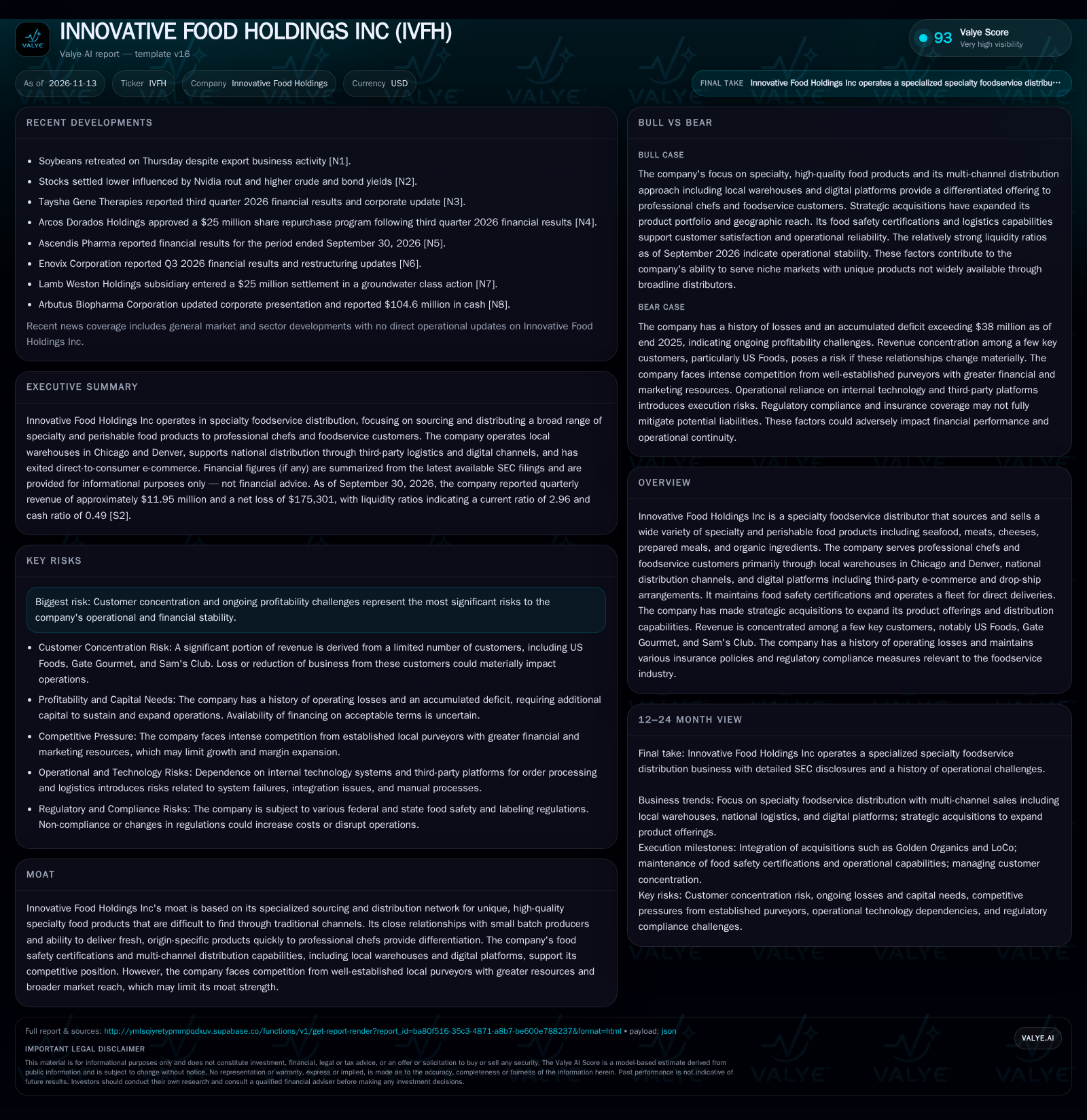
As of Q3 2026, Innovative Food Holdings reported $11.95 million in revenue and a net loss of $175,301, with basic and diluted EPS at -$0.003 [S2]. While these figures reflect a business with meaningful scale, they underscore the company’s ongoing struggle to achieve profitability. The company’s liquidity snapshot—a current ratio of 2.96 and cash ratio of 0.49—indicates reasonable short-term balance-sheet health but does not address the longer-term need to generate positive cash flow [S2].
A critical fact is the company’s acute revenue concentration: US Foods alone accounted for 37% of 2025 consolidated sales [S1]. This dependency leaves the business exposed to contract or relationship changes with a handful of key accounts, which could materially impact revenue and operational continuity.
Recent strategic moves include the acquisition of Golden Organics and LoCo, which expand wholesale organic ingredients and specialty food product sourcing [S1]. The exit from direct-to-consumer e-commerce signals a refocus on B2B and institutional foodservice, streamlining operations toward channels where the company may have more defensible differentiation [S1].
How the Specialty Sourcing Model Shapes Margin Structure and Scale
The core economics of Innovative Food Holdings are rooted in its ability to source specialty and perishable food products—such as origin-specific seafood, artisanal cheeses, and exotic meats—often in small batches and with complex logistics. The company monetizes these products through a blend of local warehouse distribution, national logistics, and digital drop-ship platforms, serving professional chefs and institutional buyers.
Gross margins in specialty foodservice can be higher than in broadline distribution if the company can maintain exclusivity or rapid access to sought-after products. However, the reliance on small-batch and perishable inventory also means higher spoilage risk, more variable COGS, and greater operational complexity. Fixed costs are embedded in warehouse leases, logistics infrastructure, and compliance (GFSI/SQF certifications), while variable costs scale with volume but may be lumpy due to seasonality and customer order patterns.
Recent acquisitions could provide operating leverage if procurement and distribution are integrated efficiently, allowing for better bulk purchasing, cross-selling, and route optimization. However, persistent net losses suggest that the company has not yet reached a scale where fixed costs are sufficiently absorbed, or that gross margins are being pressured by pricing competition or higher input costs. The company’s exit from direct-to-consumer channels may reduce fulfillment complexity and customer service overhead, but it also narrows the total addressable market.
Differentiation vs. Scale: Navigating a Crowded Foodservice Landscape
Innovative Food Holdings’ competitive position hinges on its ability to deliver specialty products not readily available from broadline distributors. Its food safety certifications, relationships with small producers, and multi-channel logistics create a degree of defensibility in niche segments. For chefs seeking unique ingredients, reliability of supply and product provenance are key differentiators.
However, the company faces significant counterforces. Large foodservice distributors can replicate specialty offerings, leverage existing logistics, and offer better pricing or credit terms. Local purveyors may have deeper relationships with regional chefs and can respond faster to changing local tastes. The company’s dependence on a few customers also limits its bargaining power and creates vulnerability to switching or consolidation among buyers.
The recent acquisitions (Golden Organics, LoCo) may help expand the product set and customer reach, but integration and retention of acquired supplier relationships will be critical. Technology integration and logistics optimization may provide moderate process advantages, but are unlikely to create high switching costs absent proprietary sourcing contracts or unique value-added services.
If Acquisitions Deliver Synergies and Customer Diversification, Margin Expansion Could Follow
A favorable trajectory for Innovative Food Holdings would involve successful integration of Golden Organics and LoCo, resulting in a broader portfolio of organic and specialty products and improved procurement leverage. If the company can cross-sell these offerings to its existing customer base and attract new institutional accounts, it could reduce customer concentration and increase order volumes.
Operating leverage could materialize if the company is able to optimize warehouse utilization, reduce spoilage rates, and extract better terms from suppliers. Margin expansion might follow if the company can command premium pricing on unique products while keeping distribution costs in check. Additional upside would be realized if the company lands new national or regional foodservice contracts, or if it creates proprietary branded products with higher repeat purchase rates.
Evidence supporting this scenario would include declining customer concentration (no single customer >25% of sales), sequential improvement in gross and operating margins, and a shift to positive net income. Announcements of new multi-year distribution agreements or successful launch of proprietary brands would further confirm the upside thesis.
Incremental Gains but Enduring Headwinds: The Plausible Middle Course
The most probable near-term outcome is that Innovative Food Holdings continues to operate at modest scale, posting incremental revenue growth from new products and gradual benefit from acquisitions. The business retains its core B2B focus, with some success in expanding the customer base but not enough to fully offset concentration risk.
Margins may improve slightly as integration efficiencies are realized, but fixed costs and competitive pricing pressure from larger distributors keep operating leverage limited. The company maintains food safety certifications, sustains relationships with key customers, and avoids major operational disruptions, but net income remains near break-even or modestly negative.
Confirmation of this scenario would be ongoing revenue and gross margin growth, continued reliance on a handful of large accounts (with some gradual improvement), and neutral to slightly negative quarterly net income. Falsification would occur if customer concentration worsens or if integration synergies from recent acquisitions fail to materialize.
Customer Loss or Margin Compression Could Trigger Financial Stress
The primary risk is a material reduction or loss of business from a key account—particularly US Foods, which accounted for 37% of sales in 2025 [S1]. Such an event could cause a rapid drop in revenue, underutilization of logistics assets, and potential covenant or liquidity stress if the cost base cannot be quickly adjusted.
Intensifying competition from larger distributors could also force price concessions or increase costs to retain customers, leading to margin compression. If integration of recent acquisitions is unsuccessful, the company could face operational disruption, supplier attrition, or inventory write-downs.
A downside scenario would be confirmed by a sharp increase in customer concentration (e.g., one customer >50% of sales), sequential revenue declines, widening net losses, or disclosures of covenant breaches, layoffs, or asset sales. Inability to access additional capital or refinance obligations would compound the risk.
Milestones That Will Clarify the Sustainability of the Specialty Distribution Strategy
Quarterly updates on customer concentration, specifically the percentage of sales from the top three accounts, will be critical for assessing revenue risk.
Gross and operating margin trends, especially after integration of Golden Organics and LoCo, would help test whether acquisitions are delivering expected synergies.
Sequential growth in the number of unique institutional customers served (if disclosed) would indicate successful diversification beyond core accounts.
Announcements of new multi-year distribution agreements or proprietary product launches could signal progress in reducing competitive vulnerability.
Net income and free cash flow trends, particularly any shift to sustained profitability, are essential for validating the company’s ability to absorb fixed costs.
Inventory turnover rates and spoilage/write-off disclosures (if provided) would provide insight into operational efficiency in handling perishable goods.
Any disclosure of renewed or expanded relationships with major customers (e.g., US Foods, Gate Gourmet) would help gauge retention and bargaining power.
Updates on regulatory compliance, food safety certification renewals, or supply chain disruptions would be important for monitoring operational risk.
Disclaimer: This is research-only, informational analysis and not investment advice. It may include AI-generated interpretation and general industry context. Always verify important details using primary sources.

Comments