
American Battery Materials: Ambition, Extraction Uncertainty, and the High-Stakes Bet on Domestic Lithium
With extensive Utah mining claims and a focus on Direct Lithium Extraction, American Battery Materials aims to address U.S. critical mineral needs—but faces acute financial constraints, unproven technology, and a long road to operational validation.
American Battery Materials holds significant lithium and magnesium claims in Utah and is pursuing Direct Lithium Extraction (DLE) to address U.S. critical mineral needs. Its future depends on technical validation, successful capital raises, and regulatory progress, making it a high-risk, high-reward proposition in the domestic minerals race.
American Battery Materials, Inc. stands at the intersection of U.S. critical mineral policy and the technological frontier of lithium extraction. With expansive claim holdings in Utah's Lisbon Valley and a stated commitment to environmentally responsible Direct Lithium Extraction (DLE), the company is attempting to carve out a domestic supply solution for lithium and magnesium—minerals essential to electric vehicles, defense, and clean energy. The core question is whether American Battery Materials can bridge the gap from potential to production before financial and technical realities force a reset.
Where American Battery Materials Stands Today: Claims, Cash, and Capability Gaps
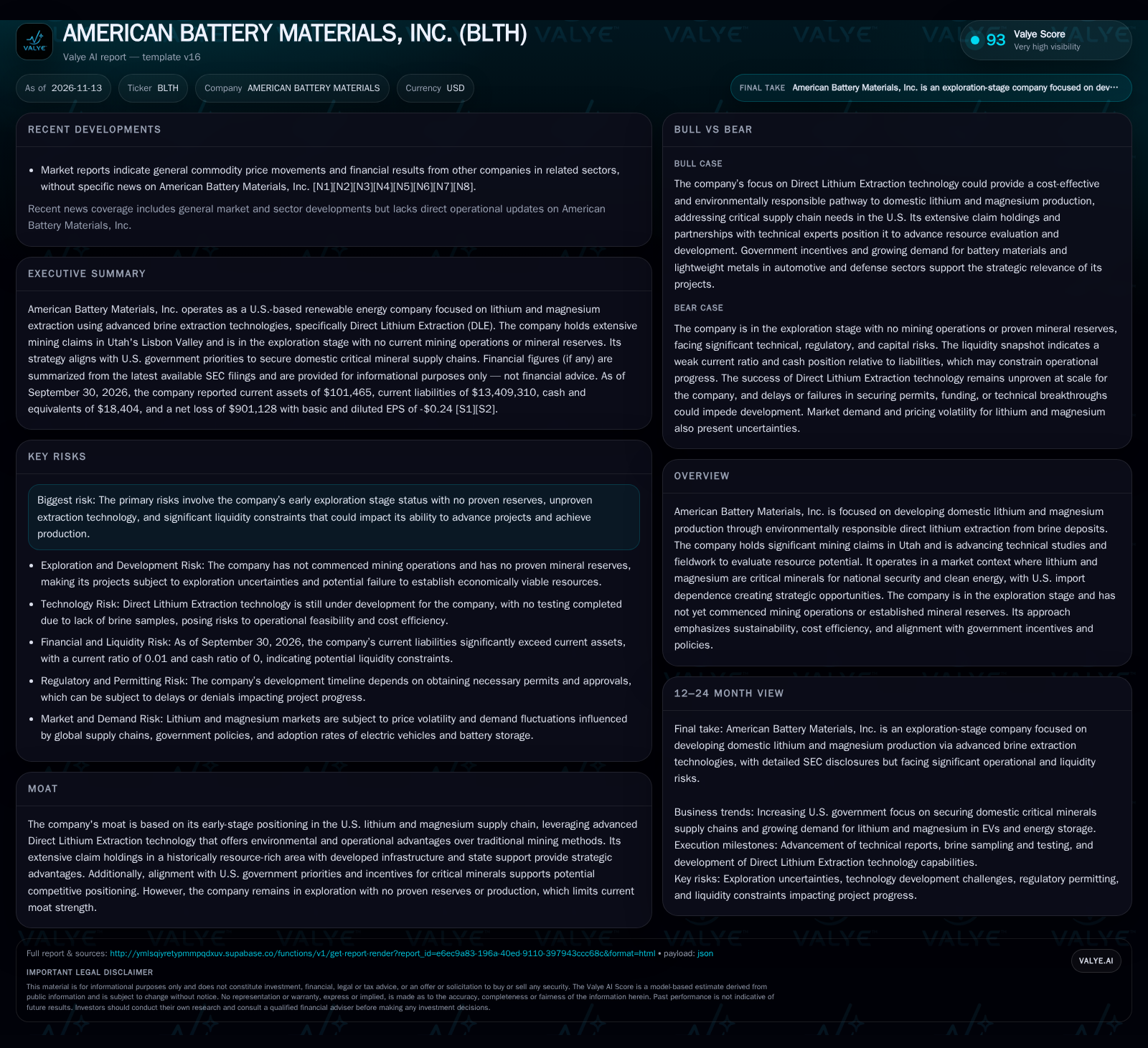
American Battery Materials has accumulated 743 placer mining claims over 14,320 acres in Utah's Lisbon Valley, aiming to extract lithium and magnesium using Direct Lithium Extraction (DLE) technology [S1]. This positions the company strategically as the U.S. seeks to reduce its dependence on foreign sources of critical minerals. However, as of September 30, 2026, the company reports only $101,465 in current assets and $18,404 in cash, against $13.4 million in current liabilities, resulting in a current ratio of 0.01 and a net loss of $901,128 for the period [S2]. No mining operations have begun, no mineral reserves are defined, and DLE technology has not been tested on actual brine samples due to the lack of available material [S1] [S2]. These facts underscore both the scale of the ambition and the immediacy of the financial and operational challenges facing the company.
Prospective Revenue Streams and the Unforgiving Math of Resource Development
American Battery Materials' business model aspires to generate revenue through the extraction, refinement, and sale of lithium and magnesium, primarily for battery and lightweighting markets. DLE technology, if successful, could offer both cost advantages and environmental benefits by reducing water usage and land disturbance compared to conventional mining. In theory, this could translate to premium pricing or lower per-unit costs, especially if government incentives for sustainable sourcing are realized.
However, as an exploration-stage company, it currently generates no revenue and faces substantial fixed costs related to exploration, permitting, technical studies, and R&D. The capital intensity is high: advancing from claim to production typically demands tens to hundreds of millions of dollars for drilling, pilot testing, plant construction, and regulatory compliance. Until mineral reserves are proven and extraction viability is demonstrated, the company is likely reliant on serial equity or debt financing—potentially dilutive or costly given its current balance sheet. Operating leverage could theoretically be significant if production scales, but at this stage, the economics are entirely speculative and hinge on future milestones.
Strategic Opportunity or Crowded Race? Navigating Early-Stage Lithium Competition
American Battery Materials operates in a global landscape where lithium and magnesium are increasingly strategic, with the U.S. aiming to onshore supply chains for clean energy and defense. The company's large claim position in a geologically promising basin and its focus on DLE technology could, if proven, offer differentiation versus traditional hard-rock or evaporation-based producers. Early-stage alignment with national policy objectives may eventually enable access to grants, offtake agreements, or favorable permitting.
However, the competitive field is crowded with established international lithium producers, well-capitalized development-stage peers, and a growing cohort of DLE technology start-ups. Many competitors possess more advanced pilot projects, greater capital resources, or existing customer relationships. Moreover, substitution risk is rising as battery chemistries evolve and alternative sources (such as recycling or unconventional deposits) attract investment. The company's current lack of technical validation and production-ready resources limits its present competitive moat; its position as a potential future domestic supplier is strategic but not yet defensible.
If DLE Delivers: How Technical Breakthroughs and Policy Tailwinds Could Transform the Story
In a favorable scenario, American Battery Materials successfully completes its technical studies, confirms significant lithium and magnesium concentrations through well sampling, and demonstrates DLE process viability on actual brine samples. This would allow the company to define mineral reserves under SEC standards and publish a compliant technical report, unlocking the next phase of development. Concurrently, a supportive regulatory environment—potentially bolstered by U.S. government incentives, grants, or offtake agreements—could lower capital costs and accelerate permitting.
Such progress would make the company a credible candidate for institutional funding or strategic partnerships, enabling the construction of pilot or commercial-scale extraction facilities. If DLE economics prove superior and environmental impact remains low, American Battery Materials could secure premium contracts with battery or automotive OEMs eager for domestic, sustainable supply. Evidence confirming this scenario would include successful brine assay results, a positive preliminary economic assessment, government funding announcements, and the initiation of pilot-scale operations.
The Most Likely Trajectory: Incremental Progress, Capital Constraints, and a Long Validation Timeline
The most plausible path for American Battery Materials over the next 12–24 months is incremental technical and regulatory progress, punctuated by ongoing capital challenges. The company may advance fieldwork with engineering partner RESPEC, complete initial brine sampling, and publish early-stage technical reports. However, without proven reserves or validated DLE performance, it will likely need to raise additional capital—potentially at unfavorable terms given its current liquidity and lack of revenue.
Regulatory approvals and permitting could take longer than expected, and technical hurdles in DLE process optimization may delay pilot testing. The company may remain pre-revenue, with operating losses persisting and dilution risk rising as it seeks ongoing funding. Evidence for this scenario would include capital raises, delays in technical milestones, and continued negative operating cash flow. Conversely, earlier-than-expected technical validation or a major partnership announcement could shift the trajectory toward the upside scenario.
When Exploration and Liquidity Risks Collide: How Failure to Advance Could Force a Reset
The downside scenario materializes if the company is unable to validate commercial lithium or magnesium concentrations in its claims, or if DLE technology proves infeasible or uneconomic in the local geology. Regulatory or permitting setbacks, or a sharp decline in lithium prices, could further undermine project economics and investor appetite.
A failure to achieve key technical milestones or secure bridging capital could force the company to suspend fieldwork, relinquish claims, or pursue a distressed sale or restructuring. Confirmation of this scenario would include negative or inconclusive brine assay results, inability to raise new capital, technical partnership breakdowns, or a formal announcement of project suspension.
Milestones That Will Determine Whether American Battery Materials Moves Beyond Exploration
Successful collection and analysis of brine samples from Lisbon Valley wells, confirming commercially relevant lithium and magnesium concentrations.
Completion and publication of a technical report compliant with SEC Regulation S-K 1300, including resource estimates and economic assessments.
Demonstration of Direct Lithium Extraction technology on field samples, with public disclosure of recovery rates, purity, and environmental metrics—if disclosed.
Announcement of non-dilutive funding sources, such as government grants, strategic partnerships, or offtake agreements with downstream customers.
Securing of key permits and regulatory approvals required to advance to pilot or commercial-scale operations.
Evidence of successful capital raises at reasonable terms, sufficient to fund the next phase of technical development.
Progress toward pilot plant construction, including detailed engineering, vendor selection, and timelines for commissioning—if disclosed.
Updates on lithium and magnesium market conditions, policy incentives, or competitive developments that could affect project economics or strategic relevance.
Disclaimer: This is research-only, informational analysis and not investment advice. It may include AI-generated interpretation and general industry context. Always verify important details using primary sources.

Comments