
BurTech Acquisition Corp II: SPAC Economics, the Blaize Merger, and the Realities of AI Infrastructure Ambitions
BurTech Acquisition Corp II is progressing with its planned merger with Blaize, targeting the AI infrastructure sector amid robust market interest.
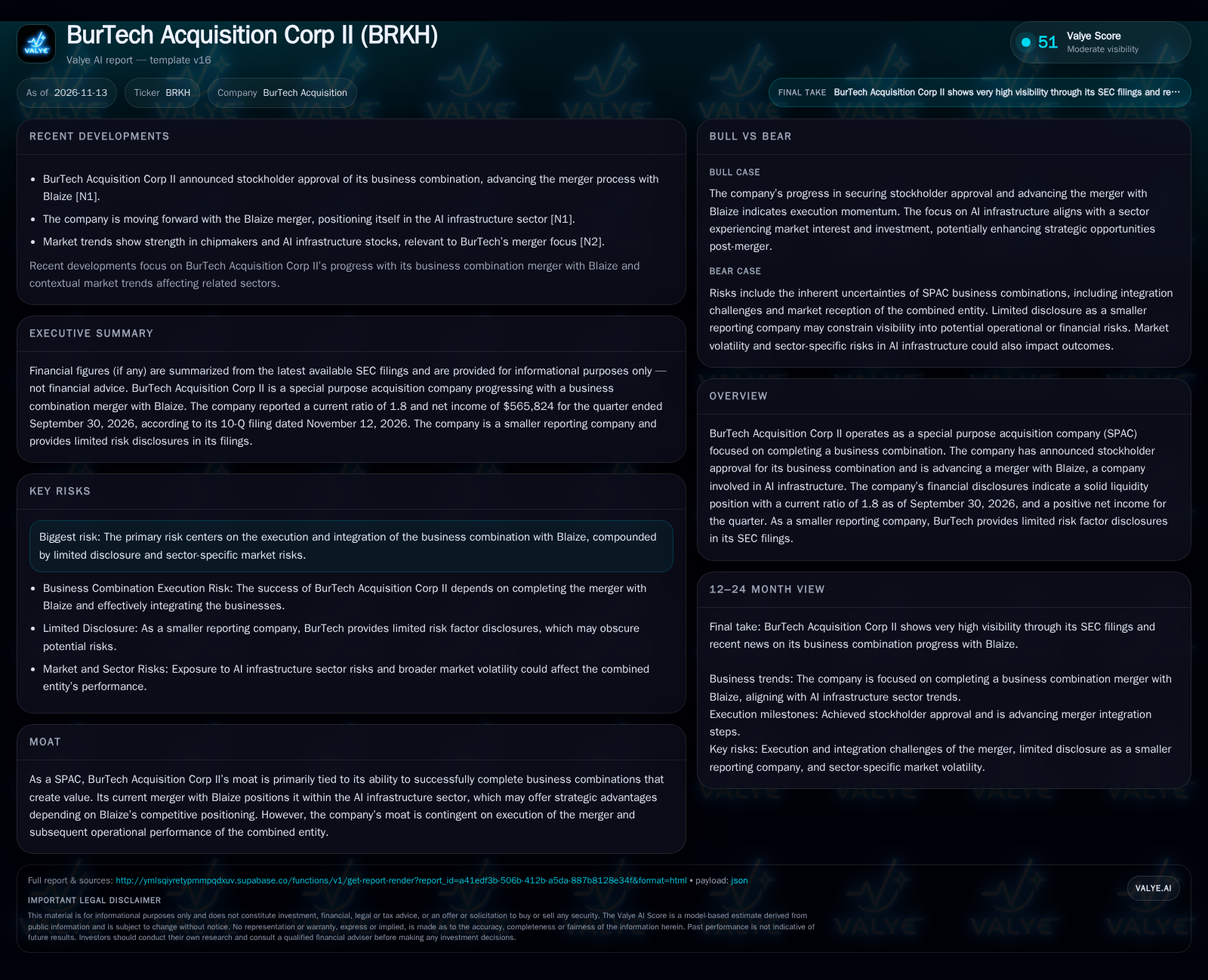
BurTech Acquisition Corp II is a newly public SPAC with $80M in gross IPO proceeds, a current ratio of 1.8, and positive net income driven by trust interest as of September 30, 2026. The company’s thesis now centers on completing its merger with Blaize to enter the AI infrastructure sector, where success will depend on integration execution and the competitive positioning of the combined entity. Sector volatility and limited disclosure as a smaller reporting company remain key uncertainties. [S1] [N1]
BurTech Acquisition Corp II, a blank-check company formed in August 2025, stands at a pivotal stage as it seeks to complete its business combination with Blaize—a move that would anchor it in the fast-evolving AI infrastructure sector. Having completed its IPO in May 2026 and reporting a current ratio of 1.8 and positive net income for Q3 2026, BurTech’s financial profile reflects the typical SPAC pattern: minimal operating activity, trust-driven income, and a balance sheet structured for deal-making. The real test now lies ahead—whether the integration of Blaize can deliver real operating momentum, or whether execution, sector volatility, and limited disclosure will present insurmountable challenges. [S1] [N1]
IPO Proceeds, Trust-Driven Income, and the Pending Blaize Merger
BurTech Acquisition Corp II reported current assets of $784,244 and current liabilities of $435,156 as of September 30, 2026, resulting in a current ratio of 1.8. For the quarter, it posted net income of $565,824, driven entirely by interest earned on marketable securities held in trust, as the company has not yet commenced operating activities. The company completed its $80 million IPO in May 2026, and its only meaningful activity since has been the pursuit of a business combination, culminating in the announced merger with Blaize. This merger, if completed, would transition BurTech from a trust-backed SPAC to an operating company in the AI infrastructure sector. [S1] [N1]
SPAC Structure and Future Operating Model: Economics Before and After the Merger
Prior to a business combination, BurTech’s economics are typical of a SPAC: no operating revenue, minimal expenses, and income limited to interest on IPO proceeds held in trust. The company’s net income of $565,824 for Q3 2026 resulted from $736,700 in trust interest, offset by $170,876 in expenses. This model is inherently temporary—once a merger closes, the economics shift dramatically to those of the acquired operating business.
Post-merger, the revenue model will depend on Blaize’s commercial mechanics, which are not detailed in the current disclosures. If Blaize operates as a typical AI infrastructure provider, it could generate revenue from hardware sales, software licensing, or cloud-based AI services. Each model presents different margin structures: hardware tends to be capital-intensive with lower margins, while software and services could offer higher operating leverage if recurring contracts or usage-based pricing are established. The merged entity’s capital needs, margin profile, and ability to scale will hinge on the nature of Blaize’s product mix and customer contracts, as well as its position in the high-investment AI infrastructure value chain.
AI Infrastructure Ambitions: Differentiation, Competition, and Sector Dynamics
The announced merger would place BurTech (via Blaize) into the AI infrastructure sector—an area experiencing significant capital inflows and competitive intensity. The sector is characterized by rapid technological evolution, large incumbent players (such as major semiconductor firms and cloud infrastructure providers), and a high bar for both performance and reliability. For a newly public company, success will likely require clear technological differentiation, customer adoption, and the ability to scale both production and support.
BurTech’s competitive position post-merger will be shaped by Blaize’s product-market fit: whether it offers unique hardware acceleration, superior software integration, or cost/performance advantages relative to established AI infrastructure providers. The sector’s barriers to entry include not just R&D intensity but also the need for customer trust, long sales cycles, and ecosystem partnerships. If Blaize has already demonstrated traction with major customers or partners, that could provide an initial moat; otherwise, the combined entity may face pressure to prove its value proposition quickly in a crowded market.
If Blaize Delivers: Integration Success and Accelerated Sector Adoption
A favorable outcome would see the BurTech-Blaize merger close smoothly, with the combined entity leveraging IPO proceeds to scale operations and accelerate customer adoption in AI infrastructure. If Blaize possesses differentiated technology—such as proprietary AI accelerators, robust software platforms, or unique cloud integration—this could enable rapid penetration into high-growth verticals like data centers, edge computing, or enterprise AI workloads.
Evidence that would confirm this scenario includes: post-merger disclosures of multi-year customer contracts, recurring revenue streams, or partnerships with major cloud or enterprise players; rapid revenue growth outpacing sector benchmarks; and positive operating leverage as fixed costs are absorbed by growing top-line performance. Announcements of new product launches, marquee customer wins, or ecosystem integrations would further support the upside thesis.
Transition from SPAC to Operating Entity: Typical Integration Hurdles and Gradual Market Entry
The most plausible outcome is that BurTech completes its merger with Blaize, but the transition to an operating public company brings typical integration challenges. These may include aligning management teams, rationalizing costs, and establishing scalable go-to-market strategies. Revenue growth may be modest in the first quarters as the combined entity works to convert pipeline opportunities and build operational infrastructure.
Confirmation of this scenario would come from moderate revenue ramp, initial customer wins (but not at scale), and disclosures of integration costs or delays in product rollout. If the company maintains reported liquidity position and shows sequential improvement in operating metrics, it would suggest a functional, if unremarkable, transition. Conversely, signs of significant customer churn, missed milestones, or persistent losses would challenge the base case.
Execution Risks, Sector Volatility, and the Potential for Value Erosion
Downside risk centers on failure to complete the Blaize merger or, if completed, poor integration and weak commercial traction. As a SPAC, BurTech’s entire value proposition is tied to the success of its business combination; failure to close would likely require liquidation and return of IPO proceeds (minus expenses), erasing any path to operating upside. If the merger closes but Blaize struggles—due to uncompetitive technology, customer losses, or inability to scale—ongoing losses and cash burn could quickly erode the value of the combined entity.
Evidence of this scenario would include: deal delays or termination; post-merger disclosures of significant operating losses; lack of customer traction; or sector-wide downturns in AI infrastructure spending. Additional risk is introduced by BurTech’s limited risk disclosures as a smaller reporting company, which could obscure emerging problems until they become acute.
Milestones and Disclosures That Will Determine the Post-Merger Trajectory
Disclosure of the final terms, closing timeline, and any material changes to the Blaize merger agreement.
Post-merger revenue growth rates, customer acquisition metrics, and contract structure—particularly the mix of recurring versus non-recurring revenue, if disclosed.
Gross margin and operating expense trends in the first quarters post-merger, to assess the scalability of the business model.
Cash balance and burn rate after the merger, especially if significant investment is required to scale operations.
Integration milestones, such as management team alignment and progress on product roadmap or go-to-market execution.
Sector developments in AI infrastructure, including major competitive moves or shifts in customer demand, which could influence adoption rates.
Any updates or expansions to risk disclosures, especially regarding customer concentration, supply chain dependencies, or regulatory exposure, if provided.
Disclaimer: This is research-only, informational analysis and not investment advice. It may include AI-generated interpretation and general industry context. Always verify important details using primary sources.

Comments