
FACT II Acquisition Corp. After the PAD Deal: Countdown Pressure, Execution Risk, and the Realities of SPAC Value Creation
With its initial merger target gone and the November 2026 liquidation deadline looming, FACT II Acquisition Corp. faces a classic SPAC race against time.
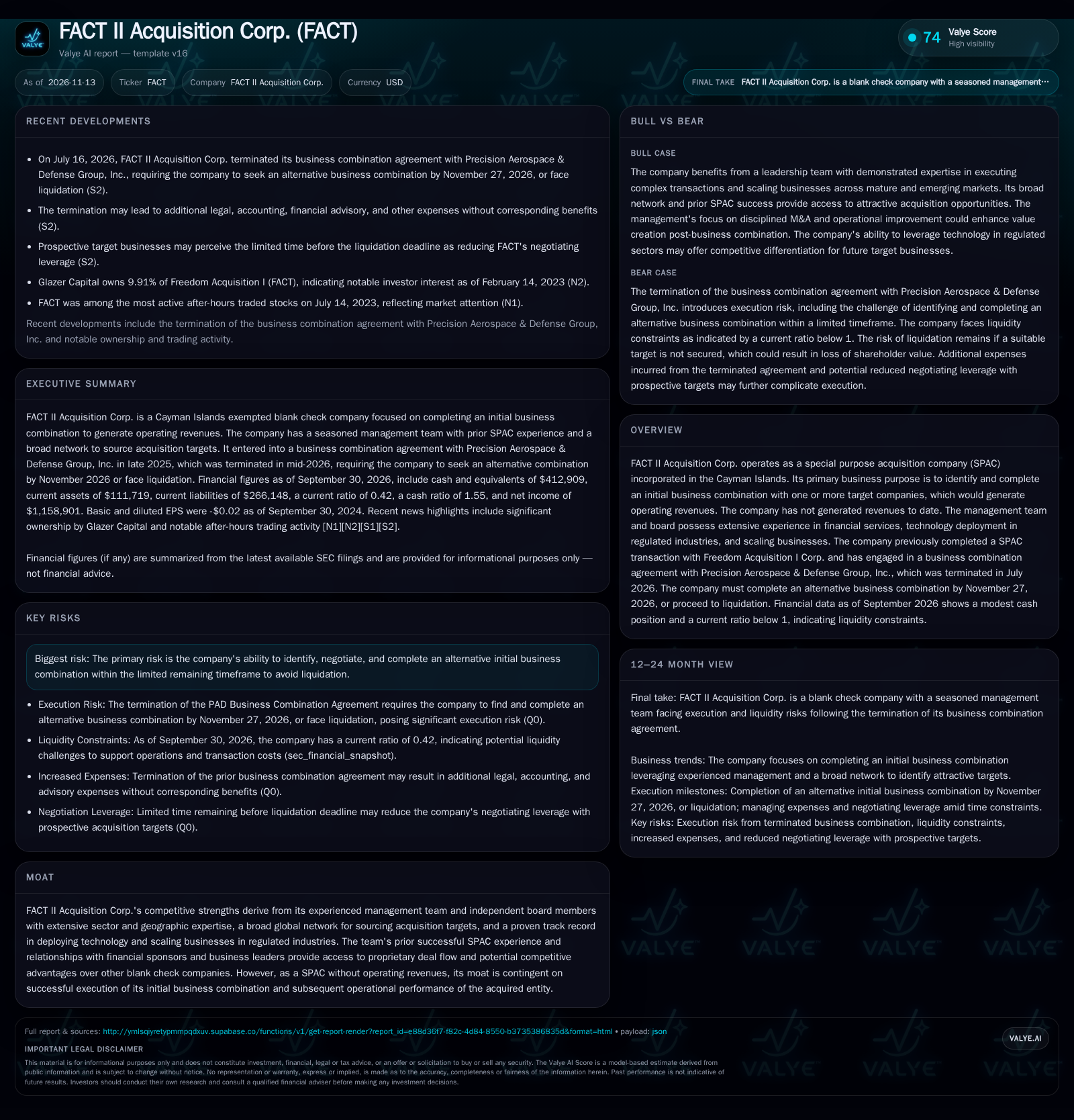
FACT II Acquisition Corp. must secure a new business combination by November 27, 2026, following the termination of its proposed merger with Precision Aerospace & Defense Group. Shareholder value now hinges on the team’s ability to source and close a credible deal under pressure. [S1] [S2]
FACT II Acquisition Corp. now finds itself in the critical phase that defines every SPAC’s lifecycle: the post-termination sprint to secure a viable merger target before a hard liquidation deadline. With the July 2026 collapse of its agreement with Precision Aerospace & Defense Group, the company faces a November 2026 cutoff to complete an alternative business combination. The management team’s strong background in financial services and regulated industries, alongside prior SPAC success, provides a foundation for deal sourcing. However, the clock is ticking, liquidity is tight, and negotiating leverage may be compromised. The next few quarters will determine whether FACT II can convert experience and connections into tangible value—or become another SPAC that fails to beat the clock.
Termination Fallout and the Race Against Liquidation
On July 16, 2026, FACT II Acquisition Corp. terminated its business combination agreement with Precision Aerospace & Defense Group (PAD), voiding its previously identified path to de-SPACing and putting the company back at square one in its search for a target [S2]. This action resets the SPAC’s core challenge: without a completed merger by November 27, 2026, the company is required to liquidate and return remaining funds to shareholders [S2]. The termination exposes FACT II to additional legal, accounting, and advisory expenses, straining already limited resources. The company reported cash and liquidity metrics for the period; these figures do not by themselves establish operating runway, investment capacity, financial flexibility, or financing capacity. [S2] These developments sharply raise the stakes: management must now deliver a credible transaction under time pressure, with less negotiating leverage and fewer financial cushions. The window for value creation is rapidly closing.
How SPAC Economics Work: Incentives, Costs, and Value Creation
FACT II Acquisition Corp., like all SPACs, generates no operating revenue until it completes a business combination; its income to date has been limited to interest earned on IPO proceeds [S2]. The fundamental economics are binary: if a deal closes, the company transitions from a shell to an operating entity, potentially unlocking value for shareholders and sponsors. If the deadline passes without a deal, the company liquidates, and shareholders receive their pro rata share of the trust account—typically at or near IPO price, minus expenses. The sponsor’s incentives are heavily tilted toward closing a deal, since their founder shares and warrants only become valuable in a successful business combination. The economics are further complicated by negotiating leverage: under time pressure, a SPAC may be forced to accept less favorable terms, increasing the risk of overpaying for a marginal target. If a deal is rushed or of poor quality, post-merger value destruction is possible—a dynamic that has plagued many late-stage SPACs.
Deal Sourcing Edge or Race to the Bottom? FACT II’s Place in the SPAC Ecosystem
FACT II’s main differentiators are its management team’s track record and sector expertise, especially in financial services, regulated businesses, and technology-enabled operations [S1]. The team’s prior successful SPAC (Freedom Acquisition I Corp., which merged with Complete Solaria) demonstrates deal-making capacity and an ability to bring complex transactions to close [S1]. In theory, this network and experience could give FACT II access to proprietary deal flow and targets less accessible to generic SPACs. However, the competitive landscape is crowded: dozens of SPACs are chasing a shrinking pool of attractive targets, and the post-2021 SPAC shakeout means many sponsors are now operating under the same deadline-driven pressure. With the PAD deal terminated and the clock ticking, FACT II’s negotiating leverage is impaired—targets know the sponsor is up against a hard deadline, which can tilt terms in the seller’s favor. While the sponsor’s reputation may open doors, the company will need to demonstrate both speed and selectivity to avoid the fate of many SPACs that settled for suboptimal deals or failed to close altogether.
What a Rapid, Quality Deal Could Unlock for Shareholders
If FACT II’s management leverages its network to identify a credible, ready-to-close target—ideally in a sector where operational expertise and technology deployment offer clear value-add—the company could complete a business combination before the November 2026 deadline. The optimal scenario is a target with strong fundamentals and growth prospects that aligns with the team’s strengths, enabling post-merger operational improvement or technology adoption. A successful deal under these circumstances could restore sponsor and shareholder value, possibly resulting in a premium to trust value if the market recognizes the quality of the target and the fit with FACT II’s capabilities. Confirmation of this scenario would come from a timely transaction announcement, supportive PIPE (private investment in public equity) commitments, and positive initial market reaction. Evidence to the contrary would be a lack of announcements, vague deal rumors, or news of ongoing financial stress.
The Most Likely Outcome: A Deal Under Pressure, with Terms Reflecting the Clock
The most plausible outcome is that FACT II, like many late-stage SPACs, manages to secure a deal before the deadline—but with terms that reflect the reduced leverage and urgency. This may take the form of an acquisition of a smaller or less proven company, or a transaction with valuation and structure favoring the target rather than the SPAC’s public shareholders. In this scenario, the deal closes and the company avoids liquidation, but post-merger performance may be mixed, with limited near-term upside for public shareholders. Evidence supporting this middle path would include a transaction announcement close to the deadline, limited PIPE participation, or dilution-heavy deal structures. A lack of significant sponsor investment or tepid market response post-announcement would further confirm a deal done under duress rather than from strength.
When Time Runs Out: Liquidation and Shareholder Losses
If FACT II is unable to identify and close a business combination by the November 27, 2026 deadline, it will be forced to liquidate and return remaining funds in the trust account to shareholders [S2]. In this scenario, not only do sponsors forfeit their founder shares and warrants, but public shareholders may receive less than their IPO investment due to expenses incurred (including those arising from the terminated PAD deal). Additional legal and advisory costs, as well as ongoing administrative expenses, will further erode the trust value. Confirmation of this scenario would come from the absence of deal announcements as the deadline approaches, escalating disclosures of liquidation preparations, or further financial deterioration. A last-minute extension attempt or continued expense accrual without progress would also point toward this outcome.
Milestones That Will Decide FACT II’s Fate in the Final Months
Announcement of a new business combination agreement—timing, target industry, and deal structure will be crucial signals.
Updates on PIPE (private investment in public equity) participation or other external capital commitments, if disclosed, to gauge market confidence in the proposed deal.
Changes in cash and current asset balances in subsequent filings—declining balances would raise the risk of value erosion prior to a deal or liquidation.
Disclosure of additional legal, advisory, or transaction-related expenses—these will directly reduce trust value and shareholder returns.
Any SEC filings or press releases discussing deadline extensions, liquidation preparations, or changes in sponsor support.
Market reaction to any announced deal, including trading volume and price movement in the days following the announcement.
Sponsor or management team purchases or sales of shares, if disclosed, as a signal of confidence or concern regarding deal prospects.
Disclaimer: This is research-only, informational analysis and not investment advice. It may include AI-generated interpretation and general industry context. Always verify important details using primary sources.

Comments