
TMC the metals Co Inc.: Seafloor Polymetallic Nodules, Regulatory Hurdles, and the Prospect of a New Critical Minerals Supply Chain
TMC is advancing deep-sea mineral development in the Clarion Clipperton Zone, targeting a multi-metal resource vital to future supply chains—but its commercial future hinges on regulatory outcomes, technical execution, and market acceptance for seabed-sourced metals.
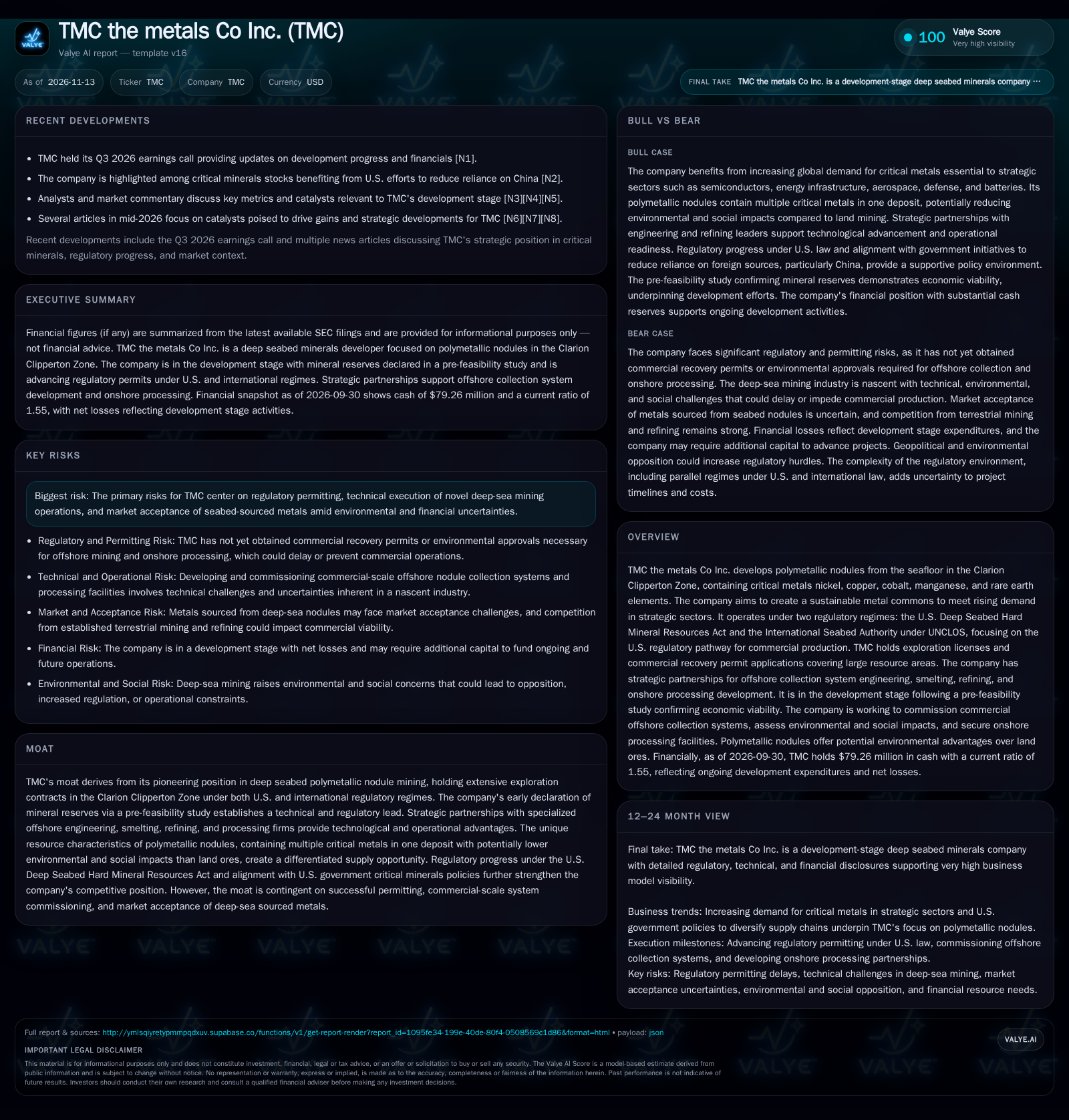
TMC the metals Co Inc. holds exploration rights to vast polymetallic nodule resources in the Clarion Clipperton Zone, aiming to supply nickel, copper, cobalt, and manganese to critical industries. The company is still pre-revenue, with $79.26 million in cash as of September 2026 and ongoing net losses. Key catalysts include regulatory permitting, technical scale-up of offshore collection, and validation of environmental claims. Success could unlock a differentiated, lower-impact supply of critical metals, but failure to secure permits or overcome technical and market barriers would materially impair the investment case. [S1] [S2]
TMC the metals Co Inc. is attempting to pioneer a new front in the global critical minerals supply chain by developing deep-sea polymetallic nodules in the Clarion Clipperton Zone. These nodules offer a potentially massive, multi-metal resource with characteristics that may lower environmental and social impacts compared to land-based mining. Backed by a pre-feasibility study and a suite of strategic partnerships, TMC is positioning itself as a future provider of nickel, copper, cobalt, and manganese to sectors ranging from semiconductors to batteries. Yet, the company remains pre-revenue, with its future tied to regulatory approval, technical execution, and acceptance of seabed metals by the market and society. The outcome will determine whether TMC becomes a lynchpin of the next-generation metals supply chain or an early casualty of the industry's formidable hurdles.
Development-Stage Progress, Resource Scale, and Financial Position Shape TMC’s Near-Term Outlook
TMC is in the development phase, holding exploration contracts and recovery permit applications that cover large swathes of the Clarion Clipperton Zone (CCZ). The company’s resource estimates are substantial: 1.639 billion wet tonnes of nodules, containing approximately 15.5 million tonnes of nickel, 12.8 million tonnes of copper, 2.0 million tonnes of cobalt, and 345 million tonnes of manganese. These metals are all critical for sectors such as semiconductors, data centers, batteries, and defense, making the resource strategically significant. [S1]
The company’s pre-feasibility study (NORI-D PFS) was a milestone, declaring the first mineral reserves for a seafloor polymetallic nodule project and suggesting economic viability. However, TMC is not yet generating significant revenue—just $410,000 as of mid-2024—and continues to post net losses, with negative $28.36 million net income as of September 2026. Cash stood at $79.26 million, with a current ratio of 1.55. The company reported cash and liquidity metrics for the period; these figures do not by themselves establish operating runway, investment capacity, financial flexibility, or financing capacity. [S2]
Strategic partnerships—spanning offshore engineering (Allseas), smelting (Pacific Metals), refining (Korea Zinc), onshore processing (Mariana Minerals), and offtake (Glencore)—suggest a holistic approach to building the supply chain, but the commercial terms, sequencing, and exclusivity of these arrangements have not been detailed. [S1]
Unlocking Value from Polymetallic Nodules: Potential Economics, Cost Drivers, and Funding Requirements
TMC’s prospective business model centers on extracting, processing, and selling multiple high-value metals from a single nodule resource. If commercialized at scale, this could confer volume and mix advantages—each tonne of nodules contains a blend of nickel, copper, cobalt, and manganese, potentially allowing for revenue diversification and operational leverage across commodity cycles.
The fixed-cost structure is likely to be high in early phases, with substantial upfront capital required for offshore collection systems, onshore processing facilities, environmental compliance, and regulatory engagement. Variable costs would include vessel operations, maintenance, and processing reagents. The ability to amortize fixed infrastructure over large, long-lived deposits could drive strong operating leverage if high throughput is achieved, but the flip side is high break-even volumes and limited flexibility if production is delayed or constrained.
Revenue realization will depend on successful metal recovery yields, the efficiency of the processing chain, and access to buyers—potentially facilitated by offtake agreements with partners like Glencore. Pricing will be set in global commodity markets, but TMC could command a premium if it can credibly demonstrate lower environmental and social impact compared to land-based mining. However, this premium remains hypothetical until confirmed by customer contracts or market evidence.
How TMC’s Seafloor Model Could Reshape—and Be Challenged by—Critical Metals Supply Chains
TMC’s principal potential advantages are rooted in resource quality and regulatory positioning. The ability to extract multiple critical metals from a single seabed resource could simplify logistics and reduce the need for multiple mining sites, while the absence of overburden removal and surface disruption may appeal to stakeholders sensitive to environmental and social impacts.
Strategic partnerships with leading engineering, refining, and offtake entities may provide technical expertise, market access, and credibility. Early declaration of mineral reserves via the NORI-D PFS gives TMC a first-mover status among deep-sea mining aspirants.
However, counterforces are formidable. Terrestrial miners have established infrastructure, supply chains, and customer relationships. They benefit from decades of process optimization, regulatory clarity, and scale. Deep-sea mining faces not only technical uncertainty but also potential regulatory tightening as environmental scrutiny intensifies globally. Alternative technologies—such as direct recycling of batteries or substitution of metals in key applications—could also erode long-term demand.
The ultimate test will be whether TMC’s product is accepted by high-value customers (e.g., battery and EV manufacturers) and whether regulatory and social license to operate can be maintained at scale.
If Regulatory Breakthrough and Technical Success Converge, TMC Could Catalyze a New Metals Paradigm
The most favorable scenario for TMC involves a sequence where the company secures all necessary commercial recovery and environmental permits, successfully commissions its offshore collection system, and demonstrates reliable, scalable production of high-purity metals. Strategic partnerships would transition from development-stage support to binding commercial contracts, and offtake agreements would underpin predictable revenue streams.
If environmental impact studies validate the company’s claims of lower disruption compared to terrestrial mining—and if these findings are accepted by regulators, NGOs, and major industrial customers—TMC could secure a social license to operate and potentially command a price premium for its metals.
What would confirm this scenario? Announcements of final permit approvals, successful offshore system trials at commercial scale, signed long-term offtake contracts (especially with Tier 1 battery or EV manufacturers), and evidence of customer willingness to pay for ‘cleaner’ metals would all be validating. Rapid growth in revenue and a narrowing of operating losses would further support the bullish thesis.
Incremental Progress Amid Regulatory Delays and Capital Needs: A Probable Trajectory
The most plausible near- to medium-term outcome is that TMC continues to advance through a series of incremental milestones—progressing technical development, environmental studies, and regulatory engagement, but at a slower-than-hoped-for pace. Permitting processes under both U.S. and international regimes may stretch over multiple years, with additional requests for data or revisions prolonging the timeline to first commercial production.
Development expenditures will likely continue to outpace revenue, leading the company to seek additional capital before full-scale operations are reached. Partnerships may deepen, but offtake agreements and customer adoption will hinge on visible progress in both technical and regulatory realms.
Evidence confirming this scenario would include periodic updates on system engineering, pilot-scale trials, new environmental study results, and interim funding rounds. Delays or extensions in permitting timelines, as well as continued net losses, would be consistent with this base case. A shift toward commercial revenue would require clear, public evidence of regulatory and technical de-risking.
Permitting Failures or Technical Setbacks Could Derail TMC’s Commercialization Prospects
The bear case centers on one or more of the following: failure to obtain commercial recovery or environmental permits, major technical breakdowns in the offshore collection system, or a negative shift in public or customer sentiment toward deep-sea mining. Any of these could strand TMC’s resource and investments, leading to a prolonged period of cash burn and ultimately forcing a strategic pivot, asset sale, or wind-down.
A tightening of international or U.S. regulatory regimes in response to environmental activism, or major negative findings from environmental impact assessments, could materially increase costs or make seabed mining unviable. Technical setbacks—such as inability to reliably collect, transport, or process nodules at scale—would erode confidence in the operating model.
Confirmation of this scenario would come from permit denials, adverse regulatory or court decisions, major cost overruns or technical failures, or public announcements by partners withdrawing from the project. Persistent net losses without progress toward commercialization would also be a warning sign.
Milestones and Metrics That Will Determine Whether TMC Can Deliver on Its Metals Commons Vision
Final approval or rejection of commercial recovery and environmental permits under both U.S. and International Seabed Authority regimes.
Successful commissioning and operational reliability of the offshore nodule collection system, as demonstrated by pilot or commercial-scale trials.
Execution and disclosure of binding, long-term offtake agreements with major industrial customers or trading houses—especially those in battery, EV, or energy sectors.
Results from independent environmental and social impact assessments, and subsequent stakeholder (regulatory, NGO, customer) acceptance.
Clarity on capital requirements and the company’s ability to secure additional funding without excessive dilution or unfavorable terms.
Progress in onshore processing and refining partnerships, including any joint ventures or facility construction milestones.
If disclosed, actual recovery yields and processing economics from pilot or early commercial runs would help test the thesis.
Evolving policy and public sentiment toward deep-sea mining, including any shifts in U.S. or international regulatory frameworks.
Disclaimer: This is research-only, informational analysis and not investment advice. It may include AI-generated interpretation and general industry context. Always verify important details using primary sources.

Comments