
Bio Green Med Solution: Liquidity Strength, Customer Concentration, and the Realities of Fire Safety Distribution
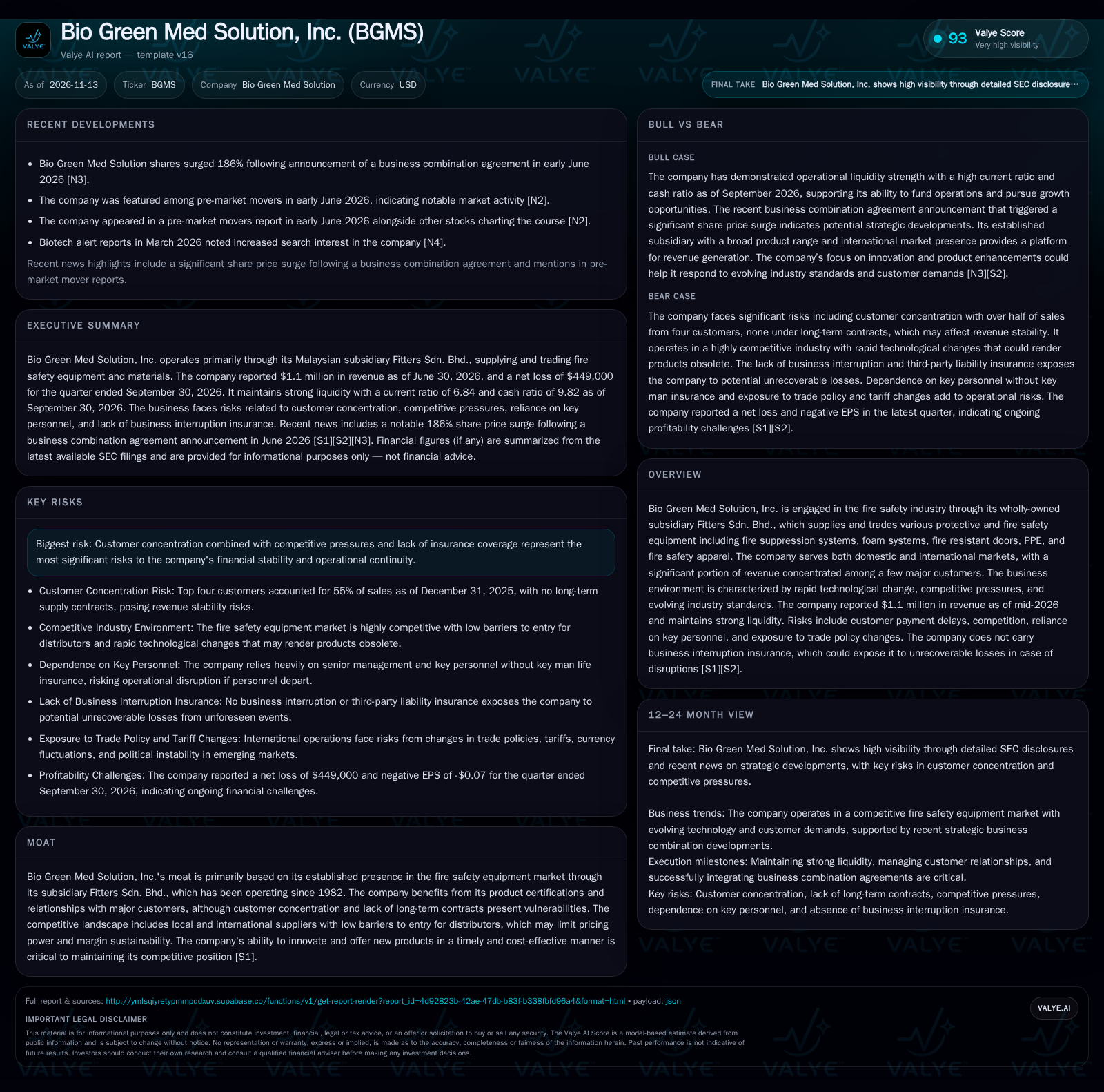
Bio Green Med Solution, through its Malaysian subsidiary Fitters Sdn. Bhd., operates in the competitive fire safety equipment market.
Execution on integration, innovation, and customer diversification will be critical to sustain momentum and mitigate downside scenarios [S1] [S2] [N3].
With more than half of its revenue tied to just four customers—none secured by long-term contracts—the company’s revenue base remains vulnerable. Meanwhile, persistent net losses underscore the difficulty of achieving sustainable profitability in a commoditized and rapidly evolving fire safety market. How the company leverages its liquidity, navigates customer concentration, and adapts to industry shifts will determine whether recent momentum translates into durable value.
Recent Strategic Moves and Financial Position Shape the Near-Term Outlook
The company reported cash and liquidity metrics for the period; these figures do not by themselves establish operating runway, investment capacity, financial flexibility, or financing capacity. [S2] However, profitability remains elusive, with a net loss of $449,000 for the most recent quarter and negative EPS [S2]. The headline development of a 186% share price surge in June 2026 followed a business combination agreement announcement, indicating renewed investor focus and potential strategic change [N3]. Yet, customer concentration risk looms large, as 55% of sales are tied to just four customers, none of whom have long-term contracts [S1]. This combination of potential financial flexibility and vulnerability to revenue shocks sets the stage for the company’s next chapter.
How Fire Safety Distribution Economics Impact Profitability and Growth
Bio Green Med Solution’s business model relies on the trading and installation of fire safety equipment—an industry where revenue is typically driven by project-based sales, tender wins, and ongoing product supply to commercial and industrial clients. Without long-term supply contracts, the company’s revenue stream is lumpy and highly dependent on repeat business from a small set of customers, increasing volatility and forecasting difficulty.
Gross margins in fire safety equipment distribution are generally thin, reflecting commoditized products and price-based competition. The company’s lack of business interruption and third-party liability insurance adds potential tail risks—any major disruption could result in unrecoverable losses, with no financial cushion from insurance payouts.
Operating leverage is likely moderate: while the distribution business can scale with volume, fixed costs (such as warehousing and personnel) are relatively low compared to manufacturing models. Profitability thus hinges on maintaining sales volume, cost discipline, and competitive pricing rather than on significant margin expansion. The recent net loss suggests that current sales levels are insufficient to cover overhead and competitive pricing pressures.
Assessing Moat and Vulnerability in a Fragmented, Low-Barrier Market
Bio Green Med Solution’s competitive position is anchored by its established Malaysian subsidiary, Fitters Sdn. Bhd., which has operated since 1982. This legacy provides some advantages in customer relationships and product certifications, but the fire safety distribution market is inherently fragmented and characterized by low barriers to entry for both local and international suppliers.
The lack of long-term contracts with major customers limits switching frictions and pricing power. Competitors can undercut on price or offer newer technologies, threatening both retention and margin. Product obsolescence risk is real, as rapid technological change can render inventory less desirable or even non-compliant with evolving standards. Incumbency and reputation help with customer trust, but are insufficient to guarantee recurring revenue in the absence of contractual lock-in.
International expansion exposes the company to additional risks from trade policy changes, tariffs, and currency fluctuations, while customer concentration amplifies the impact of any lost account. The company’s ability to innovate—whether through new product introductions or expanded service offerings—will be critical to defending share and sustaining growth.
Strategic Integration and Customer Diversification Could Unlock Durable Growth
A favorable scenario for Bio Green Med Solution would see the recent business combination agreement catalyze operational and strategic transformation. If integration brings access to new markets, expanded product lines, or improved distribution capabilities, the company could reduce its dependence on a handful of customers and achieve more stable, diversified revenue.
Confirmation would come from a material increase in customer count, new recurring contracts, or successful entry into higher-margin product categories. Evidence of improving gross margins, declining customer concentration, or sustained top-line growth beyond project-based volatility would further support the upside thesis. Strategic investments in product development or digital platforms that enhance customer stickiness could also signal a durable shift toward recurring, higher-quality revenue streams.
Falsification would occur if, after the business combination, customer concentration remains high, margin pressure persists, and no material change is observed in revenue stability or contract structure.
Maintaining the Status Quo: Volatility Persists Amid Incremental Improvement Efforts
Incremental improvements—such as modest customer wins, tighter cost controls, or selective product upgrades—could help narrow losses, but are unlikely to fundamentally alter the business’s economics. Confirmation of this base scenario would include continued high customer concentration, persistent net losses (or only marginal improvement), and absence of multi-year customer contracts or major new product launches.
Falsification would occur if the company demonstrates a meaningful shift in revenue mix, secures multi-year agreements, or achieves sustained profitability through operational leverage or higher-margin offerings.
Revenue Shock or Major Disruption Could Accelerate Losses and Erode Liquidity
A negative outcome could be triggered by the loss of one or more major customers, a failed integration of the new business combination, or a significant disruption—such as supply chain interruption, regulatory change, or uninsured event. Given that 55% of revenue comes from just four customers, even a single lost relationship could cause a sharp revenue contraction, exposing the company’s fixed cost base and rapidly increasing losses.
The lack of business interruption insurance compounds this risk: a fire, flood, or other disaster could result in unrecoverable losses and operational downtime. Intense price competition from existing or new entrants could force further margin compression, while rapid technological change could leave the company with obsolete inventory and reduced relevance in tenders.
Confirmation would come from a sharp sequential drop in revenue, accelerated cash burn, or new disclosures of customer loss or major project failures.
Milestones That Will Shape Bio Green Med Solution’s Next Chapter
The proportion of revenue from the top four customers in upcoming filings—declining concentration would suggest progress on diversification.
Disclosures of new or renewed long-term supply contracts, which would enhance revenue visibility and test the company’s ability to secure recurring business.
Gross margin trends—improvement could indicate successful product or service differentiation; compression may flag intensifying price competition.
Quarterly revenue growth or volatility, especially in the context of tender wins or losses, to gauge the health of the project pipeline.
Updates on the implementation and integration of the business combination agreement—details on new capabilities, customer wins, or expanded geographies would help assess strategic impact.
Cash flow from operations and changes in the cash balance, especially if disclosed alongside major investments, customer losses, or disruptions.
Evidence of investment in product innovation, certification upgrades, or digital sales platforms, which would help test the company’s adaptability to technological change.
Disclaimer: This is research-only, informational analysis and not investment advice. It may include AI-generated interpretation and general industry context. Always verify important details using primary sources.

Comments