
Silexion Therapeutics: RNAi Ambitions, Clinical Progress, and the Realities of Capital-Dependent Oncology Innovation
Silexion’s push to advance its RNAi drug SIL204 for KRAS-driven cancers is defined by scientific promise, ongoing clinical risk, and the necessity of maintaining capital market access. The company’s recent reverse split and authorized share increase show the importance of Nasdaq compliance to its financing roadmap, while early trial data and partnerships suggest a plausible path to value if clinical milestones are met.
Silexion Therapeutics is advancing SIL204, an RNAi therapy targeting KRAS-driven cancers, through Phase 2/3 trials, supported by positive preclinical results and a strategic Catalent partnership. With $4.76M in cash as of September 2026, the company faces ongoing net losses, Nasdaq compliance pressures, and a critical need for future capital raises. Successful clinical outcomes and continued market listing are essential for Silexion’s ability to unlock value.
Silexion Therapeutics embodies the high-stakes, capital-intensive realities of clinical-stage oncology biotech. Its lead RNAi candidate, SIL204, targets the notoriously tough KRAS-driven cancer segment—a space with significant unmet need but daunting scientific and commercial hurdles. As Silexion advances through Phase 2/3 trials, recent reverse share splits and an urgent focus on Nasdaq compliance underscore that the company’s ability to fund its ambitions is as critical as its clinical progress. The coming quarters will test both its science and its capital strategy.
Recent Moves Define Silexion’s Pivotal Moment: Clinical Progress Meets Financing Imperatives
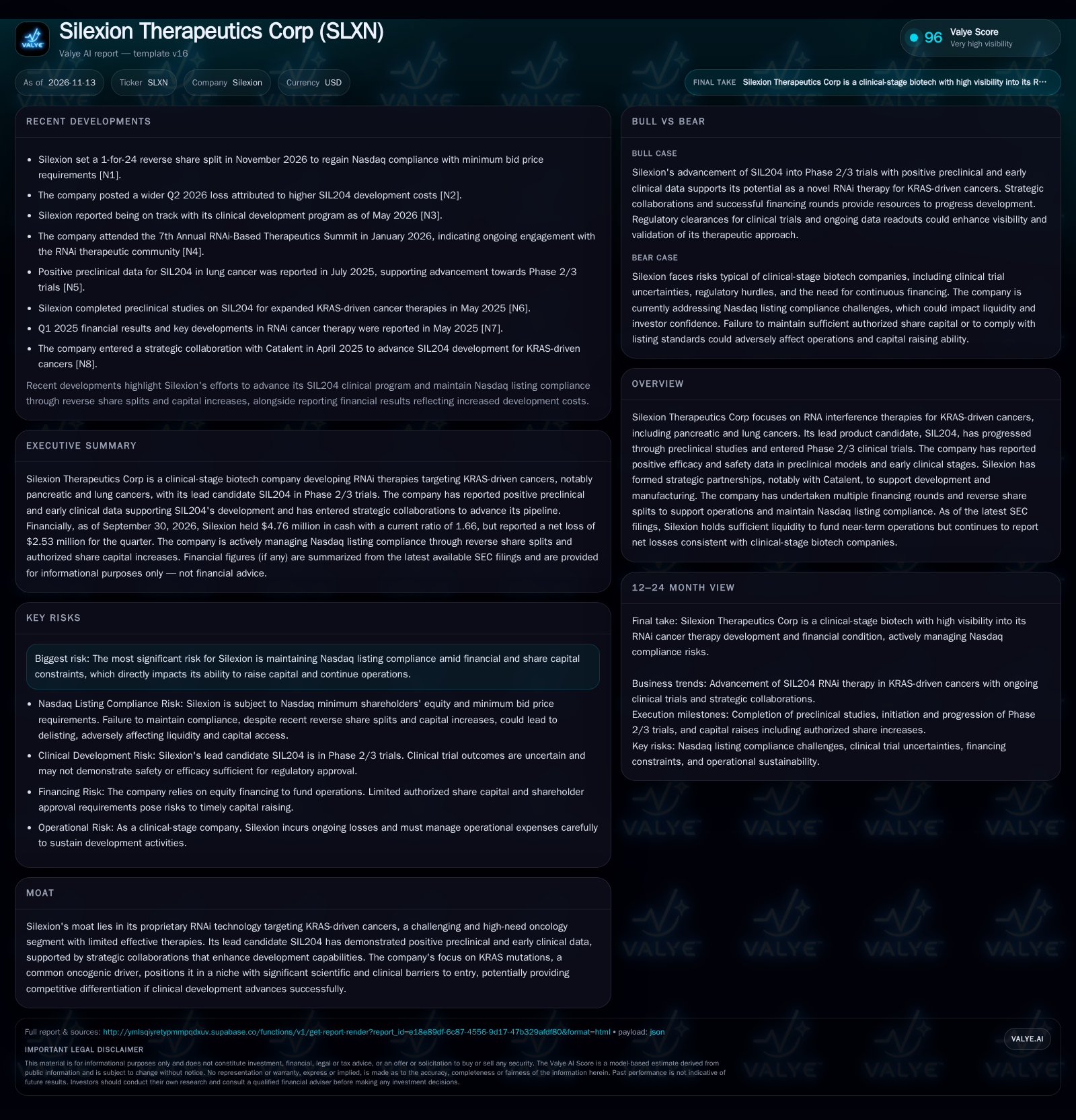
Silexion Therapeutics is at a strategic crossroads, with several recent actions shaping its immediate outlook. The company’s lead asset, SIL204, is in Phase 2/3 trials for pancreatic cancer—a notoriously difficult indication—and has shown positive preclinical results in both pancreatic and lung cancer models [S2] [N5] [N6]. This progress supports continued development but comes with escalating R&D costs, as reflected in a $2.53 million net loss for the quarter ended September 2026 [S2]. The company reported cash and liquidity metrics for the period; these figures do not by themselves establish operating runway, investment capacity, financial flexibility, or financing capacity. [S2]
To preserve its Nasdaq listing—a prerequisite for equity raises and institutional investor access—the company executed a 1-for-24 reverse share split in November 2026 and secured shareholder approval to increase authorized shares after prior failed attempts [N1] [S2]. These moves are not cosmetic: they directly affect Silexion’s ability to raise new capital, which is essential for progressing SIL204 and supporting ongoing R&D.
The Economics of RNAi Drug Development: High Burn, Binary Outcomes, and Relentless Need for Capital
Silexion’s business model follows the classic clinical-stage biotech template: invest heavily in R&D to advance one or more high-potential assets through clinical proof-of-concept, then seek value through out-licensing, partnerships, or eventual commercialization. Revenue is non-existent at this stage; expenses are dominated by research, clinical trial execution, regulatory filings, and G&A. The company’s net loss of $2.53 million for the most recent quarter is in line with typical burn rates for similar-stage oncology biotechs [S2].
The company’s cash resources—$4.76 million as of September 2026—are sufficient for near-term obligations but do not provide runway through late-stage trials or commercialization [S2]. Silexion’s ability to raise additional equity is contingent on maintaining its Nasdaq listing and sufficient authorized share capital. The recent shareholder vote to increase authorized shares is thus not just a governance event but a gating factor for continued operations [S2].
Economically, the company’s prospects hinge on clinical milestones: positive Phase 2/3 data could enable lucrative partnerships or licensing deals, while negative or ambiguous results would likely close off financing options. Fixed costs are relatively low outside of R&D, but variable costs escalate with trial progression. There is no current product revenue, and the company is structurally loss-making until (and unless) a pivotal clinical success is achieved.
KRAS: A Hard Target, a Crowded Field, and the Search for Differentiation in Oncology
Silexion’s focus on RNAi therapies for KRAS-driven cancers places it in a highly competitive, scientifically challenging segment. KRAS mutations are among the most common oncogenic drivers in pancreatic and lung cancers, but have long been considered ‘undruggable’ due to the protein’s structure and biological role. Recent advances—particularly small-molecule inhibitors for specific KRAS mutations—have increased competition for this target class, with both large pharma and innovative biotechs pursuing diverse modalities.
Silexion’s differentiation rests on its RNAi approach, which theoretically allows for the silencing of a broader range of KRAS mutations than mutation-specific small molecules. However, this comes with delivery and durability challenges: effective RNAi therapies require sophisticated delivery mechanisms to reach tumor cells in vivo, a hurdle that has limited the commercial success of most RNAi cancer drugs to date.
The company’s strategic collaboration with Catalent may help address some development and manufacturing bottlenecks [N8]. Still, Silexion must contend with well-capitalized competitors, rapid advances in adjacent modalities (including targeted protein degraders and next-generation small molecules), and the ever-present risk that a competing technology will outperform or outpace its own clinical progress.
If SIL204 Delivers: Clinical Breakthroughs as the Catalyst for Value Creation
The most favorable scenario is one where SIL204 demonstrates clear, statistically significant efficacy and safety in its Phase 2/3 clinical trial for pancreatic cancer. Such a result would validate Silexion’s core scientific approach and provide a strong foundation for raising additional capital, securing partnerships, or even pursuing accelerated regulatory pathways.
In this scenario, Silexion could attract interest from larger pharmaceutical companies seeking to bolster their oncology pipelines, particularly if SIL204 shows activity across multiple KRAS-driven tumor types. The company’s collaboration with Catalent would be an asset, supporting rapid scale-up and regulatory compliance [N8].
Confirmation of this scenario would require: (1) robust, peer-reviewed clinical data demonstrating efficacy in a high unmet-need population, (2) clear communication of regulatory progress (e.g., FDA meetings, Breakthrough Therapy or Fast Track designations if achieved), and (3) evidence of non-dilutive or partnership funding that extends financial runway. Failure to achieve meaningful clinical endpoints, or inability to differentiate from competitors, would falsify this upside.
Sustained Capital Raising and Incremental Clinical Progress: The Most Likely Near-Term Trajectory
The most plausible scenario is that Silexion continues to make incremental clinical progress with SIL204, accompanied by periodic capital raises through equity offerings enabled by its recent share authorization increase and continued Nasdaq listing. Clinical data may be mixed or early, with ongoing enrollment and readouts extending over several quarters.
In this case, the company remains structurally loss-making, with cash inflows tied primarily to new equity or warrant exercises, and outflows dominated by R&D. The strategic partnership with Catalent may help streamline development, but major value inflection is deferred until stronger clinical signals emerge [N8].
This scenario is confirmed by ongoing Nasdaq compliance, steady (but not transformative) progress in clinical trials, and recurring announcements of financing activity. It would be falsified by a clinical hold, major negative data, or loss of listing—any of which could trigger a strategic reset or force a search for partners under distressed terms.
Delisting, Trial Failure, or Financing Breakdown: What Could Derail Silexion’s Ambitions
The most adverse scenario is one in which Silexion fails to maintain Nasdaq compliance—whether due to minimum equity, bid price, or other listing requirements—leading to delisting and severely restricted access to public equity markets. This would constrain or halt clinical development, forcing the company to rely on dilutive private financings or to seek a strategic transaction under unfavorable terms [S2] [N1].
Clinical risk is equally acute: if SIL204 fails to demonstrate efficacy or is associated with unexpected safety signals in Phase 2/3, the company’s scientific thesis would be undermined and future funding options likely foreclosed. In this case, Silexion could be forced to suspend trials, lay off staff, or liquidate assets.
Confirmation of this downside would come from (1) Nasdaq delisting notices not remedied by corporate actions, (2) negative or inconclusive clinical trial updates, (3) cancellation or delay of strategic partnerships, and (4) disclosure of ‘going concern’ risk or inability to raise capital at viable terms. Avoiding these outcomes depends on both operational execution and favorable external conditions.
Milestones and Metrics That Will Define Silexion’s Clinical and Financial Trajectory
Progress and data readouts from SIL204 Phase 2/3 trials in pancreatic cancer—efficacy, safety, and regulatory feedback would directly affect valuation and capital-raising ability.
Nasdaq listing status: any communication regarding compliance extensions, delisting risk, or further reverse splits will impact Silexion’s access to public equity markets.
Shareholder votes or actions regarding authorized share capital—additional increases or failed attempts could signal financing constraints or dilution risk.
Updates on the Catalent partnership: specifics on manufacturing readiness, scale-up, or expanded collaboration would help test the company’s ability to meet clinical and commercial supply demands.
Any clinical holds, trial discontinuations, or major safety events associated with SIL204—a critical red flag for ongoing development.
Disclosure of new strategic partnerships, non-dilutive financing, or licensing deals—if announced, these would validate the underlying science and reduce financial risk.
A useful metric would be patient enrollment rates and trial site activation for SIL204 studies, if disclosed, as a proxy for operational momentum.
Disclaimer: This is research-only, informational analysis and not investment advice. It may include AI-generated interpretation and general industry context. Always verify important details using primary sources.

Comments