
Pyrophyte Acquisition Corp. II and the Sakuu Deal: Dilution, Governance, and the Realities of SPAC Value Transfer
Pyrophyte Acquisition Corp. II’s merger with Sakuu Corporation brings the SPAC’s structural incentives, dilution mechanics, and Cayman governance framework into sharp focus.
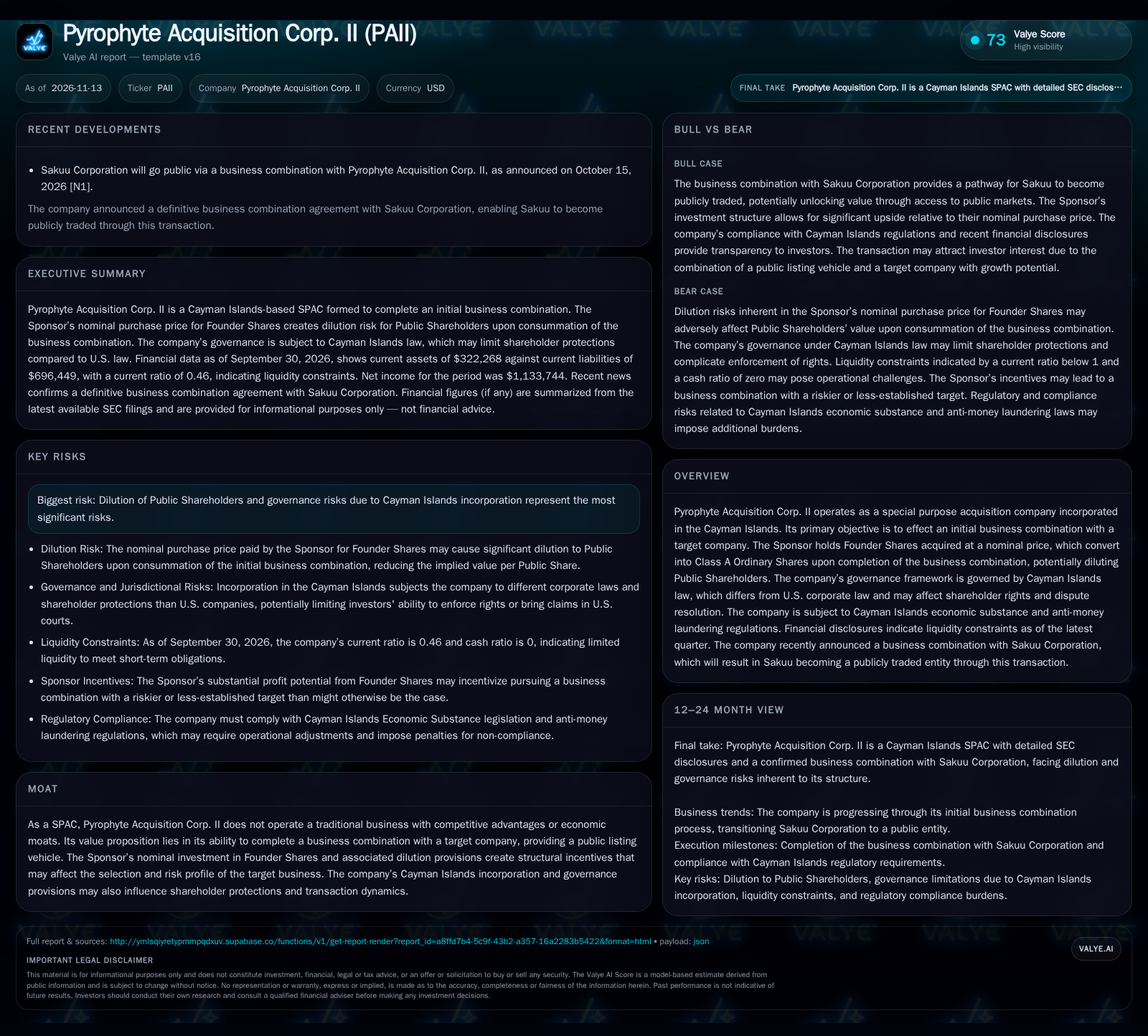
Pyrophyte Acquisition Corp. II is a Cayman Islands-based SPAC with a confirmed business combination with Sakuu Corporation. Sponsor’s Founder Shares, acquired at a nominal price, will dilute Public Shareholders upon deal close, reducing the implied value per share from $10.00 to $7.01. [S1] [S2] [N1]
Pyrophyte Acquisition Corp. II is set to bring Sakuu Corporation public via a SPAC merger, thrusting the mechanics of sponsor incentives, dilution, and offshore governance into the spotlight. With the sponsor poised for outsized returns regardless of post-merger share performance, and public shareholders facing a reduced implied value per share, the transaction exemplifies both the potential and the pitfalls of the SPAC model. [S1] [S2] [N1]
Sakuu Merger, Sponsor Dilution, and Liquidity Constraints Define the Moment
Pyrophyte Acquisition Corp. II has announced a definitive business combination with Sakuu Corporation, marking its pivotal transition from blank-check status to a merger-driven public listing vehicle. Upon completion, Sakuu will become a publicly traded entity, with Pyrophyte’s structure driving several material implications for investors. The Sponsor acquired Founder Shares for a nominal $25,000, and these convert into Class A Ordinary Shares at closing, diluting Public Shareholders and reducing the implied value per share from $10.00 to $7.01. This mechanical dilution is a core feature of the SPAC structure and central to the economics of the deal. The company reported cash and liquidity metrics for the period; these figures do not by themselves establish operating runway, investment capacity, financial flexibility, or financing capacity. [S1] [S2] [N1]
This financial tightness may influence strategic decisions, potentially prioritizing near-term capital preservation over longer-term growth initiatives. Investors should consider how such liquidity dynamics interplay with the dilution mechanics, as constrained potential financial flexibility might exacerbate the challenges of achieving sustainable post-merger value creation.
SPAC Value Transfer: How Sponsor Economics and Public Dilution Interact
SPACs like Pyrophyte are fundamentally capital reallocation mechanisms. Sponsors invest a small sum for Founder Shares and private placement warrants, bearing the risk of deal failure but standing to earn substantial returns if any business combination is completed. In Pyrophyte’s case, the sponsor’s $25,000 for Founder Shares and $5,050,000 for warrants create a levered return profile: even if the post-merger share price falls well below the initial $10.00, sponsors can profit handsomely. This structure means value is effectively transferred from public shareholders, who bear dilution (as seen in the implied $7.01 per share post-merger value), to sponsors and potentially the target company.
From a cash flow perspective, SPACs typically generate interest income on trust assets pre-deal, but have minimal operating revenue or cash flow until a merger closes. After the combination, the economic model will shift entirely to Sakuu’s underlying business fundamentals, but until then, Pyrophyte’s economics are dominated by the timing, terms, and mechanics of the deal itself. [S1] [S2]
The sponsor’s economic incentives also create a nuanced risk profile regarding deal quality and timing. Because sponsors receive substantial upside upon deal completion regardless of post-merger share performance, there is an embedded incentive to prioritize closing a transaction over maximizing long-term shareholder value. This misalignment can lead to value transfer scenarios where public shareholders absorb dilution and risk, while sponsors realize gains upfront. Understanding this dynamic is crucial when evaluating the sustainability of the post-merger valuation, as it conditions the likelihood that the sponsor will support additional capital raises or operational interventions if Sakuu underperforms after going public.
SPACs as Public Listing Vehicles: Differentiation, Substitutes, and Structural Limitations
Pyrophyte’s competitive positioning is less about operating advantages and more about acting as a conduit for private companies seeking public capital. In a crowded SPAC market, differentiation usually comes from sponsor pedigree, target sector focus, and deal execution track record. Pyrophyte’s Cayman Islands incorporation may appeal to some international targets or investors, but also introduces governance and legal complexity compared to U.S.-domiciled SPACs.
The main substitutes for a SPAC merger are traditional IPOs, direct listings, or reverse mergers. Each route has its own trade-offs in terms of cost, speed, regulatory scrutiny, and dilution. For targets like Sakuu, a SPAC merger can offer a faster and more flexible route to public markets, albeit with the baggage of sponsor dilution and post-merger redemption risk. Pyrophyte’s challenge is to convince both the target and the market that its vehicle provides superior value, while managing the inherent misalignment between sponsor incentives and long-term public shareholder interests.
The Cayman Islands incorporation adds a layer of complexity to governance that can affect investor protections and dispute resolution mechanisms. Compared to U.S. jurisdictions, Cayman law may offer less familiarity and potentially fewer established precedents for shareholder rights enforcement, which could influence the cost and speed of resolving conflicts. This jurisdictional choice might appeal to certain international investors or targets seeking regulatory flexibility, but it simultaneously introduces uncertainty for public shareholders accustomed to U.S. governance standards. Such legal nuances should be factored into the risk assessment, particularly in scenarios involving sponsor conflicts of interest or contested corporate actions post-merger.
If Sakuu Delivers: Value Creation Beyond the Initial Dilution
The optimistic case relies on Sakuu leveraging public capital access to accelerate growth, deliver on operational milestones, and eventually command a valuation that more than offsets the initial dilution to public shareholders. If Sakuu’s business model proves robust—demonstrating revenue traction, technological differentiation, and a credible path to profitability—public investors could see significant appreciation from the post-merger base, even after factoring in the reduced implied value per share.
Confirmation of this scenario would require evidence of strong post-merger execution by Sakuu, such as exceeding growth projections, securing marquee customer contracts, or unveiling new product breakthroughs. Above-average trading volumes and low post-merger redemption rates would also suggest market confidence. Falsification would occur if Sakuu’s fundamentals disappoint, share liquidity dries up, or the stock trades persistently below the already-diluted post-combination value.
Most Likely Outcome: Dilution Sets the Floor, Sakuu Must Prove Itself
The most plausible outcome is that the merger closes, public shareholders experience the anticipated dilution, and Sakuu begins life as a public company with a valuation baseline reflecting the $7.01 implied per-share value. Unless Sakuu’s business rapidly outperforms expectations, returns for public shareholders will be shaped by the initial value transfer to the sponsor and the uncertain performance of the newly public entity.
This scenario would be confirmed if Sakuu trades near or slightly above the post-merger implied value, with moderate trading volumes and no immediate operational surprises. If disclosed, tracking early financial reports, customer wins, and the pace of redemptions will be crucial for validating the base case. If Sakuu fails to meet market expectations or if excessive redemptions occur, further downside could materialize.
Sponsor Incentives and Governance Risks: When Dilution Compounds Downside
The adverse scenario is one where the sponsor’s incentive to complete any deal—regardless of the target’s quality—results in a suboptimal or poorly vetted business combination. If Sakuu underdelivers operationally or faces unexpected challenges post-merger, public shareholders, already diluted, could see further value erosion as the market discounts the new entity’s prospects.
This downside would be confirmed by persistent underperformance of Sakuu’s shares, high redemption rates, or the emergence of legal/regulatory disputes stemming from the Cayman Islands governance framework. Additional risks include liquidity shortfalls, delayed SEC filings, or inability to attract institutional support post-listing. Any signs that the sponsor or management is prioritizing short-term deal closure over long-term value would also validate this scenario.
Milestones and Signals That Will Shape the Sakuu–Pyrophyte Outcome
Completion timeline and final terms of the Sakuu business combination—including any adjustments to merger consideration or conversion rates.
Actual dilution realized by public shareholders versus projections, particularly if redemption rates are high or additional capital is raised.
Sakuu’s initial public market trading performance and liquidity, especially in the first 90 days post-merger.
Early financial disclosures from Sakuu, including revenue, gross margin, and cash burn if disclosed—these will test the fundamental upside thesis.
Redemption rate at the time of the business combination, as high redemptions could reduce available capital and signal weak investor confidence.
Legal or regulatory developments related to Cayman Islands governance, economic substance, or anti-money laundering compliance.
Sponsor or insider selling activity post-lockup, which could indicate confidence (or lack thereof) in Sakuu’s trajectory.
Disclaimer: This is research-only, informational analysis and not investment advice. It may include AI-generated interpretation and general industry context. Always verify important details using primary sources.

Comments