
Gores Holdings XI: Financial Strength Obscured by Opaque Operations
With a robust current ratio and positive net income in the latest quarter, Gores Holdings XI, Inc. presents a superficially strong financial profile. However, the lack of public disclosure around its business model, sector, and operational activities leaves investors with more questions than answers about the drivers of its performance and the durability of its reported results.
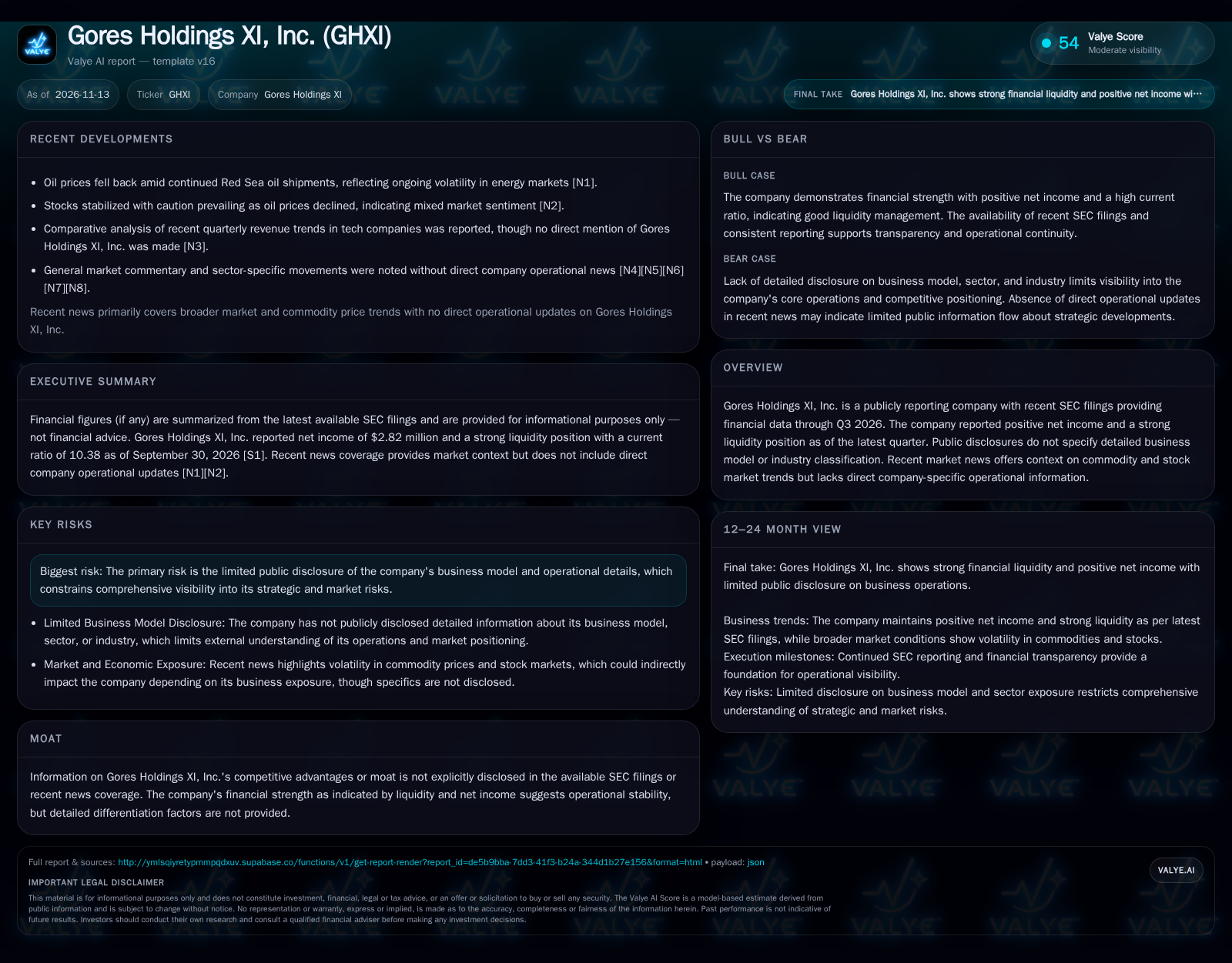
Gores Holdings XI, Inc. reported a net income of $2.82 million and a current ratio of 10.38 as of Q3 2026, signaling financial strength on paper. Yet, the absence of business model details or operational transparency prevents meaningful assessment of its competitive position or future prospects. [S1]
Gores Holdings XI, Inc. stands out in recent SEC filings for its reported liquidity position and positive net income, reporting a current ratio over 10 and a $2.82 million profit for the third quarter of 2026. While these headline numbers suggest a stable or even thriving enterprise, the company’s near-total silence on its business model, sector, and operational substance fundamentally limits a true understanding of its economic engine. In a market where transparency is often as valuable as performance, this lack of disclosure creates significant uncertainty about the sustainability and quality of reported results.
Financial Results Signal Strength—But the Source Remains Unclear
Gores Holdings XI, Inc. reported net income of $2,818,236 for the quarter ending September 30, 2026, alongside current assets of $883,583 and current liabilities of $85,122, resulting in a current ratio of 10.38 [S1]. These figures suggest the company is both profitable and highly liquid as of the latest quarter. However, the company has not disclosed its business model, sector, or operational activities in recent filings or news. This lack of operational context makes it impossible to attribute the reported profitability and liquidity to specific business actions, recurring activities, or one-time events. The most material fact is thus the disconnect between strong financial metrics and the absence of operational transparency.
Beyond the headline liquidity and profitability metrics, an important consideration is the quality and composition of the current assets reported. If these assets are largely cash or cash equivalents, the reported current ratio may reflect a conservative balance sheet posture rather than operational robustness. Conversely, if current assets include illiquid or non-operating items, the apparent liquidity cushion may be overstated. The company reported cash and liquidity metrics for the period; these figures do not by themselves establish operating runway, investment capacity, financial flexibility, or financing capacity. Without granular disclosure, the risk remains that the reported financial strength is a snapshot influenced by timing or accounting classifications rather than a reflection of ongoing business health.
Absent Business Model Details Obscure Economic Fundamentals
In the absence of public information on Gores Holdings XI’s business model, industry, or revenue sources, the economic underpinnings of its reported net income and liquidity are opaque. The company could be earning interest on held assets, managing a portfolio of investments, or operating as a shell or holding entity, as is common with some SPACs and investment vehicles. If the company’s earnings stem from short-term investments or financial structuring, these may not be repeatable nor indicative of operational strength. Without clarity on revenue composition—whether from product sales, service contracts, asset management, or other activities—it is impossible to assess pricing power, cost structure, variable versus fixed expenses, or capital intensity.
Analyzing the economic fundamentals requires understanding the cost structure and capital allocation priorities that underpin the reported net income. If the company operates primarily as a holding or investment vehicle, fixed costs may be minimal, and earnings volatility could be tied closely to market conditions rather than operational execution. In contrast, an operating business would typically exhibit a mix of fixed and variable costs, with margins influenced by competitive dynamics and operational efficiency. The absence of segment reporting or cost breakdowns obscures the ability to evaluate operating leverage or scalability. Moreover, capital expenditures or reinvestment rates—if disclosed—would help assess whether the company is building sustainable earning capacity or merely managing existing assets.
Competitive Standing: A Black Box in a Transparent Market
No information is available on Gores Holdings XI’s competitors, sector, or unique value proposition. If the entity operates as a blank-check company or investment holding vehicle, its competitive landscape may consist of other SPACs, private equity funds, or financial intermediaries. These categories typically compete on sponsor reputation, deal sourcing, and terms of acquisition or investment targets. In the absence of disclosed operations, it is not possible to assess whether the company enjoys cost advantages, differentiated access to deal flow, or proprietary technology. The lack of publicly visible strategy or execution milestones puts the company at a disadvantage relative to peers who actively communicate their pipeline, market focus, or progress toward a business combination or investment thesis.
Competitive positioning also depends on the company’s ability to differentiate itself in sourcing opportunities and managing risk. For investment vehicles, access to proprietary deal flow, sponsor expertise, and alignment of incentives with investors are critical competitive factors. Without insight into governance structures, sponsor backgrounds, or incentive arrangements, investors cannot gauge whether the company possesses durable advantages or is competing in a commoditized space. Additionally, if the entity is positioned to pursue a business combination, the timing and quality of target identification relative to peers will be decisive. The lack of disclosed strategic milestones or market engagement signals potential challenges in establishing a competitive foothold or executing value-creating transactions.
Potential Value Realization If Business Model Is Revealed and Executed
The most favorable scenario is that Gores Holdings XI is using its reported balance sheet position and positive net income as a platform to pursue a high-quality business combination, acquisition, or operational pivot. If the company were to announce a compelling target or reveal an ongoing operating business with sustainable revenue and profit streams, the current financial strength could become a launchpad for growth. Upside would be confirmed by detailed disclosures on the company’s operational strategy, revenue model, and execution milestones—especially if these are accompanied by identifiable market opportunities, experienced management, and clear pathways to scalable economics. Evidence for this scenario would include SEC filings or press releases outlining a merger agreement, a business combination vote, or the launch of operating activities with forward-looking financial guidance.
Status Quo Persists: Financial Reporting Without Operational Clarity
The most plausible near-term path is that Gores Holdings XI continues to report clean financial results—positive net income and high liquidity—without providing further business model or operational transparency. This status quo could persist if the entity is in a holding pattern, awaiting a suitable transaction or winding down operations after a failed deal, as sometimes occurs with SPACs whose business combinations have not materialized. Confirmation of this scenario would be continued SEC filings with similar balance-sheet and income-statement profiles but no substantive updates on business activities, strategy, or sector focus. Falsification would require a material event: a business combination announcement, a shift in asset composition, or a change in reporting cadence that signals operational engagement.
Risks of Opacity: Value Erosion Through Inaction or Adverse Events
The primary adverse scenario is that the lack of business model disclosure masks underlying stagnation, a failure to consummate a business combination, or exposure to risks not visible in current filings. If the company’s net income is predominantly financial rather than operational, it may be vulnerable to changes in interest rates, asset impairments, or regulatory actions affecting shell or investment vehicles. A further risk is that, absent an operational pivot or deal, the company could face shareholder pressure to liquidate, delist, or dissolve, with actual asset values potentially falling short of book figures. Downside would be confirmed by declining asset balances, negative income, or SEC filings indicating intent to liquidate or dissolve the entity. Falsification would require evidence of sustained, disclosed operational activity or a successful transaction that clarifies the company’s strategic direction.
Milestones and Disclosures That Could Redefine the Gores Holdings XI Thesis
Disclosure of a definitive business combination agreement, merger target, or acquisition—if announced—would clarify the company’s future trajectory.
A detailed breakdown of revenue sources, asset composition, and recurring versus nonrecurring income in future SEC filings would help validate the sustainability of reported profitability.
Filing of proxy statements or shareholder meeting materials related to a business combination or liquidation would signal a major corporate event.
A shift in cash or current asset balances, especially if explained by investment or operational activity, would provide clues to capital deployment strategy.
If disclosed, management commentary or investor presentations outlining strategic priorities, sector focus, or operational milestones would make the economic model testable.
Continued silence or lack of substantive updates in quarterly filings would confirm that the company remains in a holding or non-operational state.
Any regulatory actions, delisting notices, or changes in auditor opinion would be material to the company’s standing and future options.
Disclaimer: This is research-only, informational analysis and not investment advice. It may include AI-generated interpretation and general industry context. Always verify important details using primary sources.

Comments