
Jaws Mustang Acquisition Corp: SPAC Extension Mechanics, Liquidity Pressures, and the Clock on Value Creation
With a current ratio of just 0.09 and public shares now quoted on the OTC market, the path forward is binary: deliver a deal or face dissolution. The analysis below dissects the economics, structural risks, and what would need to change for value realization.
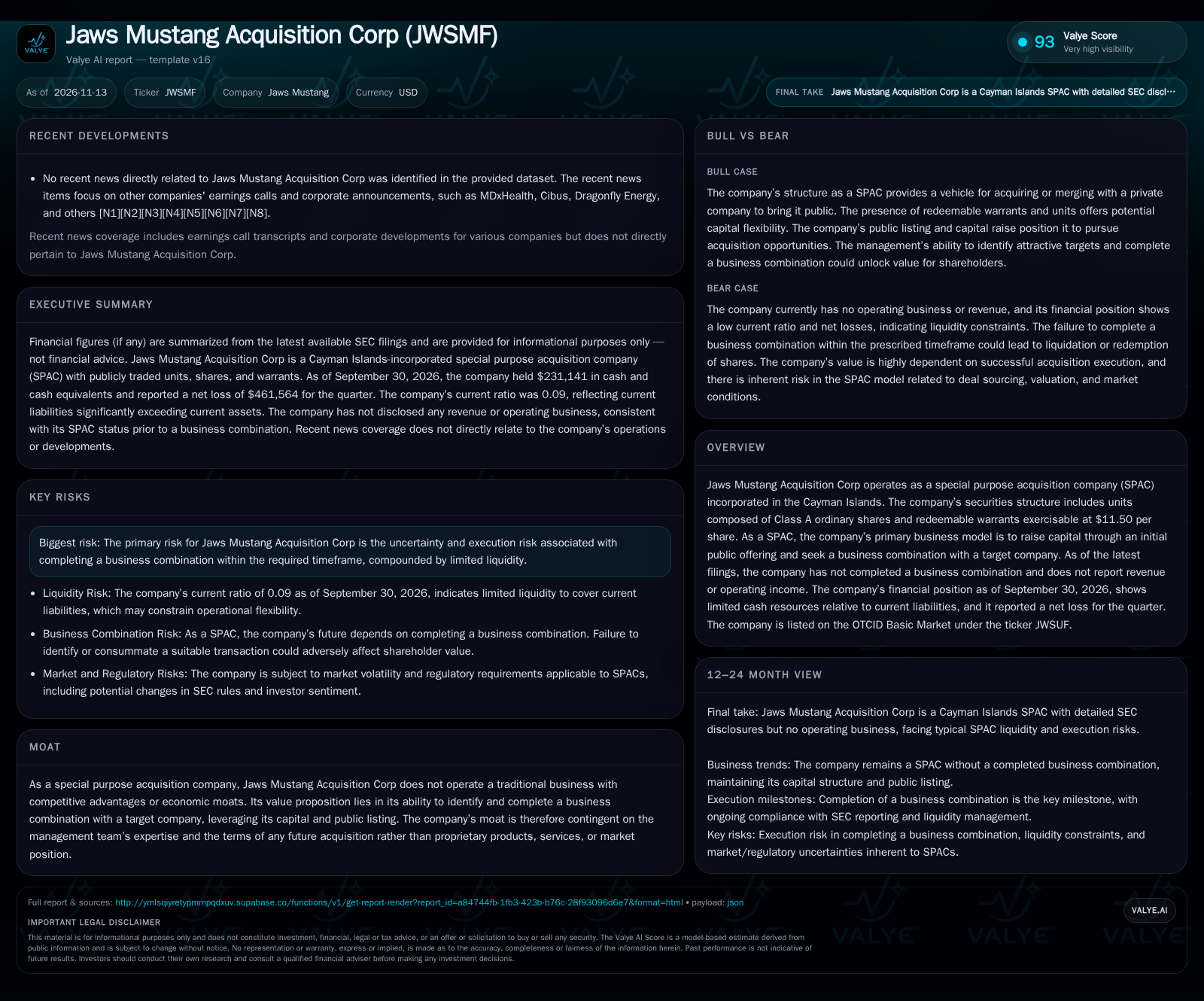
Jaws Mustang Acquisition Corp is a SPAC now trading OTC after NYSE delisting, with only $231,141 in cash against $2.7 million in current liabilities as of September 2026. Its future hinges on completing a business combination before a series of monthly extension deadlines run out. Absent a deal, shareholders face the prospect of liquidation and limited recovery. The company’s economic profile is dominated by deal execution risk and the shrinking time window for action. [S2]
Jaws Mustang Acquisition Corp illustrates the late-stage realities of the modern SPAC: after missing its NYSE listing deadline for a business combination, it now trades OTC and operates on a series of short monthly extensions, each funded by additional deposits. With less than a tenth of the cash required to cover current liabilities, the company’s only path to value is a timely and successful merger. This analysis explores the company’s structural position, the economics of its SPAC vehicle, and what would need to happen for shareholders to see an upside outcome.
Delisting, Extensions, and a Shrinking reported cash balance Define the Present
Jaws Mustang Acquisition Corp failed to complete a business combination within the 36-month window required by its original NYSE American listing, resulting in a formal delisting in November 2024. Its securities are now quoted on the OTCID Basic Market, a move that typically reduces liquidity and visibility for investors. As of September 30, 2026, the company reported $231,141 in cash and cash equivalents, with current liabilities of $2,704,437, yielding a current ratio of just 0.09. To maintain its SPAC status, the board has approved up to eleven one-month extensions, each requiring a $25,000 deposit to the trust account. As of the last filing, nine extensions had been used, leaving only two possible monthly extensions remaining. The firm continues to report no revenue and incurred a net loss of $461,564 for the most recent quarter. These facts together signal an urgent timeline: the company must secure and close a business combination or face forced liquidation, with limited cash available for operations or negotiation flexibility. [S2]
SPAC Economics: Fee Drag, Trust Mechanics, and the Binary Payoff Structure
Jaws Mustang’s business model is archetypal for late-stage SPACs: it generates no revenue and exists solely to merge with or acquire a private company. The economics are defined by two main forces: the trust account (initially funded by IPO proceeds and now incrementally topped up by extension deposits) and the ongoing burn from administrative and deal-sourcing expenses. The company reported cash and liquidity metrics for the period; these figures do not by themselves establish operating runway, investment capacity, financial flexibility, or financing capacity. Each monthly extension erodes the remaining capital, while the trust’s balance is incrementally protected only by the required deposits.
Post-business combination, a SPAC’s value can be unlocked if the acquired target commands a premium in the public market. Any target company considering a merger must weigh the reputational risk and potential dilution from a sponsor with limited remaining resources. If no deal is completed, the remaining cash (net of liabilities and expenses) is returned to shareholders, often at a discount to the initial investment due to redemptions and fee drag. The economics thus become increasingly binary as the extension window closes: either a deal is struck that creates value, or the SPAC dissolves with residual cash returned.
SPAC Target Competition and Diminished Appeal as a Merger Partner
Jaws Mustang, like all SPACs, competes for acquisition targets with other SPACs, direct listings, traditional IPOs, and increasingly, private capital providers. In 2026, the SPAC market is saturated, with an overhang of late-stage vehicles chasing a shrinking pool of attractive, deal-ready private companies. For Jaws Mustang, the competitive disadvantage is acute: delisting from NYSE American and the shift to OTC status reduce its attractiveness as a partner by limiting post-deal liquidity and perceived prestige.
Moreover, the company’s limited cash resources and monthly extension structure may deter sophisticated targets, who often seek SPAC sponsors with the ability to contribute capital, support working capital needs, and facilitate a smooth path to public market trading. With limited potential financial flexibility, Jaws Mustang’s negotiating leverage is likely weak—especially versus SPACs with more robust trust accounts or those still trading on major exchanges. In this environment, the company’s only potential edge would be the willingness to cut a highly favorable deal for a target desperate for public status, but this often comes at the expense of original SPAC shareholders.
Value Realization Hinges on a Last-Minute, Accretive Business Combination
The only route to significant shareholder value is the identification and completion of a business combination with a private company that the market values above the redemption value of the shares. For this to occur, Jaws Mustang’s sponsors must secure a credible target willing to accept a deal despite the company’s OTC status and limited trust resources. A favorable scenario would see the SPAC announce a merger with a target in a hot sector (e.g., AI, climate tech, or healthcare), with market enthusiasm driving post-deal share prices above the effective redemption value.
Evidence supporting this scenario would include a definitive merger agreement announcement, the filing of a detailed proxy statement with compelling target financials, and early indications of minimal SPAC redemptions. Additional confirmation would be a post-announcement increase in trading volume and price, signaling market belief in the combined entity’s prospects. Falsification would come if the company fails to announce a deal before the remaining extension periods expire, or if the deal faces overwhelming redemptions and fails to close.
Most Likely Outcome: No Deal and Eventual Liquidation as Extensions Expire
The most probable scenario is that Jaws Mustang exhausts its remaining one-month extensions without securing a merger partner, given the acute liquidity constraints and diminished appeal as a merger vehicle. In this path, the board would be required to commence liquidation proceedings, distributing the remaining trust account funds (net of expenses and liabilities) to public shareholders. This would likely result in a modest return well below the typical $10 per share SPAC IPO price, especially after accounting for the cumulative extension deposits, administrative costs, and any residual liabilities.
Confirmation would be the absence of a merger announcement by the final extension deadline, SEC filings indicating intent to liquidate, and a final distribution to shareholders. Any late-stage letter of intent or target engagement could alter this trajectory, but would need to be matched by rapid execution and market acceptance to avoid the default liquidation outcome.
Adverse Outcomes: Forced Liquidation, Minimal Recovery, and Sponsor Reputational Impact
The most negative scenario involves not only the failure to consummate a business combination, but also the erosion of trust assets due to ongoing administrative costs, possible litigation, or unanticipated liabilities. In this case, public shareholders could see even lower recovery than expected, and sponsors may face reputational damage that affects their ability to launch future SPACs or participate in other financial vehicles.
Confirmation of this downside would come from late filings, disclosures of unexpected liabilities, or a final liquidation distribution that is materially below the cumulative extension deposits and initial trust value. A further negative would be the emergence of shareholder litigation or regulatory scrutiny regarding the management of the trust account or the extension process.
Milestones and Metrics That Will Determine Whether Jaws Mustang Delivers Value or Dissolves
Announcement of a definitive merger agreement with a credible private company; the timing and sector focus of any such announcement would be critical.
SEC filings detailing proxy statements or merger documentation, including target company financials and terms of the proposed transaction.
SPAC redemption rates at the time of merger vote (if disclosed), as high redemptions would signal low confidence and diminish post-merger cash.
Monthly extension notices and associated deposits into the trust account, which indicate how much time remains before forced liquidation.
Changes in cash and current liabilities in quarterly filings, providing insight into the burn rate and liquidation value.
Trading volume and price reaction following any deal announcement, as a gauge of market acceptance and potential upside.
Any emergence of litigation, regulatory inquiry, or unexpected liabilities that could further erode trust assets and final shareholder recovery.
Disclaimer: This is research-only, informational analysis and not investment advice. It may include AI-generated interpretation and general industry context. Always verify important details using primary sources.

Comments