
Private Bancorp of America: Relationship Banking in Affluent Markets Confronts the Realities of Regional Scale and Earnings Variability
Private Bancorp of America, anchored in Southern California’s wealthy enclaves, reports solid capital ratios and rising Q3 2026 income, but faces familiar risks of geographic concentration, economic sensitivity, and uneven quarterly results. The bank’s relationship-centric model offers defensibility, yet its future will depend on sustained asset quality, deposit stability, and the ability to manage through regional economic cycles.
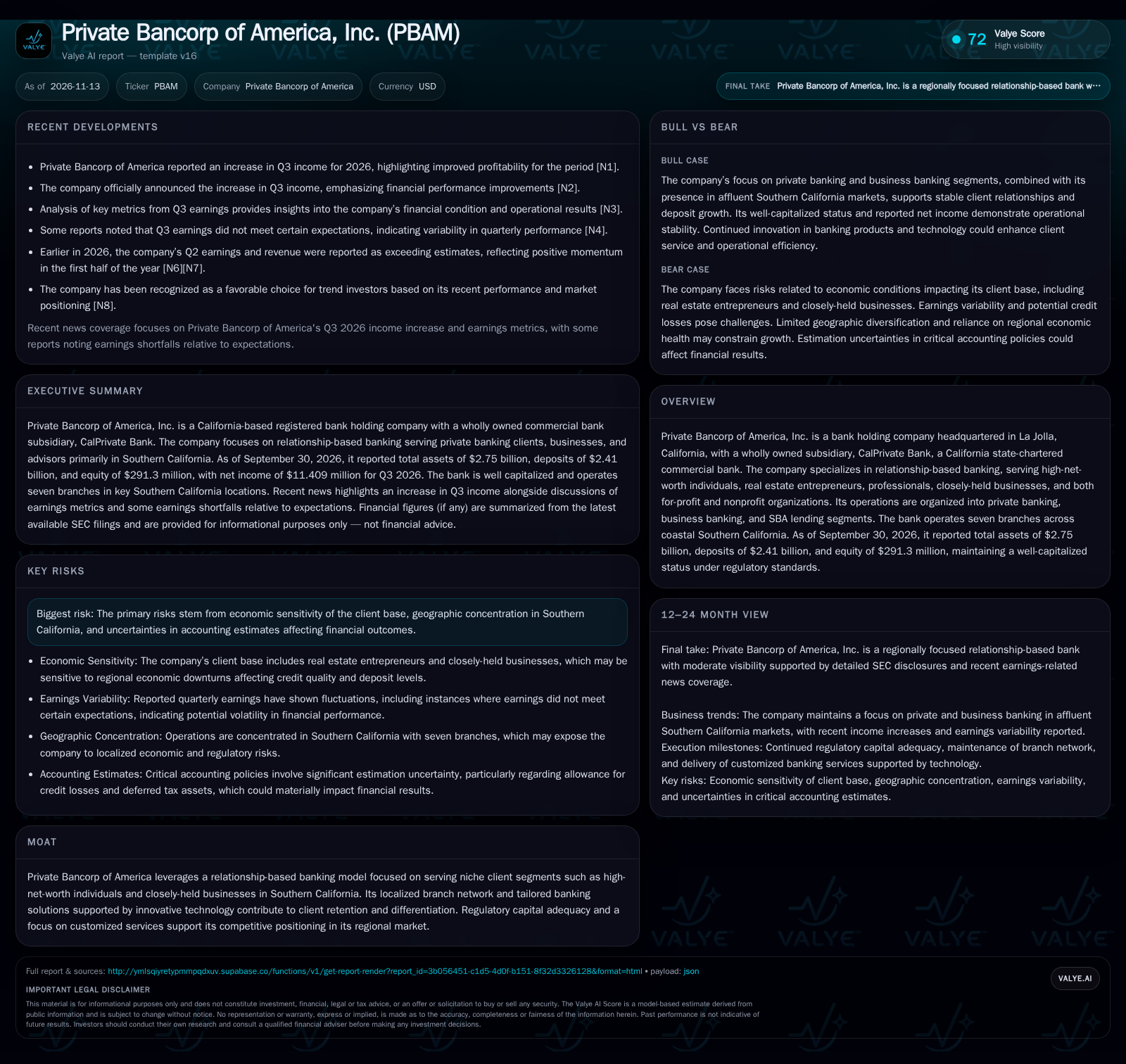
Private Bancorp of America, Inc. (PBAM) operates as a relationship-based regional bank focused on affluent Southern California markets, reporting $2.75 billion in assets and $11.4 million in Q3 2026 net income. While the bank remains well capitalized and highlights increased Q3 income, it contends with earnings variability and the inherent risks of a concentrated, economically sensitive client base. The next phase will test PBAM’s ability to maintain asset quality and grow within its niche amid potential regional headwinds and evolving client expectations. [S1] [N1] [N2] [N3] [N4]
Private Bancorp of America, Inc. (PBAM) stands as a regionally focused bank holding company, leveraging deep relationships across affluent Southern California markets through its CalPrivate Bank subsidiary. With $2.75 billion in assets, $2.41 billion in deposits, and a well-capitalized regulatory standing as of Q3 2026, PBAM’s model targets high-net-worth individuals, entrepreneurs, and closely held businesses—segments that value bespoke service but remain exposed to local economic tides. Recent increases in quarterly income point to operational resilience, yet earnings variability and concentrated exposure to regional cycles underscore the challenges ahead. The bank’s future performance will hinge on its ability to sustain asset quality, grow core deposits, and navigate the interplay between customized service and scalable economics. [S1] [N1] [N2] [N3] [N4]
Q3 2026: Rising Income Amidst Uneven Expectations and Persistent Regional Focus
Private Bancorp of America reported Q3 2026 net income of $11.409 million, translating to basic EPS of $1.99 and diluted EPS of $1.97. This marks an increase in quarterly profitability and affirms the bank’s ability to generate returns within its chosen market. However, news reports indicate that while income rose, Q3 earnings did not fully meet all analyst expectations, highlighting ongoing variability in quarterly performance. [S1] [N1] [N2] [N3] [N4]
As of September 30, 2026, PBAM’s total assets stood at $2.75 billion, with deposits of $2.41 billion and total equity of $291.3 million, confirming a well-capitalized regulatory status. The bank’s footprint remains tightly focused, with seven branches located in some of Southern California’s most affluent coastal communities, such as Beverly Hills, Montecito, and La Jolla. [S1]
Management continues to emphasize the use of innovative technology to deliver customized banking products and services, although the specific financial impact and scale advantages of these initiatives have not yet been quantified. [S1]
Relationship-Centric Banking: Economics, Capital Needs, and the Challenge of Scaling Bespoke Service
PBAM’s business model centers on high-touch, relationship-based banking for high-net-worth individuals, real estate entrepreneurs, and closely held businesses. This approach typically supports higher average account balances and lower price sensitivity, enabling the bank to compete on service rather than rates alone. In theory, such a model may yield more stable core deposits and higher fee income per client, but it can also lead to elevated operating costs per relationship and limited scale economies compared to mass-market banks.
The company’s three operational segments—private banking, business banking, and SBA lending—suggest a revenue mix of interest income from loans, fee income from customized services, and potentially SBA loan origination and servicing fees. However, as with most regionally focused banks, net interest margin (NIM) remains a primary driver, and profitability is highly sensitive to funding costs and loan yields.
Fixed costs include branch operations, regulatory compliance, and technology investments. While technology is cited as a differentiator, the extent to which digital tools reduce per-client costs or enable broader reach is not yet clear. Variable costs scale with deposit gathering, loan origination, and credit administration, all of which could rise disproportionately in periods of economic stress or rapid growth.
Capital requirements are dictated by regulatory standards. PBAM’s reported equity of $291.3 million and well-capitalized status provide a buffer for growth and risk absorption, but also set a ceiling for asset growth absent additional capital or retained earnings. [S1]
Defensibility in Niche Markets Versus Pressures from Regional and National Players
PBAM’s competitive positioning is anchored in its deep relationships with clients in Southern California’s wealthiest zip codes. The bank’s ability to offer tailored solutions and high-touch service creates switching frictions for established clients, especially those with complex financial needs or multiple business/personal accounts.
However, the same concentration exposes PBAM to competition from larger regional and national banks that can offer broader product suites, more advanced digital platforms, and sometimes more attractive pricing. Fintech entrants and digital-first banks may also encroach on segments of the high-net-worth and business banking market, particularly for clients seeking convenience or specialized digital services.
PBAM’s moat rests on trust, local expertise, and personalized service rather than cost leadership or technology alone. Its limited branch network can be a double-edged sword: fostering exclusivity and community ties, but limiting geographic diversification and scalability.
In SBA lending, the bank may face competition from specialized non-bank lenders that can process loans faster or offer more flexible terms. The question is whether PBAM’s reputation and relationship model can consistently attract and retain clients in the face of evolving preferences and technological change.
Affluent Market Resilience and Technology-Enabled Service Drive Above-Peer Growth
If Southern California’s affluent real estate and business sectors remain robust, PBAM could see continued growth in core deposits and lending volume, benefiting from its established client base and reputation for personalized service. The successful deployment of innovative technology—if it enables more efficient client onboarding, cross-selling, or risk management—could also expand margins and allow for selective geographic or segment expansion without proportionate increases in overhead.
A favorable scenario would be confirmed by sustained growth in non-interest income, stable or improving net interest margin, and evidence of new client acquisition in targeted niches. Improved operational efficiency, reflected in a declining efficiency ratio, would further support the case for scalable profitability. Additionally, maintenance of strong asset quality metrics and no material increase in credit losses would validate the defensibility of PBAM’s underwriting and client selection.
Falsification would come from stagnating deposit or loan growth, rising efficiency ratios, or evidence that technology investments are not translating into measurable financial or client-acquisition gains.
Regional Cyclicality and Selective Growth Define the Probable Trajectory
The most plausible outcome is that PBAM continues to grow moderately within its core Southern California markets, with quarterly earnings variability reflecting the realities of its concentrated client base and exposure to local economic cycles. Asset and deposit growth are likely to track regional wealth and business activity, with periodic slowdowns during real estate or business downturns.
Margins may remain stable so long as PBAM maintains a differentiated service offering and avoids aggressive rate competition. Technology investments are likely to yield incremental, rather than transformative, cost or revenue benefits over the near term. The bank’s well-capitalized status and prudent risk management should support resilience, but will not insulate it from broader credit or liquidity shocks.
The scenario would be confirmed by steady core deposit growth, manageable credit costs, and continued regulatory capital adequacy. Evidence of periodic earnings misses, as in Q3 2026, would not be surprising and would reflect the inherent volatility of a concentrated, high-touch model.
Regional Downturn or Asset Quality Deterioration Erodes Profitability and Capital Buffer
A significant adverse scenario would result if Southern California’s real estate or business environment weakens materially, leading to elevated credit losses among PBAM’s entrepreneur and business-owner clients. A spike in nonperforming loans or sharp deposit outflows could compress margins and force the bank to curtail lending, eroding profitability and potentially regulatory capital ratios.
If estimation errors in credit loss reserves or deferred tax assets are realized, reported earnings could be materially revised downward, shaking confidence in management’s risk controls and valuation. Technology investments that fail to attract or retain clients, or that lead to cost overruns, would further pressure the bottom line.
Confirmation of this scenario would come from a rising nonperforming asset ratio, declining regulatory capital metrics, negative operating leverage, or evidence of client attrition to larger or more technologically advanced competitors.
Testing PBAM’s Thesis: Metrics and Conditions That Will Define Sustainability and Upside
Quarterly trends in net interest margin (NIM) relative to regional peers—if disclosed—would clarify PBAM’s pricing power and funding cost management.
Changes in nonperforming assets and loan loss provisions will signal the health of the high-net-worth and business loan portfolio as Southern California’s economy evolves.
Branch-level deposit growth or attrition, especially in core affluent markets, would help test the stickiness of PBAM’s relationship banking model.
Efficiency ratio trends—if disclosed—would indicate whether technology investments are yielding cost advantages or scale benefits.
New client acquisition rates in core and adjacent segments would clarify PBAM’s ability to grow beyond its existing book and offset demographic or competitive pressures.
Any shift in regulatory capital ratios below ‘well-capitalized’ thresholds would warrant heightened scrutiny of risk controls and growth sustainability.
Management commentary or disclosures on technology ROI and its impact on client experience would help validate the strategic value of ongoing investments.
Tracking regional economic indicators (real estate values, small business formation, unemployment) is crucial, given PBAM’s concentrated exposure.
Disclaimer: This is research-only, informational analysis and not investment advice. It may include AI-generated interpretation and general industry context. Always verify important details using primary sources.

Comments