
Evolution Global Acquisition Corp: SPAC Economics, Execution Stakes, and the Clock on Value Creation
Evolution Global Acquisition Corp (EVOX) remains a pre-combination SPAC, holding $240 million in trust from its November 2025 IPO and facing the classic blank-check tension: can experienced sponsors deploy capital into an attractive target before time, costs, and redemptions erode the value proposition? This analysis explores EVOX’s operating realities, incentive structure, and the pivotal scenarios that will determine whether it transitions from financial shell to value-creating enterprise.
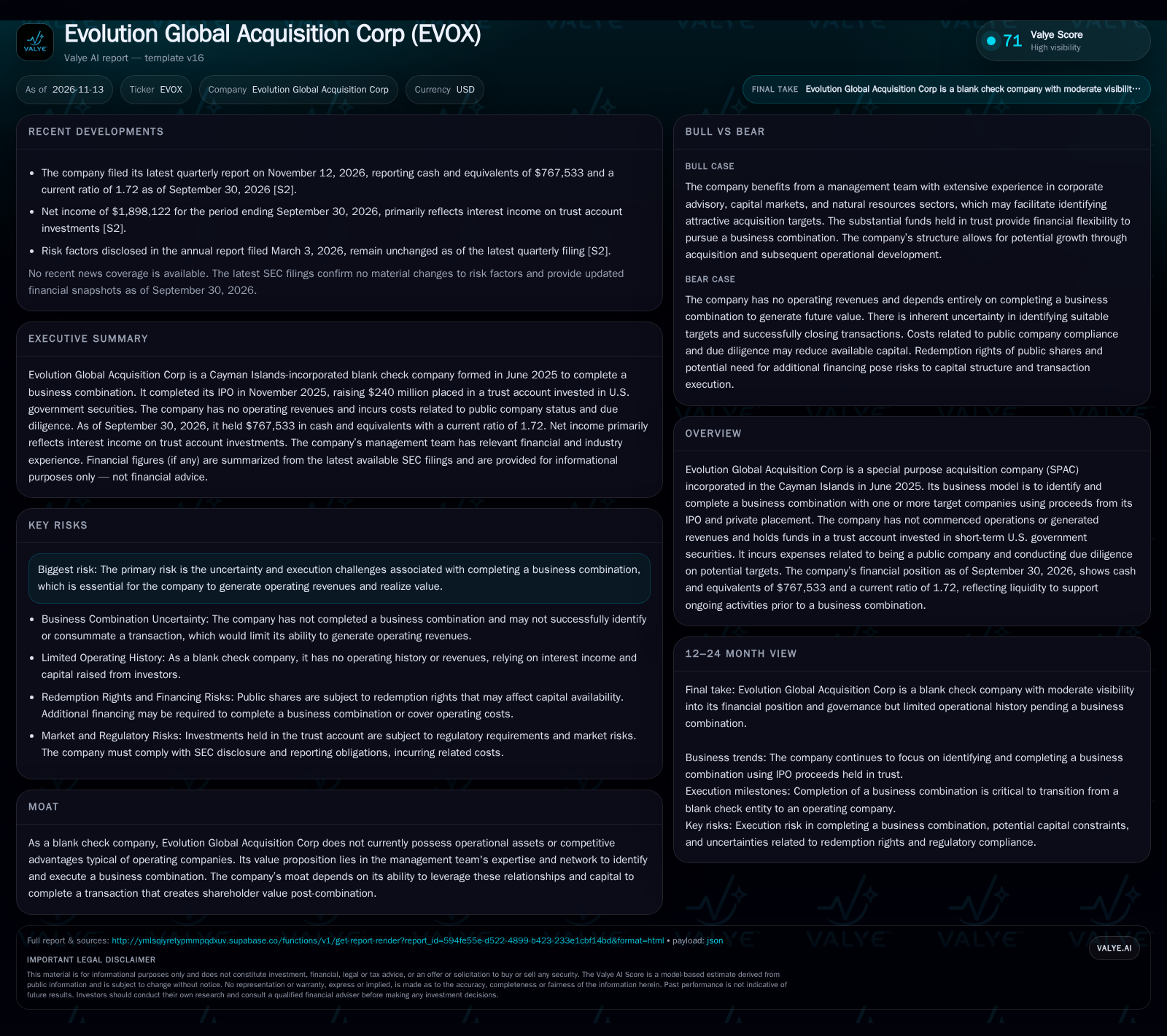
EVOX is a Cayman Islands-incorporated SPAC with no operating revenues, holding $240 million in trust post-IPO and generating income solely from interest on these funds. The business’s future hinges entirely on identifying and closing a business combination before capital is depleted by ongoing costs or redemptions. The management team’s experience, capital structure, and market conditions will shape whether EVOX can deliver value or face dissolution.
Evolution Global Acquisition Corp (EVOX) exemplifies the modern SPAC: significant capital raised, a high-profile management team, and a mandate to acquire a yet-to-be-identified business. As of late 2026, EVOX remains in its pre-combination phase, generating no operating revenue and relying entirely on interest from its $240 million trust account. The company’s fate rests on its ability to source and close a compelling transaction before the clock—and ongoing expenses—diminish shareholder value. This analysis examines EVOX’s current footing, underlying business mechanics, competitive landscape, and the scenario pathways that will define its ultimate success or failure.
EVOX’s Financial and Operating Snapshot: Trust-Driven Status Quo
As of September 30, 2026, Evolution Global Acquisition Corp had not commenced any revenue-generating operations and reported net income of $1,898,122 for the period, derived entirely from interest income on its IPO trust account investments [S2]. The $240 million raised in its November 2025 IPO remains the core financial asset, with $767,533 in cash and equivalents outside the trust available for ongoing search, legal, and compliance costs [S2]. The company reported cash and liquidity metrics for the period; these figures do not by themselves establish operating runway, investment capacity, financial flexibility, or financing capacity. [S2] These facts reinforce EVOX’s status as a financial shell whose only route to value creation is through a successful merger or acquisition.
How a SPAC Like EVOX Creates—or Erodes—Value
The economic model of a SPAC is binary: value is created only if the sponsors can identify and close a business combination that unlocks more worth than the sum of the cash in trust, after accounting for dilution, redemptions, and transaction costs. Until such a deal, EVOX’s income is limited to interest on its trust account, which does not represent true business growth. All other expenses—including due diligence, legal, and compliance—are a drag on the pool of capital available for a future acquisition.
SPACs typically face substantial fixed costs for being publicly listed entities, including ongoing SEC reporting, audit, and legal fees, as well as variable costs tied to deal sourcing and target evaluation. These costs are funded from cash outside the trust account, which for EVOX was less than $1 million as of September 2026 [S2]. If these funds are depleted before a deal is reached, the sponsor may need to inject additional capital, or the SPAC risks dissolution.
Upon a successful business combination, the economics shift: the acquired company gains access to the trust proceeds (net of redemptions), and the sponsor’s promote (typically 20% of post-combination equity) becomes valuable only if the post-merger entity trades above the redemption value. The economics for public shareholders are therefore highly sensitive to both the quality of the target and the proportion of shares redeemed at closing.
Sponsor Reputation, Target Scarcity, and the Race Against Other SPACs
EVOX competes in a crowded SPAC landscape where sponsor pedigree, sourcing network, and industry expertise are the primary differentiators. The company’s management—led by executives with backgrounds in capital markets and natural resources—may have an edge in sourcing proprietary deals, but faces the same fundamental constraints as other blank check entities: limited timeline and finite capital [S1].
The competitive environment is shaped not only by other SPACs seeking attractive targets, but also by private equity, strategic acquirers, and the targets themselves, many of whom have become more discerning post-2021 SPAC boom. The challenge for EVOX is to offer a compelling value proposition—speed, certainty, and access to public markets—while managing the risk of overpaying or selecting targets that cannot withstand public scrutiny.
Redemption rights, which allow public shareholders to exit at the trust value if dissatisfied with the proposed deal, further intensify the pressure on sponsors to deliver high-quality transactions. High redemption rates dilute the capital available for the target and may require additional PIPE financing or renegotiation of terms, undermining deal economics.
Catalyst Chain: Sourcing a High-Quality Target with Low Redemptions
The most favorable scenario for EVOX is the identification and successful execution of a business combination with a high-growth, well-vetted target—ideally in an industry aligned with the management team’s expertise. This outcome would require the following chain: (1) sourcing an attractive target with realistic public market potential; (2) negotiating deal terms that are compelling to both target shareholders and EVOX’s public investors; (3) communicating a clear value-creation narrative that minimizes redemptions; and (4) closing the transaction before administrative costs erode too much of the trust value.
Confirmation of this scenario would be evident through a merger announcement with a credible, growth-oriented company, low anticipated or actual redemptions, and post-deal trading at or above the original trust value. Additional evidence would include PIPE financing commitments at favorable terms, indicating third-party validation of the deal quality.
This path would unlock the sponsor’s promote, deliver liquidity to the target, and potentially reward public shareholders with appreciation above the redemption price, justifying the SPAC’s existence beyond its cash value.
Most Likely Trajectory: Protracted Search, Marginal Deal Quality, and Redemption Overhang
The most plausible outcome for EVOX, reflecting the broader post-boom SPAC environment, is a protracted search for a target, culminating in a transaction with moderate growth prospects and meaningful uncertainty. In this scenario, ongoing administrative and diligence costs continue to erode the cash outside the trust, while the universe of willing targets narrows.
If a deal is announced, it may be with a target that is not a clear market leader or that requires additional PIPE capital to offset high public shareholder redemptions. Shareholder approval becomes a gating factor, and redemption rates could be substantial, reducing the net funds available to the combined entity and limiting post-merger upside.
Evidence supporting this scenario would include delays in deal announcements, repeated deadline extensions, or indications that EVOX is pursuing targets outside its initial industry focus. High redemption rates at deal closing and post-combination trading near or below trust value would confirm limited value creation for public shareholders.
Failure to Close: Dissolution, Redemption, and Sponsor Loss
The adverse scenario for EVOX is failure to identify or consummate a business combination within the statutory deadline—typically 18–24 months from IPO—resulting in liquidation and a return of trust funds to public shareholders. In this event, the sponsor’s promote and private placement warrants become worthless, and public shareholders receive only their pro-rata share of the trust, less any dissolution expenses.
This scenario could be confirmed by repeated extensions without substantive deal progress, depletion of cash outside the trust to unsustainable levels, or formal dissolution filings. Triggers may include inability to secure a target willing to merge at current market valuations, regulatory or legal obstacles, or sponsor unwillingness to inject additional capital to extend the search period.
The downside scenario is not uncommon in the current SPAC environment, where deal scarcity, increased regulatory scrutiny, and shareholder skepticism have led to rising rates of SPAC liquidations.
Milestones and External Signals That Will Define EVOX’s Value-Creation Arc
Announcement of a definitive agreement for a business combination, including target sector, valuation, and proposed deal structure.
Redemption rates at the time of shareholder vote—high redemptions would signal limited investor confidence and reduce effective deal proceeds.
PIPE (private investment in public equity) commitments, if any, announced alongside a merger, which would demonstrate external validation and supplement trust capital.
Cash outside the trust account relative to ongoing administrative and due diligence expenses—a useful metric would be burn rate and months of cash runway, if disclosed.
Any extensions to the SPAC’s deadline for completing a business combination, including the terms and any required sponsor contributions.
Communications from management regarding target industry focus, sourcing progress, or deal pipeline—would help test the sponsor’s execution ability.
Changes in SEC regulations or market sentiment toward SPAC transactions, which could impact deal feasibility and redemption dynamics.
Post-merger trading levels of the combined entity relative to trust value, should a business combination close.
Disclaimer: This is research-only, informational analysis and not investment advice. It may include AI-generated interpretation and general industry context. Always verify important details using primary sources.

Comments