
Ondas Holdings: Scaling Wireless Tech and Unmanned Systems—Growth Potential Meets Execution Risk
Ondas Holdings is leveraging proprietary wireless platforms and unmanned aircraft systems to target critical infrastructure and defense markets, with recent revenue growth driven by government contracts and a planned U.S. manufacturing expansion. However, persistent net losses, customer concentration, and reliance on government funding highlight the execution and adoption hurdles in this evolving sector.
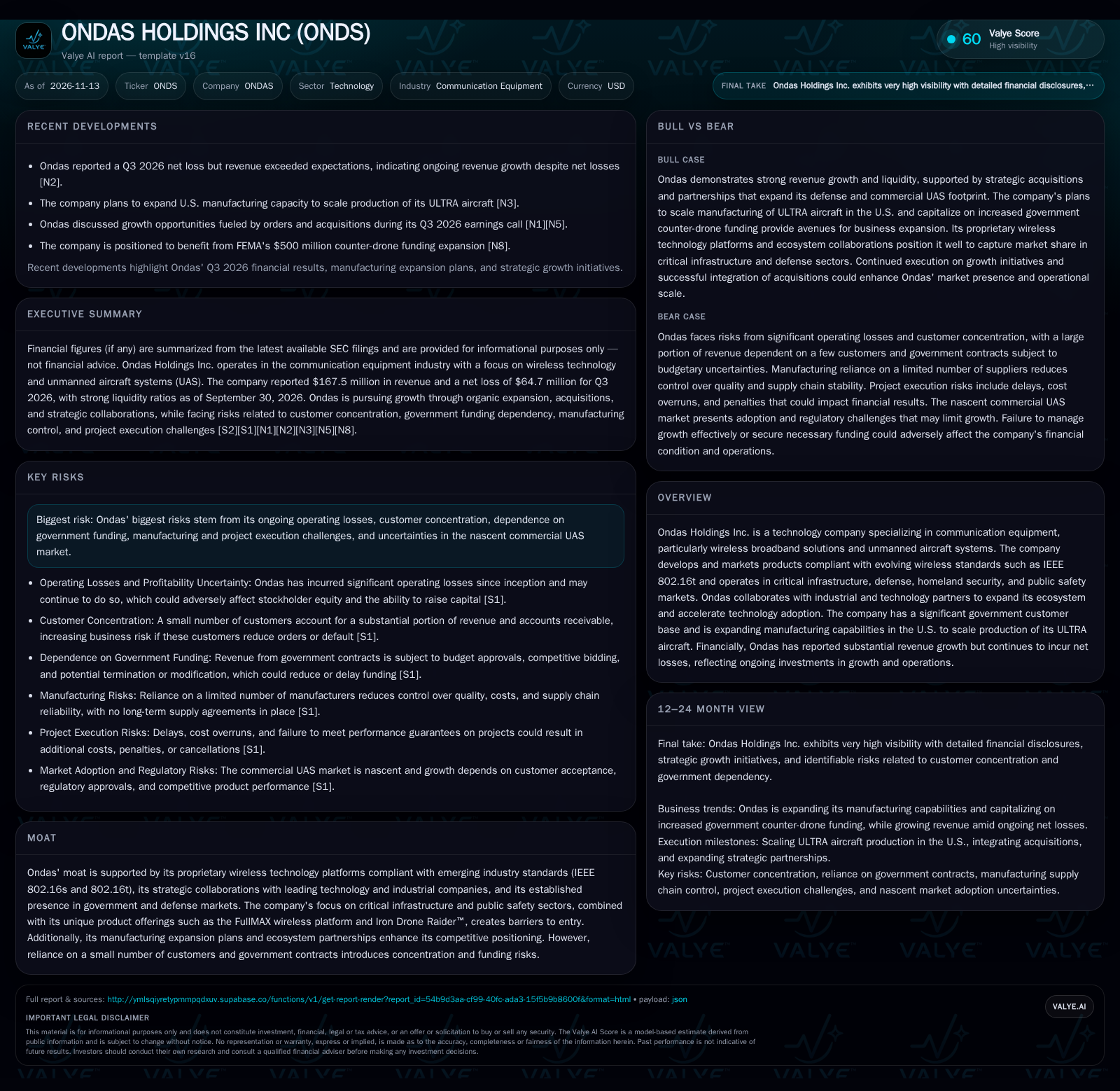
Ondas Holdings reported substantial revenue growth in Q3 2026, outpacing expectations, as it expands its U.S. manufacturing footprint to scale unmanned aircraft production and targets new government funding streams. Despite these positives, the company remains unprofitable, faces significant customer concentration, and depends on volatile government contracts for future growth. The company's ability to scale production, integrate acquisitions, and diversify its revenue base will be critical to testing the long-term thesis. [S2] [N2] [N3] [N8]
Ondas Holdings sits at the intersection of wireless broadband innovation and unmanned aircraft system (UAS) deployment, targeting high-stakes markets like defense, public safety, and critical infrastructure. The company has posted impressive revenue growth in Q3 2026—surpassing analyst expectations and underscoring its traction with government clients. Yet, persistent net losses, a heavy reliance on a small set of customers, and the unpredictability of government funding reinforce the reality that Ondas’ growth ambitions are tethered to operational discipline and successful market adoption. The company’s planned scale-up in U.S. manufacturing and its positioning for large-scale federal counter-drone initiatives could be transformative, but only if execution risks are contained and the nascent commercial UAS market matures as hoped. [S2] [N2] [N3] [N8]
Recent Performance: Revenue Growth Outpaces Losses Amid Manufacturing Expansion
Ondas Holdings reported $167.5 million in revenue for Q3 2026, exceeding expectations and signaling continued top-line momentum. However, the company registered a net loss of $64.7 million for the same period, highlighting ongoing investment in growth and operations that have yet to deliver profitability. Ondas is actively expanding its U.S. manufacturing capacity to scale production of its ULTRA unmanned aircraft, a move designed to address growing demand from government and public safety clients. The company also stands to benefit from the newly expanded $500 million FEMA counter-drone funding pool, which could fuel further order growth. These developments underline Ondas’ dual focus on scaling operations and capturing emerging public sector opportunities—but also spotlight the risks inherent in scaling complex hardware and winning large, lumpy government contracts. [S2] [N2] [N3] [N8]
How Ondas’ Revenue Model and Cost Structure Shape Value Creation
Ondas generates revenue primarily through sales of proprietary wireless broadband equipment and unmanned aircraft systems, targeting mission-critical sectors where performance, reliability, and compliance with standards (such as IEEE 802.16t) are valued. Pricing in these markets tends toward premium levels, given the technical requirements and high switching costs associated with infrastructure and defense deployments. However, the company’s cost structure is heavily front-loaded, with substantial R&D, manufacturing setup, and compliance expenses. Scaling up production—particularly for the ULTRA aircraft—requires significant capital investment in facilities, tooling, and quality assurance, raising the break-even threshold.
Operating leverage could be meaningful if Ondas succeeds in ramping production volumes and securing multi-unit or recurring contracts, particularly from government agencies. However, the lack of disclosed long-term supply agreements and reliance on a limited set of manufacturers create exposure to input cost volatility and supply chain disruptions. Gross margins may be pressured in the near term by underutilized manufacturing capacity and ongoing integration of newly acquired businesses. In the longer run, recurring revenue from software, services, or maintenance contracts could improve earnings quality, but the current revenue mix appears weighted toward project-based hardware sales—a structure that can produce lumpy results and heighten working capital needs.
Ondas’ Moat: Proprietary Tech and Government Ties, But Customer Concentration Cuts Both Ways
Ondas’ competitive position is anchored by its proprietary wireless platforms—such as the FullMAX—and compliance with evolving industry standards, which together create technical barriers for new entrants. The company’s history of collaboration with technology and industrial partners has helped it win credibility in defense and public safety markets, where established relationships and ecosystem compatibility are critical. A U.S.-based manufacturing footprint further differentiates Ondas at a time when supply chain security and domestic sourcing are increasingly prioritized by government clients.
However, the moat is not unassailable. Customer concentration remains acute, with a small number of government and infrastructure clients accounting for a disproportionate share of revenue and receivables. This makes Ondas highly sensitive to contract awards, renewals, and the vagaries of public sector budgeting. The commercial UAS market is also attracting both large defense primes and nimble startups, intensifying competition on price, features, and regulatory compliance. Substitution risk is present in the form of alternative wireless technologies and competing drone platforms, many of which may leverage broader distribution or deeper integration with end-user systems.
Unlocking Growth: Scaling ULTRA Production and Winning Recurring Government Contracts
In a favorable scenario, Ondas successfully scales its U.S. manufacturing operations, bringing down unit costs and enabling timely delivery of ULTRA aircraft to meet surging demand from government and public safety agencies. The company leverages its proprietary platforms and ecosystem partnerships to secure multi-year, recurring contracts—particularly as federal counter-drone and critical infrastructure budgets expand. Integration of recent acquisitions enhances product breadth and customer reach, while execution discipline keeps project overruns and supply disruptions in check.
Confirmation of this scenario would come from several fronts: a rapid increase in order backlog, evidence of contract renewals or expansions with existing government clients, and a shift in revenue mix toward multi-year or recurring service agreements. Improving gross margins and positive operating cash flow would further validate the emergence of scalable, sustainable economics. If Ondas can also demonstrate successful cross-selling between its wireless and UAS offerings, the company could outpace rivals and establish itself as a preferred partner for public sector modernization initiatives.
Sustained Revenue Growth, Ongoing Losses: Navigating Lumpy Orders and Execution Hurdles
The most plausible path is one in which Ondas maintains solid revenue growth, buoyed by periodic large project wins from government and critical infrastructure clients. However, operating losses persist as the company continues to invest in manufacturing scale and product development. Order flow remains lumpy, reflecting the timing of government contract awards and the slow maturation of the commercial UAS market. Supply chain constraints and project execution issues occasionally erode gross margins, while customer concentration leaves Ondas exposed to swings in a handful of key accounts.
Evidence supporting this scenario would include continued top-line growth without a clear path to sustained profitability, sporadic announcements of new or renewed contracts, and ongoing working capital volatility. Margins may improve incrementally as manufacturing efficiency rises, but the absence of a shift to higher-margin recurring revenue streams would keep earnings quality uneven. This scenario would be falsified if Ondas demonstrated either a sharp, sustained improvement in profitability or a material deterioration in revenue due to lost contracts or regulatory setbacks.
Concentration and Execution Risks Materialize: Contract Losses and Supply Chain Disruption
In a negative scenario, Ondas’ dependence on a limited set of government customers backfires—either due to budget cuts, contract non-renewals, or increased competition. Project execution issues, such as delays or cost overruns in scaling ULTRA aircraft production, trigger penalties and erode customer trust. Supply chain disruptions or quality issues—exacerbated by the lack of long-term manufacturing agreements—lead to missed deadlines and increased costs. The nascent commercial UAS market fails to accelerate, leaving Ondas exposed to an extended period of operating losses and eroding cash reserves.
This scenario would be confirmed by a sharp decline in revenue, negative revisions to order backlog, or public disclosures of project delays and penalties. Deteriorating gross margins, increased short-term borrowing, or evidence of customer defections would further signal that structural risks are being realized. In this case, Ondas might be forced to retrench, delay investments, or seek additional capital under adverse terms, further diluting shareholder value.
Milestones That Will Reveal If Ondas Can Convert Innovation into Sustainable Growth
Progress in scaling U.S. manufacturing capacity for ULTRA aircraft, including evidence of on-time, on-budget facility expansions and production ramp-up.
Order backlog growth and the mix of multi-year versus project-based contracts—if disclosed—to assess revenue visibility and customer commitment.
Customer concentration metrics: changes in the proportion of revenue and receivables from top clients, especially government agencies.
Gross margin trends, particularly as new manufacturing capacity comes online and acquisition integration progresses.
Recurring revenue share—if disclosed—as an indicator of progress toward a more stable, service-oriented business model.
Disclosure of project execution outcomes, including any delays, penalties, or customer satisfaction issues.
Updates on regulatory developments and adoption rates in the commercial UAS market, which could accelerate or hinder Ondas’ non-government business.
Liquidity and capital-raising activity, especially if operating losses persist or working capital needs spike.
Disclaimer: This is research-only, informational analysis and not investment advice. It may include AI-generated interpretation and general industry context. Always verify important details using primary sources.

Comments