
MediciNova’s Pivotal Year: Pipeline Data, Capital Structure, and the Realities of Clinical-Stage Biotech Economics
MediciNova’s late-stage clinical readouts for MN-166 and MN-001 in high-need neurological and metabolic disorders could reshape its strategic trajectory, but persistent operating losses, reliance on equity financing, and the binary outcome of upcoming trial results define near-term risk and opportunity.
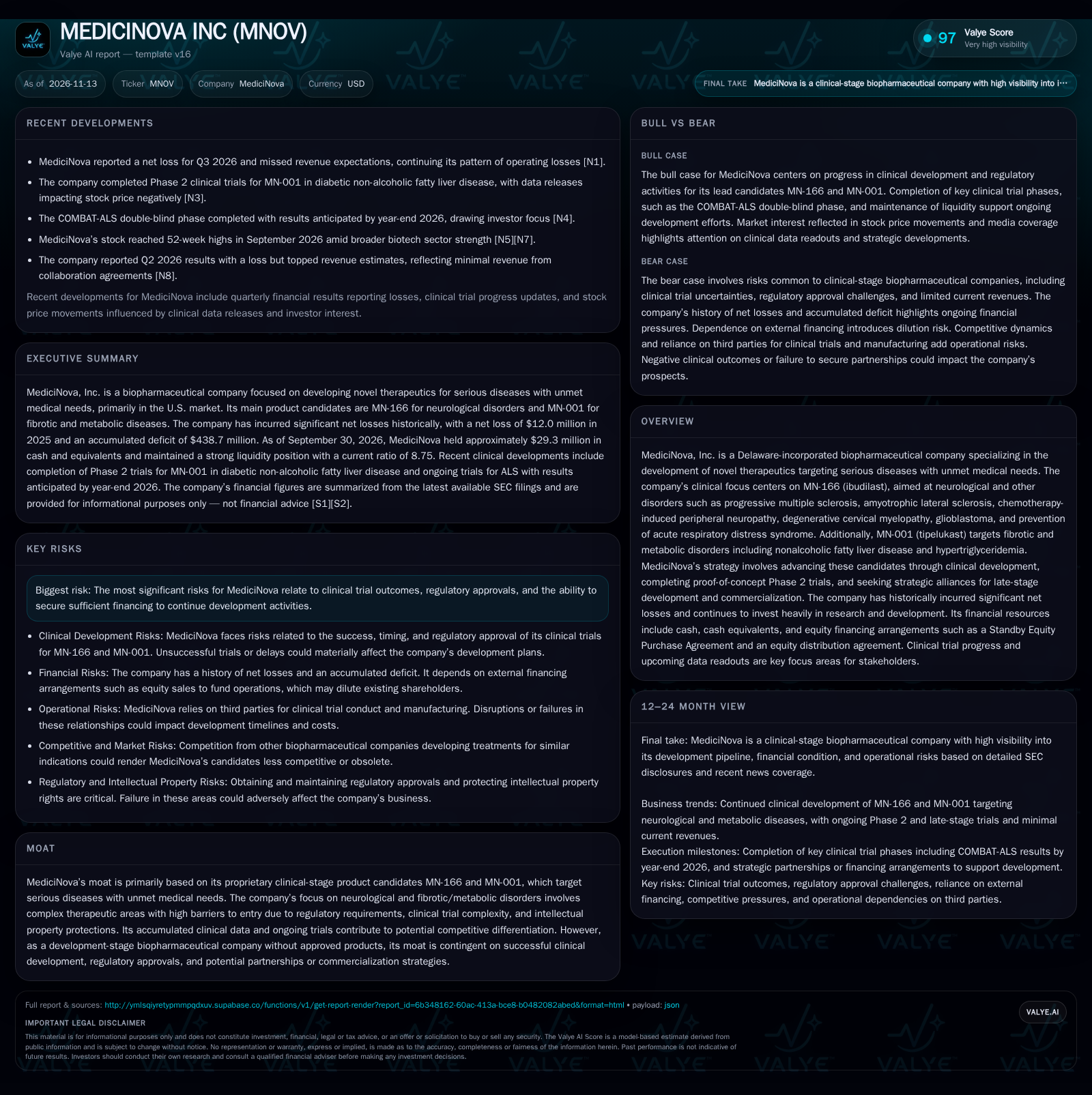
MediciNova is approaching a critical inflection as it awaits data from key trials for MN-166 (ALS) and MN-001 (NAFLD), with $29.3 million in cash and a reported current ratio supporting ongoing R&D. While its pipeline targets major unmet needs, the company’s recurring losses, limited revenue, and dependence on external financing frame both upside and downside scenarios. The next 12 months will hinge on clinical results, partnership activity, and the ability to sustain its capital position in the absence of commercialized products. [S1] [S2] [N3] [N4]
MediciNova stands at a crossroads typical of clinical-stage biopharmaceutical companies: substantial investment in a promising pipeline, but no approved products and a track record of persistent losses. The company’s near-term fate is tied to pivotal clinical results for MN-166 in ALS and MN-001 in diabetic NAFLD, both high-need areas with limited treatment options.With $29.3 million in cash and a reported current ratio as of September 2026, MediciNova has the resources to advance its programs through the next set of catalysts. However, its dependence on equity financing and the binary nature of clinical development mean that positive or negative data could radically alter its valuation, capital structure, and partnership prospects. The coming year will be decisive.
Latest Pipeline Events and Financial Position Define the Stakes
MediciNova’s most material near-term fact is the completion of the double-blind phase of its COMBAT-ALS trial for MN-166, with results expected by the end of 2026. This is a pivotal moment for the company, as ALS is a high-profile, high-unmet-need indication where positive data could catalyze licensing, partnership, or even regulatory interactions. Similarly, the company recently completed Phase 2 trials for MN-001 in diabetic nonalcoholic fatty liver disease (NAFLD), but the data release led to a negative stock reaction, highlighting the market’s sensitivity to clinical outcomes. [N3] [N4]
On the financial front, MediciNova reported a Q3 2026 net loss of $2.8 million and an accumulated deficit of $438.7 million at year-end 2025, underscoring its pre-commercial status. Revenues remain minimal, with only $0.4 million in 2025, derived primarily from a Mayo Foundation agreement. [S1] [S2]
The company’s capital structure includes a Standby Equity Purchase Agreement (SEPA) with Yorkville for up to $30 million and a newer equity distribution agreement with Lucid Capital Markets, reflecting ongoing reliance on equity markets for funding. These mechanisms provide optionality but also carry dilution risk for existing shareholders. [S1]
How MediciNova’s Business Model Hinges on Clinical Milestones and External Funding
MediciNova is a classic clinical-stage biotech: it generates negligible revenue, incurs ongoing R&D and operating expenses, and relies on external capital to fund development. The company’s economics are dominated by its investment in clinical trials, which are largely fixed costs in the short term (site setup, patient recruitment, regulatory filings) but can scale with pipeline breadth. Variable costs are limited until commercialization, at which point manufacturing, sales, and distribution would become relevant.
With R&D and patent expenses of $7.2 million in 2025 and a net loss of $12 million, MediciNova’s cash burn is typical for its stage. The company offsets this with equity financing, such as its SEPA and equity distribution agreements, rather than debt, limiting leverage but increasing dilution. [S1]
If a lead asset successfully reaches late-stage partnership or approval, MediciNova’s business model could pivot to milestone payments, royalties, or direct commercialization. In that scenario, operating leverage could be substantial: the marginal cost of additional revenue would be low compared to the fixed R&D base, especially if commercial rights are out-licensed. Conversely, failed trials or lack of partnerships would necessitate further dilutive fundraising or program discontinuation.
Pipeline Differentiation Versus Intense Competition and Substitution Risk
MediciNova’s competitive position depends on the novelty and efficacy of MN-166 and MN-001 in their respective indications. Both ALS and NAFLD are crowded, high-need markets with multiple competitors, including large pharmaceutical companies and other late-stage biotechs. The company’s proprietary compounds and focus on difficult-to-treat diseases offer a path to differentiation, especially if endpoints show clinically meaningful benefits.
However, barriers to entry in these fields are substantial—regulatory requirements, clinical trial complexity, and the challenge of demonstrating superiority or non-inferiority to existing or emerging treatments are persistent hurdles. Intellectual property protection provides some moat, but as a pre-commercial company, MediciNova’s position is not yet defensible in the way of a firm with marketed products or network effects.
If MN-166 or MN-001 produce positive late-stage data, MediciNova could attract partnership interest from larger players seeking to augment their CNS or metabolic portfolios. Failure to differentiate on efficacy, safety, or convenience would make it difficult to compete against entrenched incumbents or new entrants with deeper resources.
Breakthrough Data and Strategic Partnerships Could Transform Value
The most favorable scenario for MediciNova involves positive, statistically significant data from the COMBAT-ALS trial for MN-166 and/or new supportive results for MN-001 in NAFLD or related indications. Such outcomes would validate its scientific thesis and provide strong leverage in partnership negotiations with larger pharmaceutical companies.
Confirmation of this scenario would come from: 1) peer-reviewed publication or regulatory presentations of robust efficacy and safety data; 2) announcements of partnership deals with upfront payments or milestones; and 3) new non-dilutive funding (e.g., grants) or government support. Stock price appreciation following data readouts and increased analyst coverage would also be confirming signals. [N4] [N6]
This scenario could enable MediciNova to transition from dependence on equity dilution to a model supported by licensing revenue, milestone payments, or even direct commercialization, materially improving its long-term economic prospects.
Clinical Progress, Incremental Funding, and Continued Volatility
The most plausible medium-term outcome is that MediciNova continues advancing its pipeline, with mixed or incremental clinical results. The company likely secures additional funding through its SEPA or equity distribution agreement, resulting in further dilution but maintaining operations through 2027.
Evidence for this scenario would include modestly positive or mixed clinical data (e.g., signals of efficacy that warrant further study but do not trigger immediate partnerships), continued quarterly losses, and periodic but limited revenue from research collaborations. Stock price would remain volatile, moving with news flow but not breaking out unless a major catalyst materializes. [S1] [S2] [N3]
In this scenario, MediciNova’s value remains tied to its optionality on clinical success, and the company stays in a holding pattern, seeking inflection through additional data or external interest.
Negative Trial Results and Dilutive Financing Pressure Create Structural Risk
The adverse scenario features negative or inconclusive results from the COMBAT-ALS trial or MN-001 programs, leading to a selloff in the stock and diminished partnership prospects. With ongoing operating losses and minimal revenue, MediciNova would be compelled to draw more heavily on its equity financing lines, increasing dilution for existing shareholders.
Confirmation of this downside would include: 1) announcement of failed or halted trials; 2) absence of new partnership or licensing activity; 3) accelerated equity issuance and downward stock price pressure; and 4) possible pipeline reprioritization or cost-cutting. [N3] [S1] [S2]
Such an outcome could force MediciNova to scale back its R&D footprint, shelve programs, or seek alternative strategic options under less favorable terms, with the risk of long-term value impairment.
What Will Determine MediciNova’s Pivotal Year?
Readout of top-line data from the COMBAT-ALS trial for MN-166—positive efficacy and safety results would be a major inflection point.
Any new partnership or licensing agreements for MN-166 or MN-001, especially those with upfront or milestone payments.
Pace and terms of equity financing activity under the SEPA or Lucid Capital Markets agreements—a useful metric would be shares issued and average price realized, if disclosed.
Updates on cash burn rate and runway projections, particularly in light of ongoing R&D investment.
Publication or regulatory presentation of new MN-001 data in NAFLD or other indications, and subsequent market reaction.
Announcements regarding grant funding or government support for pipeline programs.
Strategic decisions to advance, pause, or discontinue pipeline assets based on interim results or funding environment.
Disclaimer: This is research-only, informational analysis and not investment advice. It may include AI-generated interpretation and general industry context. Always verify important details using primary sources.

Comments