
Legence Corp.: Managing Cyclicality and Complexity in Mission-Critical MEP Services
Legence Corp. delivers integrated mechanical, electrical, and plumbing (MEP) solutions for mission-critical buildings in data centers, life sciences, and healthcare. Despite recent impairment-driven losses, the company has raised its full-year outlook, reflecting resilience in high-growth sectors and a broad, long-standing client base. However, fixed-price contracts and competitive pressures pose ongoing risks to margins and project execution.
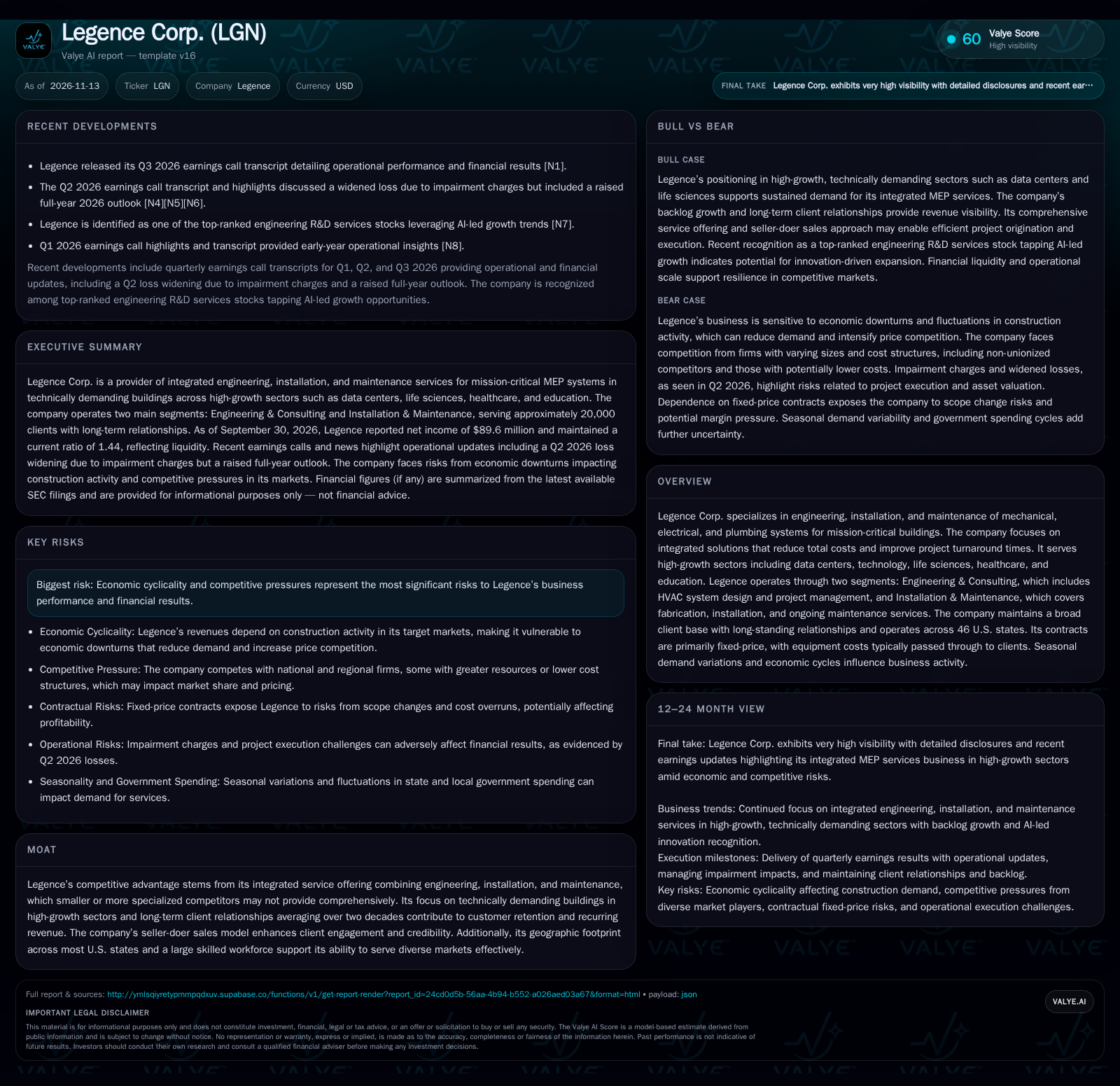
Legence Corp. serves over 20,000 clients with integrated MEP services across 46 states, focusing on high-growth, technically demanding sectors. Q2 2026 saw widened losses from impairment charges, but management raised the full-year outlook, signaling confidence in sector demand and backlog quality. The company’s fixed-price contract model supports revenue visibility but exposes it to margin risk if project costs rise. Economic cyclicality and intense competition remain central challenges. [N1] [N4] [N5] [N6]
Legence Corp. stands at the intersection of technical complexity and cyclical market forces, delivering integrated MEP solutions to mission-critical facilities in sectors such as data centers, healthcare, and life sciences. The company’s dual-segment model—covering both engineering/consulting and installation/maintenance—positions it to capture value across the project lifecycle. Recent financial results show both the risks and resilience inherent to this sector: a Q2 2026 loss widened by impairment charges was followed by a raised full-year outlook, underscoring management’s belief in the structural demand drivers of its core markets. Yet, fixed-price contracts, competitive intensity, and macroeconomic cyclicality continue to test the limits of Legence’s business model. [N1] [N4] [N5] [N6]
Recent Impairment Losses and the Upgraded Outlook Shaping Legence’s 2026 Path
Legence’s Q2 2026 financials were marked by a widened net loss, primarily attributed to impairment charges, highlighting both the company’s exposure to project execution risks and asset revaluations. Despite this setback, management raised the full-year 2026 outlook, suggesting underlying confidence in the pipeline and backlog quality. These developments are set against a backdrop of serving 20,000 clients in high-growth verticals, with recurring business supported by long-term relationships. The interplay between episodic losses (from impairments) and the ability to reaffirm guidance reflects both the volatility and potential embedded in Legence’s model. [N1] [N4] [N5] [N6] [S2]
Legence’s Integrated Model Converts Complexity into Revenue While Facing Margin Challenges
Legence generates revenue through two primary channels: Engineering & Consulting (including HVAC design and project management) and Installation & Maintenance (covering fabrication, installation, and ongoing service). Its integrated approach allows the company to capture value across the project lifecycle and cross-sell services, which can drive higher client retention and average contract value. The fixed-price contract model, where equipment costs are typically passed through to clients, provides revenue visibility and aligns with customer preferences for budget certainty. However, this structure shifts the risk of cost overruns or scope changes onto Legence, potentially compressing gross margins if project inputs or labor costs escalate unexpectedly.
Operating leverage is present but moderated by the variability of project timing and seasonal demand. Engineering and project management functions carry higher fixed costs, while installation and maintenance are more variable. The capital intensity is moderate, as the company does not own most client facilities and equipment costs are largely client-funded, but working capital management is vital due to the scale and duration of contracts.
Can Legence Maintain Its Advantage Amid Larger and More Efficient Competitors?
Legence’s core differentiation lies in its ability to deliver end-to-end MEP solutions for technically demanding buildings, combining engineering, installation, and maintenance under one roof. This integrated model is difficult for smaller, specialized firms to replicate and appeals to clients seeking single-point accountability for complex projects. Its historical focus on sectors with high technical requirements and growth profiles—such as data centers, healthcare, and life sciences—offers some insulation from commoditized, lower-margin construction work.
However, the competitive landscape remains intense. Legence competes with national and regional engineering and construction firms, including some with broader geographic reach, deeper capital resources, or non-unionized cost advantages. These peers can exert downward pressure on pricing, particularly during economic downturns when project volumes decline. Additionally, the fixed-price contract model is common in the industry, limiting structural margin advantages. The real test for Legence is whether its long-standing client relationships, sector focus, and integrated capabilities can offset these headwinds and sustain above-average returns over time.
Leveraging Backlog and Innovation to Capitalize on Sector Growth Opportunities
A favorable scenario for Legence is predicated on sustained demand from data centers, life sciences, and healthcare—sectors with secular growth drivers such as digital infrastructure buildout and expanding healthcare needs. If Legence can continue to grow its backlog, maintain high client retention, and execute projects efficiently, it could realize operating leverage as fixed costs are spread over a larger revenue base. Recognition as a top-ranked engineering R&D services stock tapping into AI-led growth suggests an opportunity to further differentiate through innovation, such as advanced building automation or sustainable design.
Confirmation of this scenario would include evidence of increasing backlog, rising project win rates in target sectors, improving gross margins (despite the fixed-price contract model), and continued recognition for technical and innovation leadership. Conversely, any signs of declining backlog quality, margin compression, or loss of key clients would challenge the upside thesis.
A Realistic 12–24 Month Outlook for Sustained Performance in a Cyclical Market
The most plausible outlook is that Legence maintains steady operations, with revenue growth tracking the underlying expansion of mission-critical sectors, but margin performance remaining variable due to ongoing competitive and contractual pressures. Project execution risk stays elevated, with occasional impairment charges or loss events offset by backlog replenishment and sectoral demand.
Confirming this scenario would involve stable revenue and backlog trends, modest improvement or maintenance of margins, and absence of major execution failures or loss of key accounts. A deterioration in project economics, significant client churn, or a spike in economic volatility would push performance below this baseline.
Margin Pressures and Execution Risks in an Economic Slowdown Scenario
A negative scenario for Legence involves a downturn in construction and capital spending across its key sectors, triggered by macroeconomic contraction or a pause in digital infrastructure buildouts. In this environment, competitive pricing intensifies, and the company is forced to accept lower-margin work or faces project delays and cancellations. The fixed-price model, while providing revenue visibility, turns into a liability if labor or material costs spike or if project scopes shift unexpectedly. Execution missteps—such as cost overruns or further impairment charges—could further erode profitability and strain liquidity.
Evidence confirming a downside scenario would include a sharp decline in backlog, persistent or widening losses, deterioration in cash flow, and signals of credit stress. Loss of major clients or failure to secure new projects in strategic verticals would also indicate a weakening position.
Future Developments That Will Influence Legence’s Trajectory
Backlog growth and composition by sector—rising backlog in data centers and life sciences would support the upside scenario; a decline or shift toward lower-margin work would be a red flag if disclosed.
Project gross margin trends—improving or stable margins would suggest effective risk management; margin compression would warn of contract or execution issues if disclosed.
Client retention rates and new project wins in high-growth verticals—continued strength here would confirm differentiation and sector focus if disclosed.
Incidence and size of impairment charges or project write-downs—recurrence would indicate ongoing execution or valuation risks.
Working capital and cash flow trends—consistent positive cash flow would support operational resilience; deterioration would signal stress if disclosed.
Competitive win rates and pricing dynamics—evidence of successful bids against larger or lower-cost rivals would reinforce the company’s value proposition if disclosed.
Adoption of technology-driven service enhancements—signs of investment in AI-enabled or sustainable MEP solutions would bolster the innovation narrative if disclosed.
Disclaimer: This is research-only, informational analysis and not investment advice. It may include AI-generated interpretation and general industry context. Always verify important details using primary sources.

Comments