
Rice Acquisition Corp 3: SPAC Structure, Capital Optionality, and the Clock on Value Creation
Rice Acquisition Corp 3 enters late 2026 with over $340 million in trust, no operating business, and reported liquidity position, but faces a finite window to identify and close a business combination. The company’s value proposition, risk profile, and eventual moat will be determined entirely by the quality and execution of its yet-unnamed acquisition.
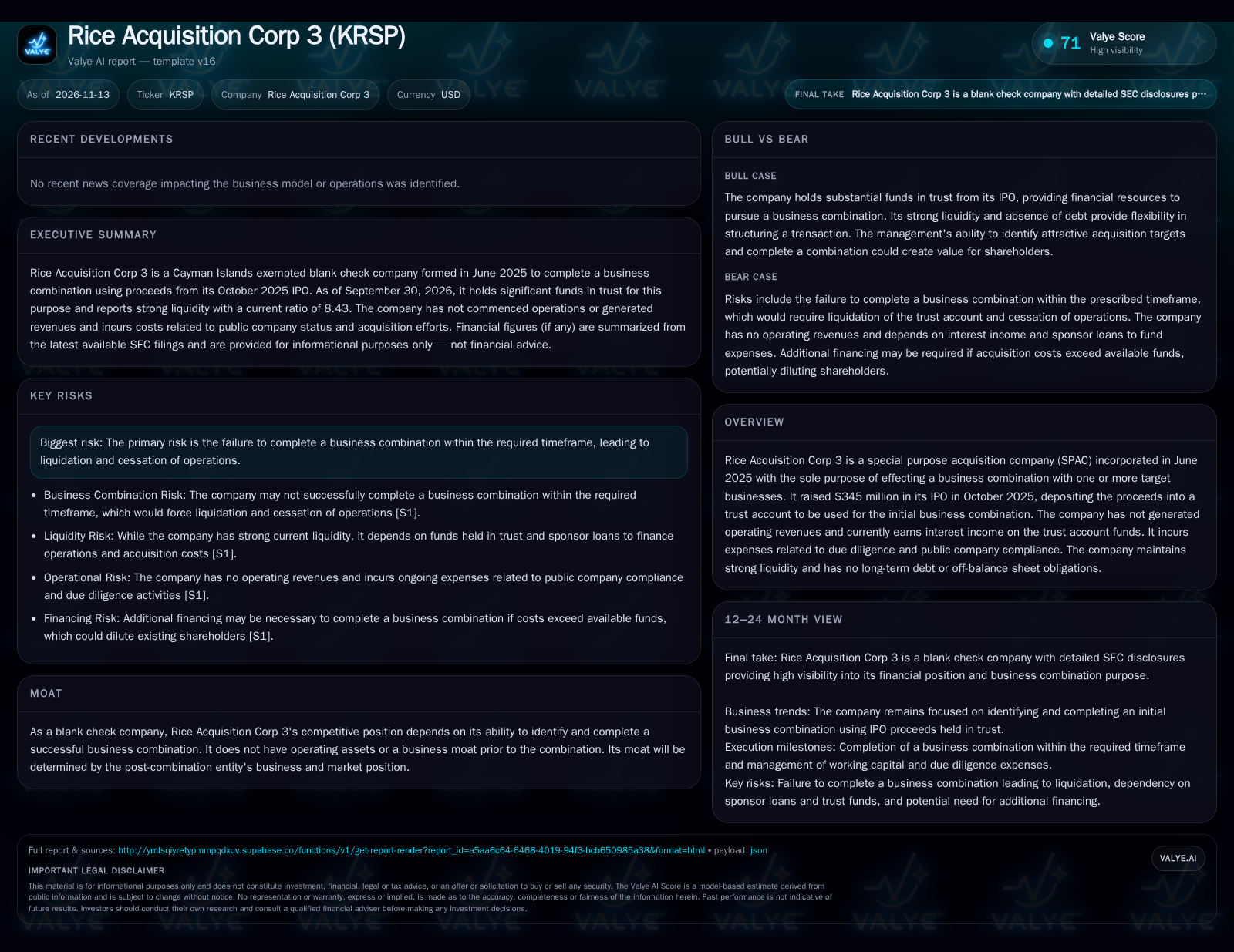
Rice Acquisition Corp 3 is a SPAC with $345 million raised in its 2025 IPO, all funds held in trust for a business combination. The core question is whether management can identify and close a value-creating transaction before the clock runs out.
Rice Acquisition Corp 3 is a blank check company operating under the familiar SPAC model, holding $345 million in trust since its October 2025 IPO. With no revenue-generating operations and no business combination target yet identified, the company’s value is a function of its cash-in-trust and the management team’s ability to source and execute a compelling acquisition. Despite strong current liquidity and no debt, the finite SPAC window imposes real pressure: failure to close a deal means liquidation and a return of funds to shareholders. Investors are betting not on an operating business, but on the team’s judgment and deal-making prowess.
Material Position: Cash-in-Trust Dominates, But No Target Yet
Rice Acquisition Corp 3’s defining feature as of late 2026 is its $345 million in IPO proceeds, held in a trust account specifically to fund a future business combination. The company reported cash and liquidity metrics for the period; these figures do not by themselves establish operating runway, investment capacity, financial flexibility, or financing capacity. [S2] The company has not selected or engaged in substantive discussions with any acquisition target [S2]. There is no operating business, and no revenues are being generated beyond interest income on the trust assets [S1] [S2]. The risk of failing to complete a deal within the SPAC timeframe is now at the forefront, as the window for deploying capital and creating value for shareholders continues to narrow.
Beyond the immediate cash-in-trust figure, a deeper analysis of the trust's composition and the underlying interest rate environment is crucial. The yield on trust assets directly impacts the SPAC's burn rate coverage and operational runway. In a rising interest rate environment, higher yields can extend the SPAC’s effective runway by generating more interest income to offset administrative costs, whereas a declining rate environment compresses this buffer. Additionally, the liquidity of the trust assets affects the flexibility to deploy capital swiftly once a target is identified, with more liquid instruments facilitating faster deal execution but potentially lower yields.
SPAC Economics: Interest Income, Burn, and the Deal-Driven Model
Rice Acquisition Corp 3 currently generates non-operating income exclusively from interest earned on its trust account, reporting $8.5 million in net income for the first nine months of 2026, driven by $9.5 million in interest and offset by nearly $1 million in administrative costs [S2]. This dynamic is typical for SPACs: cash burn consists mainly of regulatory, legal, and due diligence costs, with the trust principal shielded for the eventual acquisition. The economics transform only upon the closing of a business combination, after which the acquired entity’s operating performance, capital structure, and integration costs will define the financial profile. Until then, the SPAC structure is capital-efficient—requiring minimal capital outside the trust, no long-term debt, and offering optionality via sponsor loans if working capital needs arise. However, the lack of operating leverage or recurring revenue means all value hinges on execution of the future deal.
The SPAC’s financial model hinges on a delicate balance between preserving trust principal and funding ongoing expenses, which are typically front-loaded and can accelerate as the search progresses. Moreover, the optionality embedded in sponsor loans, while providing short-term liquidity, introduces potential dilution and shifts in capital structure post-deal, affecting long-term shareholder value. The timing and size of these loans, if utilized, would help assess the risk of capital erosion prior to closing a business combination.
Deal-Making in a Crowded SPAC Landscape: Sourcing, Competition, and Differentiation
The competitive landscape for Rice Acquisition Corp 3 is defined not by product or service differentiation, but by its ability to source and close a compelling acquisition ahead of peer SPACs. With hundreds of blank check companies still seeking targets, competition for high-quality acquisition candidates is intense. The absence of a pre-existing moat or unique sourcing channel means Rice Acquisition Corp 3 must rely on its sponsor’s reputation, network, and industry expertise to gain access to desirable deals. SPAC sponsors with specialized domain knowledge, credible track records, or alignment with target management teams may have a sourcing edge. However, bidding wars, target scarcity, and increased target selectivity (given the proliferation of SPACs) are material counterforces. The company’s ability to differentiate will only materialize after the business combination, and will depend on the acquired entity’s market position and post-merger execution.
Value Creation if the Right Target is Secured and Closed
The favorable scenario for Rice Acquisition Corp 3 is predicated on management identifying an attractive, scalable business—ideally with strong growth prospects, proven management, and a clear path to public-market value creation. Confirmation of this scenario would come from a timely announcement of a definitive merger agreement with a high-quality, differentiated target, robust PIPE (private investment in public equity) participation, and positive market reaction to deal terms and target fundamentals. Early disclosure of synergies, growth plans, and alignment between sponsor and target management would further strengthen the thesis. Conversely, failure to secure a top-tier target, or announcement of a deal with weak fundamentals, would quickly falsify the upside case.
Most Likely: Prolonged Search, Incremental Burn, and an Average Deal or Liquidation
The most plausible outcome is that Rice Acquisition Corp 3 continues its search, incurring incremental administrative and due diligence expenses as it evaluates potential targets. As the SPAC’s deadline approaches, management may face pressure to close a deal—potentially settling for a less compelling acquisition if high-quality targets remain scarce or bid up by competing SPACs. In this scenario, shareholder value may be preserved only through redemption rights (return of trust capital plus interest), with limited upside and little downside but also no material value creation. Confirmation would come from continued lack of deal announcements, modest cash burn, and an eventual deal with average or below-average target quality. Falsification would occur if a high-quality transaction is announced ahead of the typical SPAC timeline or if the company moves to liquidate and return funds without a deal.
Liquidation Risk: No Deal, Forced Wind-Down, and Opportunity Cost
The primary downside scenario is the failure to identify and close a business combination within the mandatory SPAC timeframe, resulting in the liquidation of the trust and return of capital to shareholders. While this outcome typically limits direct financial loss (as investors recover their pro rata share of the trust), it implies significant opportunity cost for both investors and the sponsor, as capital remains idle and public company expenses erode interest income. Additional risk emerges if the company attempts to close a deal under deadline pressure, potentially overpaying for a subpar target or accepting unfavorable terms. Evidence for this scenario would include repeated deadline extensions, lack of substantive deal progress, increased use of sponsor loans to fund operating expenses, and a final liquidation announcement.
Evidence That Will Determine Whether Rice Acquisition Corp 3 Creates Value
Announcement of a definitive business combination agreement, including target industry, size, and financial profile.
Disclosure of PIPE commitments or other financing to support the transaction, if any, and at what terms.
Redemption rates at the time of shareholder vote on the business combination—high redemptions may signal weak investor confidence.
Total cash burn and administrative expenses—if disclosed—relative to interest income, indicating the pace of capital erosion.
Any extensions to the SPAC’s deadline, or amendments to the trust agreement or charter.
Sponsor loans or additional financings—terms, use of proceeds, and potential for dilution, if disclosed.
Market reaction to deal announcement or liquidation notice, including trading price relative to trust value.
Disclaimer: This is research-only, informational analysis and not investment advice. It may include AI-generated interpretation and general industry context. Always verify important details using primary sources.

Comments