
BlossomHill Therapeutics: Advancing EGFR C797S Lung Cancer Therapy with Clinical Momentum and Financial Resilience
BlossomHill Therapeutics, Inc. is progressing its lead candidate, BH-30643, for EGFR C797S-mutant non-small cell lung cancer, reporting strong early clinical efficacy and reported liquidity position. The upcoming pivotal SOLARA-2 trial and the company's ability to translate promising data into regulatory and commercial success will determine its long-term trajectory.
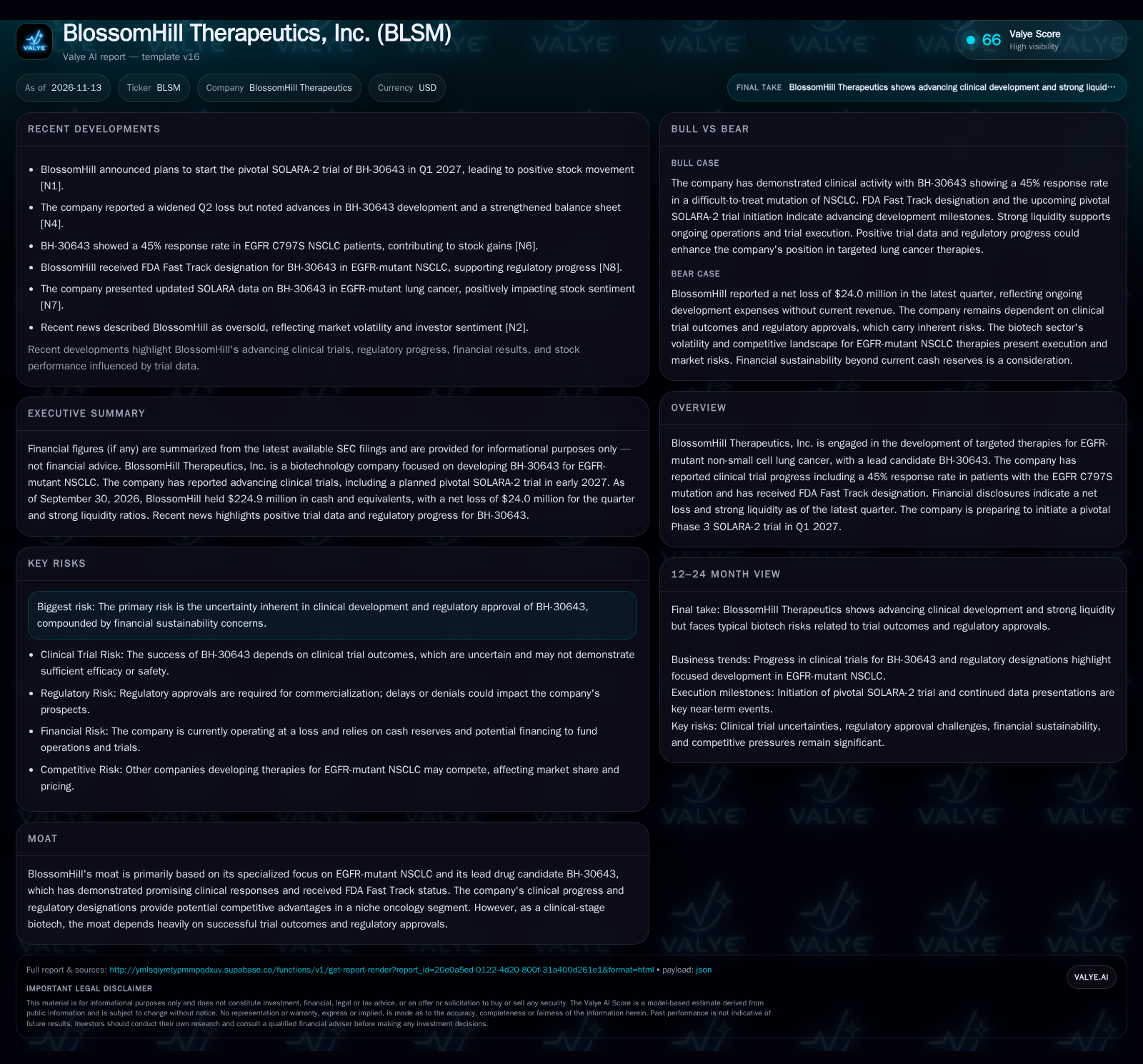
BlossomHill Therapeutics is advancing BH-30643 for EGFR-mutant NSCLC, with a 45% response rate in a key mutation and a pivotal Phase 3 trial set for early 2027. Reported liquidity position supports ongoing R&D, but financial sustainability depends on successful clinical and regulatory milestones. The company's future hinges on whether it can convert clinical promise into approval and market adoption. [S1] [N1] [N6]
BlossomHill Therapeutics, Inc. is emerging as a notable player in the targeted oncology landscape, focusing on therapies for EGFR-mutant non-small cell lung cancer (NSCLC). The company’s lead drug candidate, BH-30643, has shown a clinically meaningful 45% response rate in patients harboring the challenging EGFR C797S mutation, a group with limited treatment options. With a reported cash position of $224.9 million as of September 2026, BlossomHill is poised to initiate the pivotal SOLARA-2 Phase 3 trial in early 2027. The company’s ability to maintain momentum, execute on clinical strategy, and navigate the high-stakes regulatory environment will be central to its future value creation. [S1] [N1] [N6]
Recent Clinical Success and Financial Position Set the Stage for Pivotal Trial
BlossomHill Therapeutics is advancing BH-30643, its lead candidate targeting the EGFR C797S mutation in non-small cell lung cancer. In September 2026, the candidate reported a 45% response rate in this hard-to-treat population, signaling meaningful clinical activity and fueling investor optimism. The company plans to launch the pivotal SOLARA-2 Phase 3 trial in Q1 2027, a major milestone that could define its regulatory and commercial trajectory. [S1] [N1] [N6]
Therapeutic Development Economics: High Stakes, High Burn, and Binary Value Creation
As a clinical-stage biotech, BlossomHill’s short-term economics are defined by R&D expense, milestone-driven value inflection, and zero product revenue. The company’s current net loss—$24.0 million for the latest quarter—reflects ongoing clinical trial investment and overhead, with the cash runway dependent on burn rate and future financing needs. If BH-30643 advances to approval, the economics could shift dramatically: targeted oncology drugs can command premium pricing, especially in molecularly defined, high-unmet-need segments like EGFR C797S NSCLC.
In a successful commercial scenario, revenue would be driven by the eligible patient population, payer reimbursement, and the speed of adoption by oncologists. However, high fixed costs related to ongoing R&D, regulatory submissions, and eventual commercialization infrastructure mean operating leverage only materializes if the drug reaches market. Until then, fixed and variable costs will likely outpace any non-dilutive income (e.g., grants, partnerships). The capital needs for later-stage trials and launch preparation remain significant, and the risk of future dilution via equity raises is material if additional funding is needed before revenue generation.
Navigating a Crowded EGFR NSCLC Therapy Landscape
The market for EGFR-mutant NSCLC therapies is highly competitive, with multiple incumbents and emerging biotechs targeting various resistance mutations. The C797S mutation represents a subset with fewer effective options, offering an entry point for BH-30643 if efficacy and safety are confirmed in larger trials. However, established players in the EGFR inhibitor space, as well as next-generation candidates in development, could pose significant threats if they deliver superior or broader efficacy, better tolerability, or more convenient dosing.
Barriers to entry in oncology can include intellectual property, clinician adoption, payer coverage, and regulatory exclusivity, but these are conditional on successful trial outcomes and approval. Switching frictions may exist if BH-30643 becomes the only effective therapy for C797S-mutant patients, but otherwise, the ability to capture share depends on differentiation versus both first-line and resistance-mutation competitors. Pricing power is plausible if the drug is first-in-class or best-in-class, but payers may scrutinize value given the rising number of targeted agents.
Transformational Potential if Pivotal Data Confirms Efficacy and Safety
A best-case outcome would see the SOLARA-2 pivotal trial replicate or exceed the 45% response rate observed in earlier studies, with a favorable safety profile and robust progression-free survival data. This could position BH-30643 as a breakthrough therapy for EGFR C797S NSCLC, potentially enabling accelerated regulatory review and rapid uptake among oncologists treating patients who currently have limited options.
Commercial upside would be amplified if the drug is adopted as standard of care for this mutation, and if data suggest utility in additional EGFR resistance settings. Evidence that would confirm this scenario includes positive topline SOLARA-2 results, regulatory fast-track or breakthrough designation, and early signs of payer willingness to reimburse at premium prices. Partnership interest from larger pharmaceutical companies or licensing deals would further validate the asset’s value and could provide non-dilutive capital for launch and pipeline expansion.
Execution on Clinical Milestones While Managing Burn and Uncertainty
The most plausible scenario is that BlossomHill successfully initiates the SOLARA-2 trial in early 2027, with ongoing data readouts and incremental clinical progress over the next 12 to 24 months. Interim trial results may show efficacy broadly consistent with earlier data, but not without some variability in patient response or safety events typical for the class.
The company remains pre-revenue, with continued net losses and a watchful eye on the cash runway. Financing risk is mitigated in the near term by the current balance sheet, but longer-term sustainability will depend on either successful partnering, non-dilutive funding, or eventual equity raises. Confirmation of this scenario would include on-time trial initiation, stable or improving liquidity metrics, and regular clinical updates that meet expectations without major setbacks. Falsification would come from significant trial delays, materially worse efficacy or safety data, or an unexpected acceleration in cash burn.
Value Erosion If Clinical or Regulatory Hurdles Derail BH-30643
The primary risk is that the pivotal SOLARA-2 trial fails to confirm the efficacy or safety profile seen to date, resulting in disappointing response rates or adverse events that preclude regulatory approval. This would severely limit BlossomHill’s path to commercial revenue, potentially forcing a strategic pivot, pipeline reprioritization, or cost-cutting measures.
A further downside risk is that competitors deliver superior data or gain approval for C797S-mutant NSCLC ahead of BH-30643, eroding the value of BlossomHill’s lead asset. Prolonged trial timelines, regulatory setbacks, or an accelerated cash burn could necessitate dilutive financing or lead to unfavorable partnership terms. Evidence of this scenario would include negative or inconclusive pivotal trial results, clinical holds, waning investor interest, and a rapid deterioration in liquidity ratios.
Milestones and Data That Will Determine BlossomHill’s Trajectory
Initiation and enrollment pace of the SOLARA-2 pivotal trial in Q1 2027; delays or slow recruitment would challenge the company’s timeline. [N1]
Topline and interim efficacy/safety data from SOLARA-2; a useful metric would be response rate, progression-free survival, and incidence of serious adverse events, if disclosed.
Cash burn rate and updatedreported liquidity position projections as clinical expenses ramp; a useful metric would be quarterly net cash used in operations, if disclosed. [S1]
Strategic partnership or licensing activity related to BH-30643; announcements of collaborations or up-front payments would help test the commercial viability thesis.
Competitive developments—such as approval or late-stage data from other EGFR C797S-targeted therapies—that could shift the market landscape.
Regulatory interactions, including fast-track designations or feedback from FDA/EMA, which would indicate likelihood and speed of approval.
Pipeline updates beyond BH-30643, particularly advancement of other candidates or new indications, would provide insight into long-term optionality.
Disclaimer: This is research-only, informational analysis and not investment advice. It may include AI-generated interpretation and general industry context. Always verify important details using primary sources.

Comments