
Ensysce Biosciences: Clinical Progress and Platform Potential in Abuse-Deterrent Opioids
With pivotal Phase 3 trials underway for PF614 and a Breakthrough Therapy designation for PF614-MPAR, Ensysce Biosciences stands at a critical juncture in the race to offer safer opioid pain relief. The company's proprietary molecular platforms could reshape abuse deterrence, but execution, clinical outcomes, and market adoption remain key variables.
Ensysce Biosciences is advancing clinical-stage opioid candidates built on proprietary abuse-deterrent platforms, supported by strong current liquidity and regulatory recognition. The company’s future hinges on pivotal clinical readouts, regulatory approvals, and its ability to carve out a differentiated position in a competitive and evolving pain management landscape [S1] [S2].
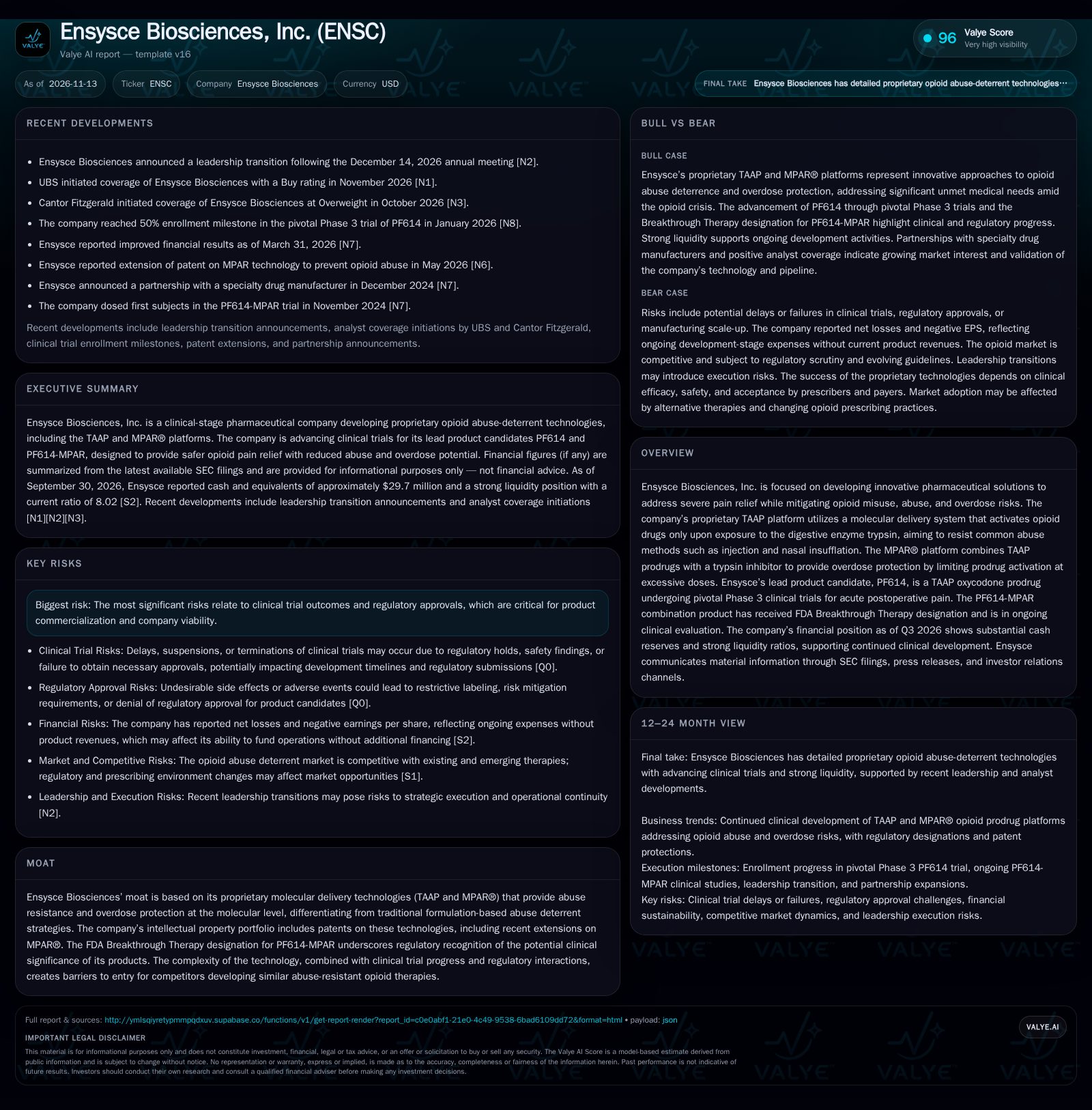
Ensysce Biosciences, Inc. is navigating a pivotal period as it advances its proprietary opioid abuse-deterrent drug candidates through late-stage clinical trials. Leveraging molecular delivery technologies aimed at reducing misuse and overdose, Ensysce’s lead assets—PF614 and the overdose-protective PF614-MPAR—are positioned to address major public health needs amid ongoing scrutiny of opioid prescribing. With recently strengthened analyst coverage, a substantial reported cash balance, and a pending leadership transition, the next 12-24 months will likely determine whether the company’s science can translate into regulatory approvals and commercial traction in a challenging and competitive market [S1] [S2] [N1] [N2] [N3] [N8].
Recent Milestones and Strategic Positioning
Ensysce’s most material developments center on its clinical and financial progression. The pivotal Phase 3 trial for PF614, a trypsin-activated oxycodone prodrug, reached 50% enrollment as of January 2026, marking significant advancement toward late-stage data [N8]. PF614-MPAR, which adds overdose protection to the base prodrug, remains in clinical development and holds an FDA Breakthrough Therapy designation—an important signal of both regulatory engagement and potential expedited review [S1]. Financially, the company reported $29.7 million in cash and a current ratio of 8.02 as of September 30, 2026, suggesting resources for near-term development priorities [S2]. Finally, a leadership transition is set for post-December 2026, which could alter execution dynamics or strategic focus [N2].
How Ensysce’s Model Could Monetize Abuse-Deterrent Innovation
Ensysce’s business model is predicated on commercializing proprietary opioid formulations that address both pain management and the societal costs of opioid misuse. The TAAP and MPAR platforms are designed to offer molecular-level abuse deterrence and overdose protection, distinguishing them from traditional formulation-based approaches. If successful, these features could justify premium pricing relative to generic or standard opioids—especially if payers, prescribers, and regulators recognize a quantifiable reduction in abuse, diversion, or overdose risk.
Revenue generation would likely depend on a combination of direct sales, licensing, or partnerships with established drug manufacturers—common for development-stage biotechs lacking their own commercial infrastructure. The economics hinge on both volume (driven by clinical efficacy, prescriber adoption, and payer coverage) and mix (the extent to which premium pricing is accepted for abuse-deterrent claims). Fixed costs are dominated by R&D and regulatory expenses; manufacturing scale-up could introduce additional capital needs, but variable costs would likely be modest if the platform can be adapted across multiple opioid and non-opioid pain therapies.
Operating leverage could be substantial if multiple candidates based on the same core technology progress to commercialization, but this is contingent on clinical and regulatory success. [S2]
Assessing Ensysce’s Edge in a Crowded and Scrutinized Market
The opioid market is intensely competitive, with established branded and generic players, as well as other specialty pharma companies pursuing abuse-deterrent formulations. Ensysce’s moat is its molecular approach to abuse deterrence and overdose protection—TAAP restricts activation to enzymatic digestion, while MPAR adds a pharmacological brake to prevent overdose. This could address regulatory and payer demands for innovation beyond simple formulation tweaks.
However, competitors with greater resources may develop alternative abuse-deterrent technologies or pivot to non-opioid pain solutions, which could limit Ensysce’s addressable market. Furthermore, prescriber and patient adoption depends not just on scientific merit but on ease of use, cost, and payer reimbursement. If payers remain skeptical of premium pricing or if regulators impose additional post-marketing requirements, the commercial advantage could narrow.
A key differentiator for Ensysce will be robust clinical data demonstrating meaningful real-world reductions in abuse or overdose versus existing therapies. FDA Breakthrough Therapy designation for PF614-MPAR offers a regulatory tailwind, but ultimate differentiation will depend on both clinical outcomes and practical market acceptance [S1].
Breakthrough Data and Regulatory Success Drive Rapid Uptake
In a favorable scenario, pivotal Phase 3 data for PF614 demonstrate not only non-inferior analgesic efficacy but also strong, quantifiable reductions in abuse and overdose risk compared to standard opioids. This, coupled with the FDA’s Breakthrough Therapy engagement for PF614-MPAR, results in accelerated regulatory approval and positive labeling around abuse deterrence and overdose protection.
Such outcomes could unlock premium payer coverage, drive rapid prescriber adoption in high-risk patient segments, and potentially attract licensing or commercial partnerships with larger pharmaceutical companies. Validation of the TAAP/MPAR platforms could also open up additional indications (e.g., chronic pain, opioid use disorder) and new product candidates, amplifying operating leverage.
Evidence supporting this scenario would include positive top-line Phase 3 results, early regulatory feedback on labeling, new partnership announcements, and initial formulary wins with major payers.
Progress Continues, but Commercial Path Remains Unproven
The most plausible trajectory is continued advancement of PF614 and PF614-MPAR through clinical and regulatory milestones, but with a measured pace of adoption even if approved. [S2]
Clinical data may support safety and efficacy, but real-world demonstration of reduced abuse and overdose could take time to accumulate and convince payers or prescribers to switch from entrenched competitors. Regulatory approval may come with labeling or post-marketing study requirements, and payer reimbursement could be limited initially, constraining pricing power.
Confirmation of this scenario would be continued clinical progress, regulatory filings, and initial commercial planning, but without major licensing deals, rapid uptake, or significant revenue in the first commercial years. Falsification would come from either a major clinical setback or an unexpectedly rapid commercial ramp.
Clinical or Regulatory Setbacks Undermine Platform Value
In a negative scenario, one or more of the lead programs encounter clinical setbacks—such as failure to demonstrate clear efficacy, insufficient differentiation in real-world abuse deterrence, or unanticipated safety signals. Regulatory review could be delayed or result in restrictive labeling, limiting commercial appeal.
Such outcomes would likely erode investor and partner confidence, raise capital constraints (despite current liquidity), and potentially force a strategic pivot or downsize. The opioid field’s regulatory scrutiny and shifting prescribing guidelines amplify these risks, as do the high expectations set by Breakthrough Therapy designation.
Evidence for this scenario would include negative or ambiguous top-line results, clinical holds, FDA requests for additional studies, or lack of payer interest even after approval.
Milestones That Will Shape Ensysce’s Competitive Trajectory
Pivotal Phase 3 data readout for PF614: The timing, magnitude, and clarity of efficacy and abuse deterrence signals will be central to both regulatory and commercial outcomes.
Progress and data from the ongoing PF614-MPAR clinical trials, especially any updates on overdose protection and real-world abuse metrics.
Regulatory feedback on NDAs or labeling: Early or unexpected communications from the FDA—regarding abuse-deterrent claims, required post-marketing studies, or labeling restrictions—would materially affect commercial viability.
Partnership or licensing announcements with larger pharmaceutical companies, signaling validation of the platform and potential for commercial reach.
Payer coverage decisions and formulary placement: Concrete evidence of premium reimbursement or early adoption by major payers would help test the pricing power thesis.
Execution and impact of the post-December 2026 leadership transition, particularly any strategic shifts or operational disruptions [N2].
Cash burn rate and funding plans: If disclosed, updated projections on runway and capital needs as the company approaches commercialization would provide visibility into sustainability.
Prescriber and patient adoption trends post-launch (if/when commercialized): Early prescription data, feedback from pain specialists, and market share metrics would help validate or challenge the adoption curve.
Disclaimer: This is research-only, informational analysis and not investment advice. It may include AI-generated interpretation and general industry context. Always verify important details using primary sources.

Comments