
KBS Real Estate Investment Trust III: Office Portfolio Faces Refinancing Cliff and Industry Headwinds
KBSR’s core office portfolio, once a source of stability, now confronts a compressed timeline to refinance $1.3 billion in debt or execute asset sales amid a stressed office market, with going concern uncertainty intensifying scrutiny on its disposition strategy and loan covenant management.
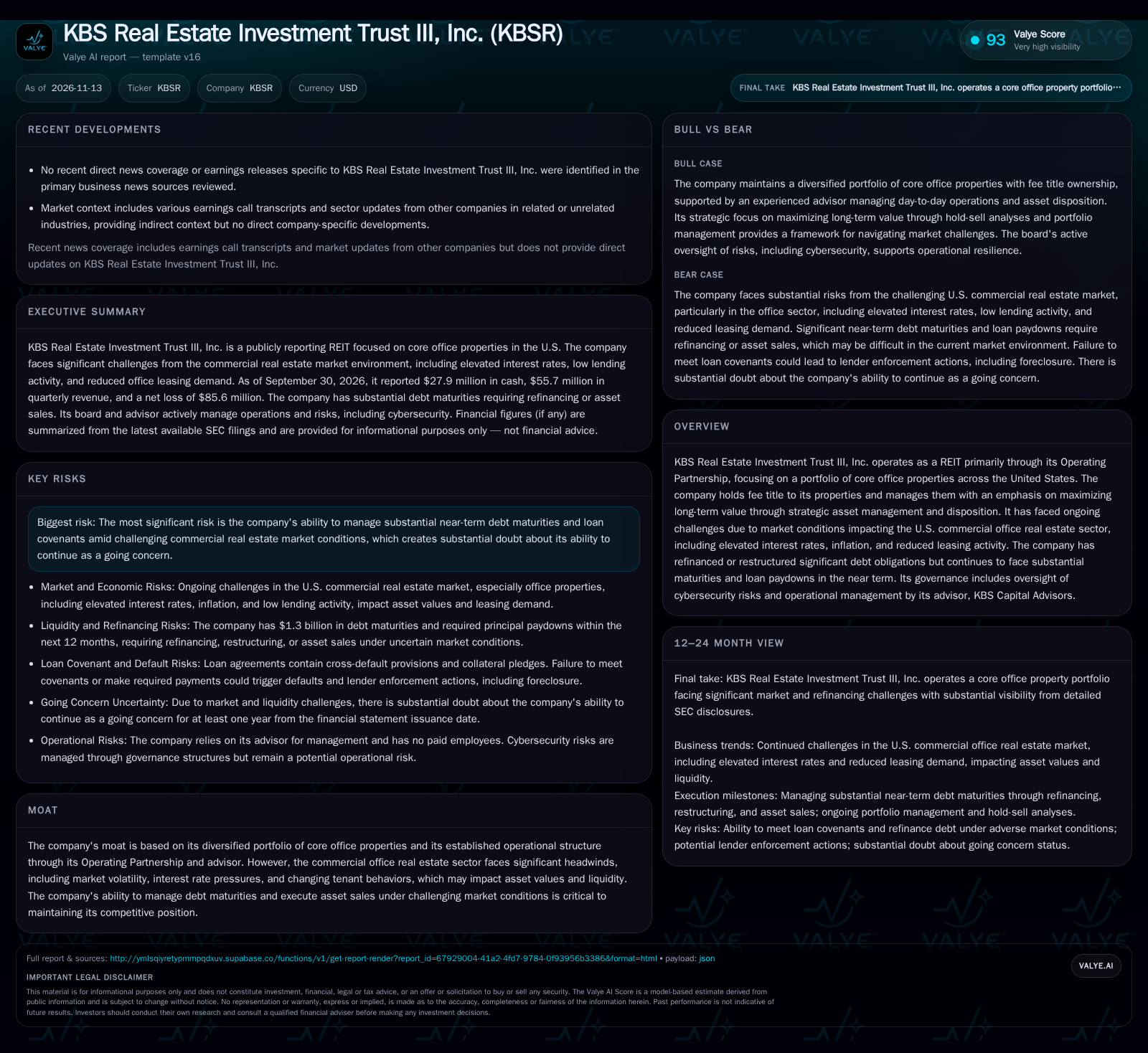
KBS Real Estate Investment Trust III holds 12 U.S. office properties and a Singapore REIT stake, but faces $1.3 billion in imminent debt maturities, persistent net losses, and challenging office market conditions. Asset sales and refinancing are required to address looming obligations, while substantial doubt remains about the company’s ability to continue as a going concern. Execution on asset dispositions and loan negotiations will determine its survival trajectory. [S2]
KBS Real Estate Investment Trust III, Inc. (KBSR) stands at a crossroads typical of U.S. office-focused REITs in 2026: a mature, fee-simple portfolio with a highly compressed refinancing window, thin liquidity, and a sector roiled by low leasing demand and scarce credit. With $1.3 billion in debt coming due within months and asset sales contractually mandated by lenders, the company’s fate depends on its ability to execute portfolio dispositions and negotiate with creditors—even as market conditions remain hostile to large office transactions. The coming year will test whether KBSR’s asset base and advisory structure can deliver value preservation or if compounding headwinds will force more drastic restructuring.
Debt Maturities and Asset Sales Define the Immediate Outlook
As of March 27, 2026, KBSR faces approximately $1.3 billion in debt with a weighted average remaining term of only 0.5 years, meaning most of its obligations come due within months. The company reported $27.9 million in cash and $55.7 million in revenue for the quarter ended September 30, 2026, but a net loss of $85.6 million underscores operating challenges. Loan agreements require additional property sales in 2026 and 2027, and include cross-default and collateral provisions that could trigger lender enforcement rights if covenants are breached. Management has acknowledged substantial doubt about KBSR’s ability to continue as a going concern, highlighting the severity of liquidity and refinancing stress. [S1] [S2]
How the Portfolio Generates—and Consumes—Capital in a Downturn
KBSR’s economics hinge on rental income from its 12 core office properties and returns from its Singapore REIT stake, offset by the costs of property operations, debt service, and asset management fees to its external advisor. In normal environments, core office assets offer stable cash flows and the prospect of incremental value creation through leasing, capital improvements, or strategic sales. However, the current reality is sharply negative: reduced leasing demand depresses occupancy and rental rates, while elevated interest rates inflate refinancing costs and restrict access to new credit. Fixed costs related to property upkeep and debt service create negative operating leverage when revenues fall, as seen in the Q3 2026 net loss. The capital-intensive nature of office real estate, combined with the absence of meaningful internal cash generation, means KBSR must rely on asset sales or refinancing to meet obligations. Given the wind-down of its dividend reinvestment and share redemption programs, new equity capital is not a near-term lever.
In addition to the immediate pressures of declining rental income and elevated refinancing costs, the portfolio's capital structure amplifies financial vulnerability through its leverage profile. When debt levels are high relative to asset values and cash flow, even modest declines in occupancy or rent can disproportionately erode equity cushions and increase default risk. This dynamic is exacerbated by limited access to new equity capital, which constrains the company's ability to deleverage or fund capital improvements that might enhance asset competitiveness. Furthermore, the fixed nature of many property-level expenses means that cost-cutting opportunities are limited, resulting in persistent negative operating leverage during downturns. Consequently, the timing and pricing of asset sales become critical, as selling under distress conditions may crystallize losses and reduce the capital available for debt repayment or reinvestment.
Navigating a Distressed Office Sector with Limited Strategic Options
KBSR’s competitive position is shaped less by traditional real estate factors—such as location or tenant mix—and more by its ability to navigate a distressed sector. The company’s fee-simple ownership and diversified portfolio once provided a degree of resilience. Now, however, the office sector faces secular demand shifts due to hybrid work, persistently high vacancy rates, and investor skepticism. Competing landlords must often offer substantial concessions or capital expenditures to attract tenants, compressing net operating income and making properties harder to sell at attractive valuations. The company’s reliance on its external advisor for operational and disposition expertise is a double-edged sword: while it brings professional asset management, it also reduces direct operational flexibility. The cross-default and collateralized loan structures further constrain KBSR’s room to maneuver, as a default in one property or subsidiary could cascade through the portfolio.
The external advisory model, while providing specialized expertise, can introduce agency challenges that affect strategic responsiveness. The advisor's incentives and priorities may not fully align with those of equity holders, particularly under stressed conditions where disposition timing and pricing decisions are pivotal. Moreover, the reliance on external management can slow decision-making processes or limit the company's ability to rapidly adapt leasing strategies, renegotiate tenant terms, or implement cost efficiencies. This structural characteristic may reduce KBSR’s agility in a sector where tenant preferences and market dynamics are shifting rapidly. Additionally, the cross-default provisions embedded in loan agreements create systemic risk within the portfolio, as distress in one asset can cascade, limiting the company's ability to isolate and manage individual property challenges effectively.
Successful Dispositions and Lender Cooperation Could Reset the Clock
The most favorable outcome for KBSR would involve executing timely asset sales at valuations sufficient to cover near-term debt maturities and restore lender confidence. If select office properties—perhaps those in stronger submarkets or with better lease profiles—can be sold above distressed levels, proceeds could be used to retire or restructure debt, reducing the risk of covenant breaches and lender enforcement. Lender flexibility, whether through maturity extensions or covenant waivers, would further increase survival odds. In this scenario, the company could stabilize its remaining portfolio, reposition assets, and perhaps eventually return to a more normalized earnings trajectory. Evidence that would confirm this pathway includes announced property sales at reasonable cap rates, negotiated loan extensions, and a reduction in going concern language in future filings.
Asset Sales at Discounts and Incremental Restructuring Amid Ongoing Losses
The most plausible path is that KBSR is able to sell properties, but only at discounted valuations reflecting the weak office market. Sale proceeds may cover some, but not all, debt maturities, requiring ongoing negotiations with lenders for extensions or restructurings. Operating losses persist, and the company may need to dispose of its stronger assets first (those with higher occupancy or better locations), leaving a residual portfolio of more challenged properties. This scenario is characterized by continued uncertainty, elevated refinancing and disposition costs, and the risk that cumulative asset sales erode long-term value. Confirmation would come from SEC filings showing asset sales at below book value, incremental loan modifications, and continued going concern disclosures.
Loan Covenant Breaches and Forced Liquidation Risk Loom Large
If KBSR fails to execute asset sales or secure lender accommodations, cross-default provisions and collateral pledges could enable lenders to accelerate debt or foreclose on properties. In this scenario, the company could be forced into a piecemeal liquidation or restructuring, with asset values impaired further by distressed sale dynamics. The risk is magnified if market liquidity deteriorates or if broader office sector distress triggers fire sales across multiple landlords. Evidence of this scenario would include event-of-default disclosures, foreclosure notices, or the appointment of receivers, as well as an abrupt drop in reported property values.
Milestones That Will Determine KBSR’s Survival or Restructuring Outcome
Announcement of material property sales, including sale price versus book value and use of proceeds; this will reveal the market’s willingness to transact and the level of discount required.
Updates on loan modifications, extensions, or covenant waivers from major lenders, which would indicate lender flexibility or tightening.
Quarterly occupancy and leasing metrics, if disclosed, to assess whether the remaining portfolio is stabilizing or deteriorating further.
Changes in the company’s reported going concern language or auditor emphasis, which could signal improved or worsening outlook.
Quarterly cash flow from operations and debt service coverage ratio, if disclosed, to evaluate short-term liquidity stress.
Disposition of the Singapore REIT stake—whether it becomes a source of liquidity or is retained as a strategic asset.
Board or advisor communications regarding strategic alternatives, including potential mergers, restructurings, or bulk asset sales.
Disclaimer: This is research-only, informational analysis and not investment advice. It may include AI-generated interpretation and general industry context. Always verify important details using primary sources.

Comments