
Fluent, Inc.: Commerce Media Ambitions Meet Compliance and Liquidity Crosswinds
Fluent is repositioning its business toward scalable, tech-driven commerce media solutions after regulatory scrutiny upended its owned-and-operated sites.
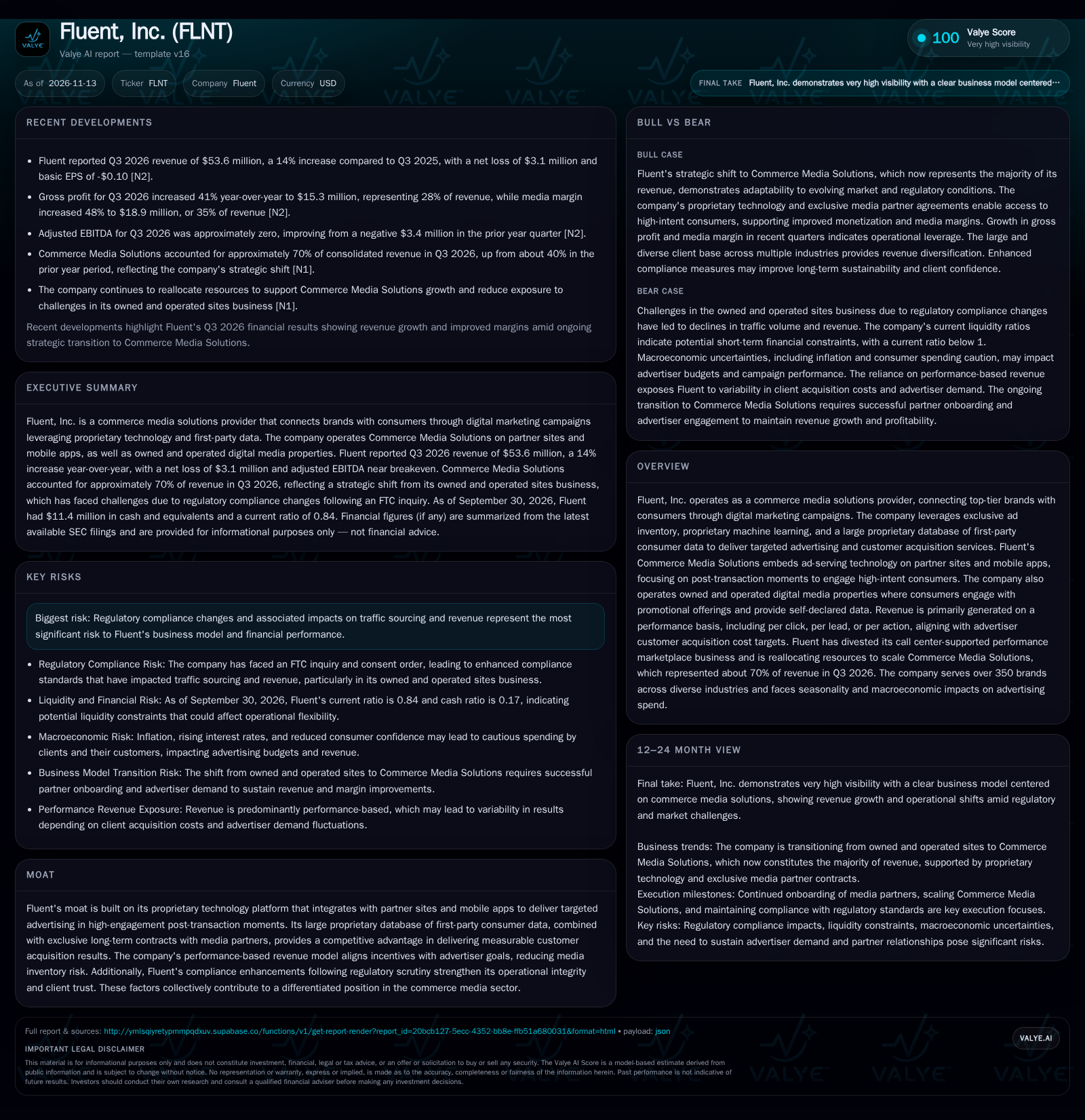
Fluent is shifting focus toward its Commerce Media Solutions platform after regulatory changes forced a reset in its owned-and-operated business. The company’s differentiated data assets and platform integrations offer upside if client demand and partner onboarding can accelerate, but revenue variability and potential financial flexibility remain key watchpoints. [S2] [N1] [N2]
Fluent, Inc. stands at a pivotal juncture as it attempts to transition from a heavy reliance on owned-and-operated media sites—recently hindered by regulatory compliance—to a more platform-driven commerce media model. The coming quarters will reveal whether Fluent can execute on its platform vision, reestablish a growth trajectory, and navigate the risks that have recently reshaped its fortunes.
Regulatory Overhang and Platform Pivot Shape Fluent’s Present
Fluent’s recent trajectory has been defined by a forced strategic shift: following an FTC inquiry and consent order, the company was compelled to enhance its compliance standards, which in turn constrained traffic sourcing and revenue in its owned-and-operated (O&O) sites business. In response, Fluent has reallocated resources to support growth in its Commerce Media Solutions offering, which leverages proprietary ad-serving technology on partner environments rather than relying on O&O media properties. This pivot is material because it both reduces exposure to compliance-sensitive channels and seeks to capitalize on scalable, integrated brand partnerships. [N1]
Financially, Fluent reported approximately break-even adjusted EBITDA for Q3 2026, a notable improvement from a $3.4 million loss in the prior year’s quarter. These financial constraints may limit the company’s ability to invest aggressively or buffer against further shocks. [S2] [N2]
The company serves over 350 brands across diverse consumer verticals, and its business is inherently seasonal, with volume peaking in Q4 for retail partners. Macroeconomic factors, such as inflation and consumer confidence, continue to weigh on advertiser budgets and campaign volumes.
Performance-Based Revenue and the Economics of Data-Driven Advertising
Fluent’s core business generates revenue primarily on a performance basis—per click, per lead, or per action—aligning with advertisers’ customer acquisition cost (CAC) targets. This model can be attractive for clients seeking measurable return on advertising spend (ROAS), but it exposes Fluent to significant revenue variability tied to both client demand and the efficiency of its traffic acquisition.
The company’s economics hinge on its ability to source high-intent consumer traffic cost-effectively, leveraging its proprietary database of self-declared user data and ad-serving technology. If Fluent’s platform can consistently identify and monetize these high-value moments (notably post-transaction), it may achieve superior media margins and operating leverage as fixed technology and compliance investments scale across more campaigns and partners.
Where Fluent’s Platform Stands in a Crowded Commerce Media Landscape
Fluent competes in a rapidly evolving commerce media sector, where the ability to deliver targeted, measurable outcomes for brands is increasingly table stakes. Its proprietary first-party data, gathered through O&O engagement and partner integrations, is a potential differentiator as privacy regulations and signal loss challenge third-party tracking across the industry.
However, the competitive field is intense: large digital advertising platforms, retail media networks, and independent performance marketing agencies all vie for brand spend. Many peers have deeper partner networks, broader omnichannel capabilities, or more resilient balance sheets. Fluent’s exclusive media partner agreements and post-transaction targeting focus may help carve out a niche, but its recent compliance history and liquidity constraints could deter some partners or clients wary of operational risk.
In this context, the company’s ability to maintain and grow exclusive partner relationships, deliver superior ROAS, and adapt to ongoing regulatory shifts will determine whether it can sustain a differentiated role or be relegated to the margins of the performance marketing value chain.
If Platform Integration Accelerates, Growth and Margin Recovery Could Follow
A favorable outcome for Fluent hinges on successful execution of its pivot toward Commerce Media Solutions: rapid onboarding of new media partners, increased adoption of its proprietary ad-serving technology, and continued improvement in compliance processes. If these efforts enable the company to attract higher-quality, high-intent consumer traffic and deliver demonstrably better ROAS to clients, Fluent could regain revenue momentum and see improved media margins.
Confirmation of this scenario would come from sequential growth in Commerce Media Solutions revenue, expansion in the number and depth of partner integrations, and evidence of client retention or wallet share gains. Improved adjusted EBITDA and positive operating cash flow would further validate that fixed investments in technology and compliance are yielding scalable, profitable results.
Falsification would be clear if Commerce Media Solutions revenue stagnates, partner onboarding slows, or if incremental compliance costs erode media margins faster than new revenues can replace them.
Rebuilding Stability: Platform Growth and Cost Discipline Offset by External Headwinds
The most plausible near-term outcome is a period of gradual stabilization: Fluent continues to grow its Commerce Media Solutions platform but at a measured pace, constrained by both macroeconomic caution among advertisers and the company’s reported liquidity position. Cost controls and compliance investments help avoid further regulatory setbacks but also limit aggressive growth initiatives.
Revenue variability persists due to the performance-based model and ongoing challenges in replacing lost O&O traffic. Gross margins may remain under pressure if partner-sourced inventory cannot fully substitute for higher-margin O&O supply. Confirming evidence would include modest sequential revenue and margin improvements, stable client counts, and maintenance of compliance standards without additional regulatory fallout.
Falsification would be signaled by a renewed decline in revenue, deterioration in adjusted EBITDA, or failure to secure new meaningful partner integrations.
Liquidity Squeeze and Compliance Drag Threaten Business Continuity
This could be triggered by weak seasonal volumes, a pullback in advertiser demand due to macro shocks, or additional regulatory hurdles that further restrict traffic sourcing.
In this scenario, the company might face shrinking partner confidence, loss of key clients, and potential erosion of its proprietary data asset as consumer engagement wanes. If compliance costs continue to rise while revenue fails to recover, Fluent could be forced into restructuring, asset sales, or seeking external capital under unfavorable terms.
Confirming signs would include further compression in cash balances, negative operating cash flow, missed partner or client targets, or public disclosure of additional regulatory investigations or penalties.
What Will Test Fluent’s Commerce Media Rebuild in the Next Year
Sequential growth in Commerce Media Solutions revenue, if disclosed, would be a primary indicator of successful platform execution.
The number and quality of new media partner integrations announced or launched each quarter would help test whether Fluent is rebuilding a scalable ecosystem.
Trends in adjusted EBITDA and operating cash flow will reveal whether business mix shifts and cost controls are translating into sustainable profitability.
Disclosure of client retention rates or expansion in wallet share among top advertising customers would provide evidence of improving value proposition.
Public updates on compliance milestones, regulatory audits, or any additional consent orders would signal the ongoing risk environment.
If disclosed, gross margin trends by channel (O&O vs. partner-sourced) would help clarify the impact of business mix changes on underlying economics.
Seasonal volume patterns, particularly in Q4 retail campaigns, will show whether macro headwinds are still curbing advertiser demand or if spending is recovering.
Disclaimer: This is research-only, informational analysis and not investment advice. It may include AI-generated interpretation and general industry context. Always verify important details using primary sources.

Comments