
BioStem Technologies: Product Access Gains Meet Liquidity and Execution Headwinds
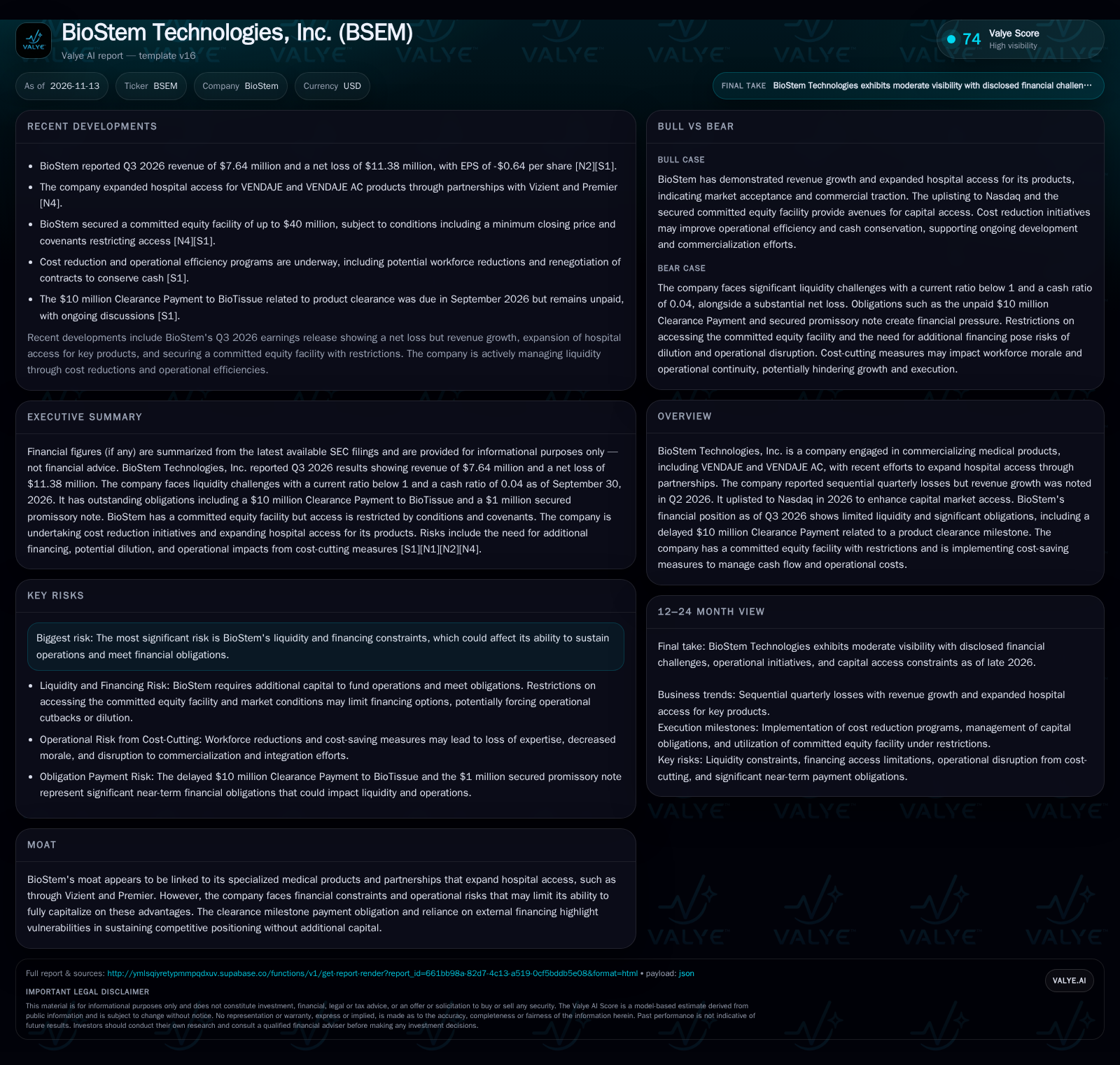
BioStem Technologies has expanded hospital access for its regenerative products and posted revenue growth, but mounting liquidity pressures, a large unmet milestone payment, and restricted access to committed capital shape a precarious outlook. The company’s ability to navigate cost reductions while sustaining commercial momentum and meeting obligations will determine whether operational progress can translate into durable value.
Access to a $40 million equity facility is restricted, and cost-cutting efforts are underway. Whether these moves can preserve commercial traction or trigger further disruption is the central strategic question [S1] [N2] [N4].
BioStem Technologies, a regenerative medicine company, has recently made strides in expanding access to its VENDAJE product line through key hospital partnerships and demonstrated revenue growth. However, these commercial advances are overshadowed by acute financial strain: the company’s cash position is perilously low, a critical $10 million milestone payment remains unpaid, and access to lifeline capital is restricted by market and covenant conditions. Management is pursuing aggressive cost containment, but the risk is that these measures compromise operational continuity and future growth. The coming quarters will test whether BioStem can reconcile its commercial promise with the realities of capital scarcity and execution risk.
Recent Commercial Advances and Mounting Financial Constraints
BioStem Technologies reported Q3 2026 revenue of $7.64 million, but this topline growth is overshadowed by a net loss of $11.38 million and a negative EPS of $0.64 [N2] [S1]. The company’s liquidity position is acute: cash and cash equivalents stood at just $971,000 as of September 30, 2026, with a current ratio of 0.73 and a cash ratio of 0.04. Against this backdrop, BioStem faces a $10 million Clearance Payment to BioTissue—due in September 2026 and still unpaid as of mid-November—plus a $1 million secured promissory note maturing in April 2027 [S1].
On the commercial side, BioStem expanded hospital access for its VENDAJE and VENDAJE AC products via partnerships with Vizient and Premier, potentially increasing its addressable market [N4]. To address its cash needs, the company arranged a committed equity facility of up to $40 million, though access is constrained by minimum price requirements and debt covenants. Cost reduction programs—including potential workforce reductions and renegotiation of contracts—are being implemented to extend operational runway [S1].
Revenue Model, Cash Burn, and the Leverage Equation
BioStem’s core revenue is derived from the sale of regulated regenerative medicine products, primarily VENDAJE and VENDAJE AC, which are distributed through hospital and clinical channels. Revenue growth in Q2 and Q3 2026 suggests some success in expanding market access, likely driven by new institutional partnerships. However, the company’s negative operating leverage is stark: net losses consistently outpace revenues, reflecting high fixed costs (R&D, regulatory, SG&A) relative to current sales volumes [N2] [S1].
The business model in this sector typically depends on scaling product adoption to absorb fixed costs and eventually achieve margin expansion. However, BioStem’s current cash burn—$11.38 million net loss in Q3 alone—highlights the gap between commercial progress and financial sustainability. The operational cost base may be sticky, as regulatory compliance, clinical education, and hospital onboarding demand sustained investment. Capital needs remain high, both to fund ongoing commercialization and to meet milestone obligations. Without a material increase in sales, margin improvement, or new capital, the risk of further dilution or forced operational retrenchment is significant.
Hospital Access Partnerships and the Challenge of Scale in Regenerative Medicine
The company’s recent partnerships with Vizient and Premier open up more hospital procurement channels, which can be a meaningful commercial advantage in regulated medical products. These group purchasing organizations (GPOs) can accelerate adoption by streamlining vendor approval and providing broader institutional reach. However, these relationships do not guarantee recurring or contracted revenue—real uptake depends on clinical differentiation, reimbursement, and physician preference, which remain to be validated at scale [N4].
BioStem operates in a competitive landscape that includes other wound care and regenerative medicine firms, ranging from large diversified medtechs to specialized tissue product providers. Barriers to entry include regulatory approval, clinical data, and hospital onboarding. However, the company’s current financial constraints may hinder its ability to invest in further clinical evidence, field sales, and product support—areas where better-capitalized rivals could outpace it. If BioStem cannot sustain commercial investments, any early-mover advantage in hospital access could erode rapidly.
Unlocking Capital and Scaling Hospital Adoption Could Drive a Turnaround
A favorable outcome for BioStem hinges on two reinforcing developments: successful access to a meaningful portion of its $40 million committed equity facility, and effective conversion of expanded hospital partnerships into recurring, higher-margin sales [S1] [N4]. If the company is able to resolve its milestone payment with BioTissue—potentially through renegotiation or new funding—this would remove a major overhang and could restore supplier and investor confidence.
Signs of success would include sequential revenue acceleration from hospital channels, improvement in gross margins (as fixed costs are absorbed by higher volumes), and evidence that cost reductions do not undermine product delivery or customer support. If new capital is raised on non-punitive terms and is deployed into revenue-generating activities (not just plugging liquidity holes), the company could begin the transition from cash burn to self-sufficiency. Confirmation would come from reported increases in hospital orders, reduced quarterly net losses, and disclosure of expanded gross margin or positive operating cash flow.
Commercial Progress Collides with Capital Constraints
The most plausible scenario is that BioStem’s commercial momentum continues at a modest pace, but is constrained by limited capital and operational belt-tightening. The company may be able to maintain or slightly grow revenues through its newly established hospital partnerships, but the pace of adoption is likely to be gradual given competitive pressure and the time required for clinical integration.
Cost reduction initiatives could temporarily extend the cash runway but may also slow the pace of commercialization and hamper responsiveness to hospital partners. Access to the committed equity facility will likely be episodic and dilutive, given restrictive covenants and market volatility. The unresolved $10 million milestone obligation could further distract management and limit negotiating leverage with suppliers and partners.
Confirmation of this scenario would include steady but unspectacular revenue growth, continued net losses (albeit at a potentially slower rate), and piecemeal capital raises that dilute existing shareholders. Falsification would occur if the company either unlocks substantial new capital and accelerates growth, or if operational disruption causes revenue to stall or decline.
Liquidity Shortfall Triggers Operational Retrenchment or Restructuring
The bear case is that BioStem is unable to secure sufficient capital—either due to market conditions, covenant restrictions, or declining share price—and is forced to make deeper cuts to operations. If the $10 million Clearance Payment remains unpaid, BioTissue could take legal or commercial action, potentially disrupting supply or triggering litigation costs. Further workforce reductions and deferred investments could impair BioStem’s ability to service its hospital partners, leading to declining sales and loss of institutional trust.
This scenario could culminate in a distressed capital raise under punitive terms, a forced sale of assets, or even bankruptcy proceedings if obligations cannot be met. Early warning signs would include a sharp drop in reported cash, missed payroll or vendor payments, sequential declines in revenue, and the loss of key hospital relationships.
What Will Determine Whether BioStem’s Commercial Gains Translate into Sustainable Value?
Resolution of the $10 million Clearance Payment to BioTissue—whether paid, renegotiated, or otherwise settled—would clarify near-term viability.
Reported cash balance and quarterly cash burn trends; a useful metric would be monthly net operating cash flow, if disclosed.
Actual drawdowns and use of proceeds from the $40 million committed equity facility, including dilution impact and compliance with covenants.
Sequential revenue growth from hospital channels, with detail on contracted versus non-contracted sales, if disclosed.
Gross margin progression, as an indicator of fixed cost absorption and pricing leverage.
Headcount trends and disclosed impact of workforce reductions on commercial and R&D capacity.
Any new financing deals, their terms, and the extent to which they alleviate or exacerbate dilution and operational risk.
Retention and expansion of hospital partnerships—updates from Vizient, Premier, or new group purchasing agreements would help test the thesis.
Disclaimer: This is research-only, informational analysis and not investment advice. It may include AI-generated interpretation and general industry context. Always verify important details using primary sources.

Comments