
GEN Restaurant Group: Persistent Losses, Liquidity Pressure, and the Search for a Turnaround
The company’s ability to improve profitability and stabilize cash flow remains central to its future.
The company’s ability to improve profitability and stabilize cash flow remains central to its future.
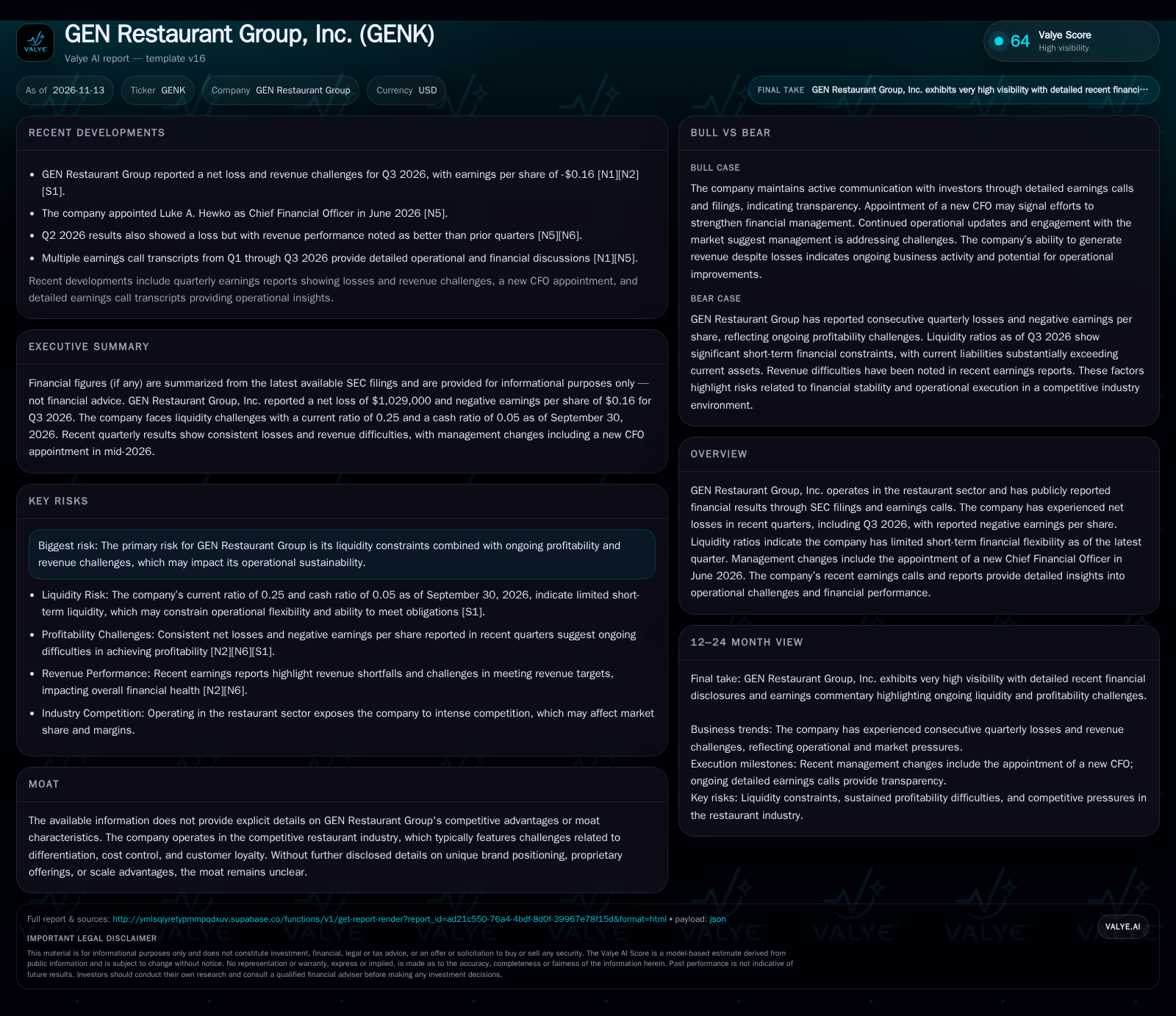
GEN Restaurant Group, Inc. enters the final quarter of 2026 with acute financial headwinds: three consecutive quarters of losses, shrinking liquidity, and no clearly articulated competitive advantage. In response, GEN has brought in a new CFO, but the path to sustainable profitability remains uncertain. Investors and stakeholders are left weighing whether management can execute a turnaround or whether persistent industry pressures will force more drastic measures.
Recent Financial Results Highlight Mounting Liquidity Strain
As of September 30, 2026, GEN Restaurant Group reported a net loss of $1,029,000 for the quarter, translating to basic and diluted earnings per share of -$0.16 [S1]. The company’s balance sheet shows only $2.9 million in cash and cash equivalents, against current liabilities of $61.1 million and a current ratio of 0.25 [S1]. The company reported cash and liquidity metrics for the period; these figures do not by themselves establish operating runway, investment capacity, financial flexibility, or financing capacity. Consecutive quarterly losses throughout 2026 reinforce the persistence of these pressures [N2] [N6]. The appointment of Luke A. Hewko as CFO in June 2026 suggests leadership is seeking new strategies to address financial and operational challenges [N5]. These facts set the stage for a company at a critical inflection point, where near-term execution will determine viability.
For example, the composition and aging of accounts payable and receivable could reveal whether the company is extending payment terms or facing collection challenges, both of which impact day-to-day operations. Additionally, the absence of disclosed capital expenditures or investment plans may suggest a freeze on growth initiatives, which, while preserving cash, could hinder long-term competitiveness. The interplay between short-term liabilities and available credit lines, if any, also shapes the company's runway and ability to manage unexpected expenses or operational disruptions.
Restaurant Operating Economics Under Pressure: Fixed Costs and Cash Flow Implications
The restaurant industry is characterized by high fixed costs—rent, labor, and utilities—while variable costs (food, beverage, direct supplies) are relatively predictable but can be pressured by commodity price swings. [S1]
Without evidence of material revenue growth or cost control, the business model risks a downward spiral: declining liquidity may force operational cutbacks, which in turn could further weaken customer experience and revenue.
Given the high fixed-cost structure, the company's operating leverage means that even small fluctuations in revenue can disproportionately affect profitability. If revenue declines persist or accelerate, fixed costs become a heavier burden, compressing margins and eroding cash flow. Conversely, any revenue stabilization or growth must be sufficient not only to cover variable costs but also to contribute meaningfully toward fixed cost absorption. Cost control efforts must therefore balance short-term savings with the risk of degrading service quality or employee morale, which could further depress revenues. Moreover, the company's ability to leverage technology or optimize labor scheduling could be pivotal in managing these fixed cost pressures without sacrificing customer experience.
Competitive Dynamics: Low Barriers, Intense Rivalry, and the Search for Differentiation
GEN Restaurant Group operates in a sector notorious for low switching costs and high competition. Customers can easily substitute between restaurant brands, and established chains often benefit from economies of scale, brand loyalty programs, and digital ordering infrastructure. Without evidence of a unique concept, proprietary menu, or technological advantage, GEN faces significant headwinds in attracting and retaining diners.
The lack of disclosed moat characteristics suggests GEN may be vulnerable to price-based competition, rising labor costs, and changing consumer preferences. Furthermore, larger peers can often weather economic cycles and supply chain disruptions more effectively due to stronger balance sheets and diversified revenue streams. The company’s ability to carve out a defensible niche—or at minimum, stabilize its customer base—remains an open question in the absence of clear differentiation.
In a market with low entry and exit barriers, differentiation often hinges on brand identity, customer experience, or operational efficiency. GEN’s apparent lack of proprietary menu offerings or technological enhancements places it at a strategic disadvantage relative to competitors investing in digital engagement or loyalty programs. Moreover, shifting consumer preferences toward convenience, health-conscious options, or sustainability could further marginalize players without adaptive strategies. The company’s vulnerability is compounded if competitors exploit scale advantages to negotiate better supply terms or invest in marketing campaigns, thereby capturing greater market share. Without a clear competitive edge, GEN’s pricing power is limited, increasing exposure to margin erosion during cost inflation periods.
Turnaround Potential: What Would a Recovery Look Like?
A credible turnaround for GEN Restaurant Group could unfold if new management, led by the recently appointed CFO, implements aggressive cost controls, renegotiates lease terms, and drives a targeted marketing push to reignite customer traffic. If the company is able to stabilize or grow same-store sales, improve restaurant-level margins, and demonstrate positive operating cash flow—even modestly—investor confidence and potential access to new capital could return.
Evidence confirming this scenario would include a reversal of quarterly losses, material improvement in liquidity ratios, and clear disclosure of operational initiatives that drive measurable revenue growth or cost savings. Announcements of new menu offerings, digital ordering partnerships, or strategic asset sales could also signal a pivot toward sustainability. Conversely, continued losses and stagnant or declining revenue would quickly falsify the recovery thesis.
Stabilization Amid Financial Constraints: Survival Mode in a Tough Market
The most plausible near-term trajectory for GEN Restaurant Group is one of continued operational strain: management focuses on cash preservation, incremental cost reductions, and selective store closures or divestitures. Revenue may remain flat or slightly decline, with no immediate catalyst for a return to profitability. The company might seek to negotiate with creditors or landlords for temporary relief, while exploring limited avenues for external financing.
Liquidity Exhaustion and Escalating Financial Distress
If GEN Restaurant Group is unable to stem cash outflows or secure new funding, the company could face acute liquidity exhaustion within a short time frame. This would likely force rapid operational retrenchment: accelerated restaurant closures, layoffs, and possible creditor negotiations or restructuring efforts. In the restaurant sector, such distress often precedes bankruptcy filings or forced asset sales, particularly when current liabilities vastly exceed available resources.
Downside confirmation would come in the form of missed payments to vendors or landlords, substantial asset impairments, or management disclosures regarding 'going concern' risks. Any abrupt changes in executive leadership or the engagement of restructuring advisors would further signal an imminent financial crisis.
Signals That Will Reveal GEN Restaurant Group’s Direction
Quarterly net income/loss trends: Whether the company can reduce losses or move toward breakeven in upcoming periods.
Cash and cash equivalents: Monitoring for material changes, especially in relation to short-term liabilities.
Same-store sales growth (if disclosed): A key indicator of underlying demand and brand health.
Restaurant-level operating margins (if disclosed): Would clarify the effectiveness of cost-control initiatives.
New financing announcements or capital raises: Evidence of external support or shareholder dilution risk.
Store closure or asset sale disclosures: May indicate a shift to defensive operational tactics.
Management commentary on strategic initiatives: Specific plans for differentiation, digital adoption, or market repositioning would help test the turnaround thesis.
Disclaimer: This is research-only, informational analysis and not investment advice. It may include AI-generated interpretation and general industry context. Always verify important details using primary sources.

Comments