
National Bankshares: Margin Expansion and Efficiency Gains Amid Regional Banking Crosswinds
National Bankshares, Inc. is demonstrating improved profitability through rising net interest margins and operational efficiency in its core Virginia markets, yet faces persistent headwinds from rate volatility, credit risk, and intensifying competition. The company's ability to translate recent system upgrades and branch expansions into durable earnings growth will hinge on credit quality, deposit retention, and disciplined execution.
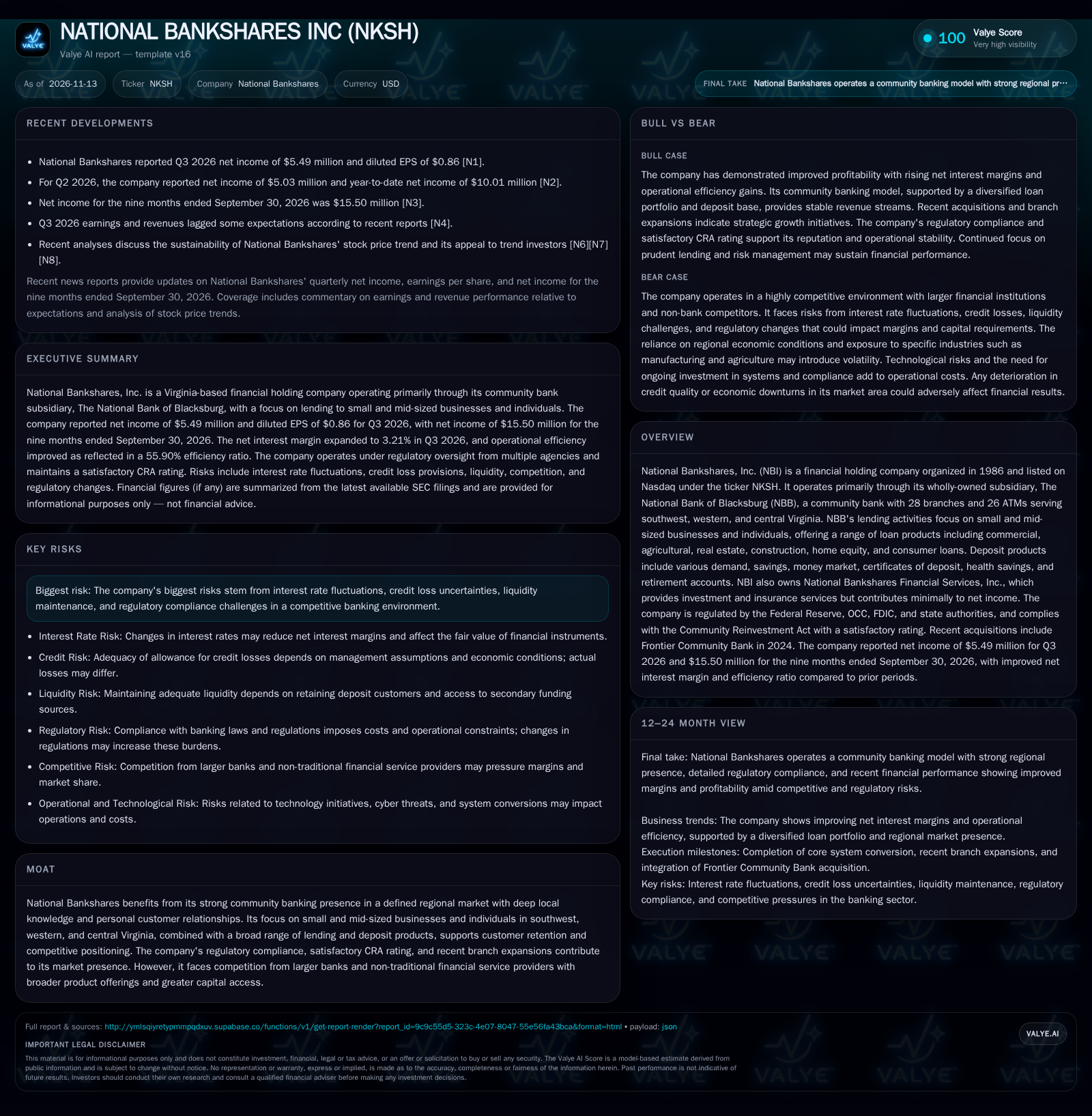
National Bankshares has reported rising net interest margins and improved efficiency in 2026, benefiting from loan repricing and operational upgrades. While profitability is trending up, the bank remains exposed to rate, credit, and competitive pressures typical of community banking. Sustained performance will depend on maintaining credit quality, cost discipline, and defending its deposit base against both traditional and emerging rivals. [S2] [N1] [N3]
National Bankshares, Inc. (NKSH), a community-focused bank holding company in Virginia, is showing clear signs of operational improvement in 2026, evidenced by rising net interest margins and a more efficient cost structure. With $1.82 billion in assets and a network spanning 28 branches, the company is leveraging its regional presence and recent system upgrades to drive profitability. However, as a small bank operating in a competitive and regulated environment, National Bankshares must navigate persistent risks from interest rate volatility, credit quality, and the evolving competitive landscape. Its ability to convert recent gains into sustainable long-term performance will be tested by both macroeconomic and sector-specific forces. [S1] [S2] [N1] [N3]
Recent Margin Gains and Efficiency Improvements Define 2026 Performance
National Bankshares reported net income of $5.49 million and diluted EPS of $0.86 for Q3 2026, bringing year-to-date net income to $15.50 million. This uptick in profitability is paired with a notable expansion of the net interest margin to 3.21%, up from 2.72% in the same quarter last year, reflecting the benefit of higher rates on adjustable loans and redeployed investments. Operationally, the efficiency ratio improved to 55.90% from 58.75%, highlighting cost control and the impact of a completed core system upgrade in 2025. These developments mark a period of tangible financial and operational progress, even as earnings in Q3 fell short of some analyst estimates. [S2] [N1] [N3] [N4]
How Community Banking Economics Shape National Bankshares’ Profit Model
National Bankshares’ core earnings are driven by the spread between interest earned on loans and investments and interest paid on deposits. The recent improvement in net interest margin suggests the bank has successfully repriced a portion of its adjustable-rate portfolio and benefited from higher yields on new loans and securities. However, deposit costs are likely rising as well, and the competitive intensity for core deposits could erode some of these gains if customers migrate to higher-yield products or competitors.
The efficiency ratio improvement signals greater operating leverage, potentially from branch rationalization, cost discipline, and technology investments, such as the recent core system conversion. Community banks like NBI generally face high fixed costs relative to asset base, making scale and efficiency critical for sustainable ROE. Non-interest income remains a minor contributor, with the investment and insurance subsidiary playing a limited role in overall profitability.
Capital needs are modest by large-bank standards but remain meaningful in a rising-rate or adverse credit environment. As a small bank holding company, NBI is subject to less stringent capital rules than larger peers, but still faces regulatory scrutiny regarding credit reserves and liquidity. The allowance for credit losses is determined using a cash flow model with management overlay, introducing some subjectivity in reserving for potential downturns. [S1] [S2]
Regional Strengths Meet Intensifying Competitive Pressures
NBI’s competitive position rests on its deep local relationships, regional knowledge, and tailored service for small and mid-sized businesses and individuals. Its 28-branch footprint provides physical access across southwest, western, and central Virginia, while recent branch upgrades and expansions aim to reinforce its local relevance.
However, the bank faces intensifying competition from both large national banks with greater product breadth and digital capabilities, as well as fintechs and online banks offering attractive rates and digital convenience. Larger institutions can often outspend smaller banks on technology, compliance, and marketing, putting pressure on customer acquisition and retention costs. Additionally, non-bank lenders and alternative finance providers are increasingly targeting small business and consumer segments, eroding the traditional community bank moat.
Switching friction in banking is traditionally high due to direct deposit arrangements and relationship-based lending, but digital account opening and improved transferability of financial services are lowering these barriers. NBI’s satisfactory CRA rating and regulatory compliance help defend its position, but ongoing investment in technology and customer experience will be needed to compete effectively. [S1] [S2]
Sustained Margin Expansion and Credit Quality Drive Outperformance
A bullish scenario for National Bankshares would see the company continue to expand its net interest margin, outpacing peer averages due to favorable loan repricing and stable deposit costs. If the bank can maintain or even lower its efficiency ratio through further operational streamlining, it could translate incremental revenue into higher bottom-line growth. Successful integration of branch expansions and any future acquisitions would provide additional scale benefits and potentially diversify the loan book.
The upside is most plausible if regional economic conditions remain healthy, supporting both loan demand and credit quality. Evidence that would confirm this scenario includes continued net interest margin improvement, further reductions in the efficiency ratio, stable or improving credit metrics (e.g., low non-performing assets and charge-offs), and above-peer profitability ratios. A demonstrated ability to grow non-interest income, even modestly, would further support outperformance.
Profitability Holds Steady as Competitive and Rate Pressures Offset Operational Gains
The most likely trajectory is that National Bankshares sustains its recent gains in net interest margin and efficiency, but faces offsetting headwinds from higher deposit costs and ongoing competition. As the industry adjusts to a plateau or decline in interest rates, loan yields may stabilize or compress, while depositors, increasingly rate-sensitive, could demand higher returns, squeezing net interest margin.
Operational efficiency, aided by the core system upgrade and branch optimization, should help preserve profitability, but incremental gains will be harder to achieve. Credit quality is expected to remain solid if the local economy avoids significant shocks, but any regional downturn could quickly pressure provisioning and earnings. The base case would be confirmed by stable margins, a steady efficiency ratio, and no material uptick in loan losses or deposit attrition.
Rising Credit Costs and Deposit Competition Erode Earnings Power
A negative scenario could emerge if regional economic conditions deteriorate, leading to rising delinquencies and credit losses—particularly in commercial, agricultural, or real estate segments that dominate the loan book. At the same time, intensifying competition for deposits could force NBI to raise rates more aggressively, compressing net interest margin below sustainable levels.
If cost pressures mount—either from technology compliance, regulatory changes, or branch network inefficiency—the efficiency ratio could worsen, further reducing profitability. Evidence supporting this outcome would include a spike in non-performing assets, rising charge-offs, shrinking net interest margin, and a reversal of recent cost control gains. Regulatory intervention or negative ratings actions could amplify downside risk.
Benchmarks That Will Shape National Bankshares’ Strategic Trajectory
Quarterly trends in net interest margin—sustained expansion or compression will reveal the true balance of loan repricing versus deposit cost escalation.
Movement in the efficiency ratio—further improvement would validate operational leverage from technology upgrades, while backsliding could signal cost control challenges.
Credit quality metrics such as non-performing assets, charge-offs, and allowance coverage—if disclosed—are critical for assessing downside risk.
Deposit growth or attrition figures, especially in core transaction accounts versus higher-cost products, would help gauge competitive vulnerability and funding stability.
Loan growth by segment—commercial, agricultural, real estate, and consumer—will offer insight into both regional economic health and the bank’s market share.
Progress in non-interest income generation from investment and insurance services—if disclosed—would test the potential for fee-based diversification.
Updates on branch network performance and customer acquisition costs would clarify the return on recent expansions and upgrades.
Regulatory developments or ratings changes, including updates to CRA ratings or compliance findings, could materially alter the risk/reward profile.
Disclaimer: This is research-only, informational analysis and not investment advice. It may include AI-generated interpretation and general industry context. Always verify important details using primary sources.

Comments